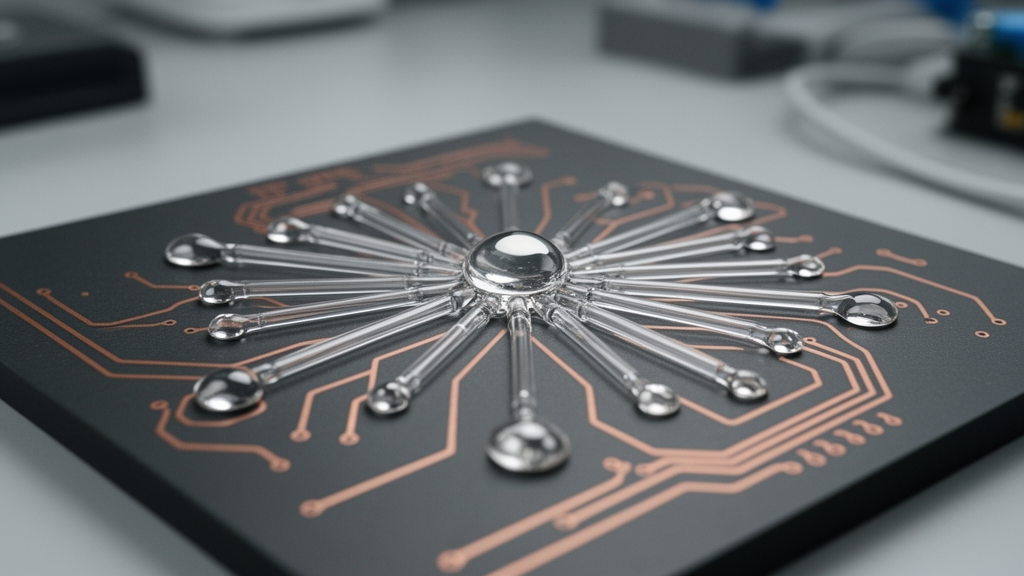
Fluid antenna systems consistently outperform conventional antenna configurations in downlink multiple-access communications even when operating under dense spatial correlation, according to an analytical modeling study conducted by researchers Sixu Han, Kai Kit Wong, and Hanjiang Hong. The investigation, based at University College London and Kyung Hee University, examined the integration of hybrid automatic repeat request with chase combining into downlink slow fluid antenna multiple access networks. However, the authors also observed that the operational benefits of scheduling subsequent retransmission rounds diminish significantly when networks encounter severe multiuser interference conditions.
Despite these established reliability advantages, providing a tractable analytical characterization of fluid antenna systems aided by retransmission mechanisms has historically presented formidable theoretical difficulties. Specifically, mathematical models must simultaneously account for the fluctuating interference patterns generated by active competing users across the network and track the cumulative accumulation of the signal-to-interference ratio across multiple successive transmission attempts.
To overcome these analytical barriers, the research team developed a dedicated theoretical analysis framework tailored to downlink slow fluid antenna multiple access equipped with densely spaced and highly correlated fluid antenna system ports. Recognizing that tightly packed antenna ports inevitably experience intense mutual spatial correlation, the researchers operated under a spatial block correlation model to represent channel interactions realistically. Within this correlation structure, the authors constructed two distinct and mathematically admissible high-correlation approximations to describe the conditional per-round selected-port signal-to-interference ratio cumulative distribution function. The first formulation established an endpoint-normalized Marcum-Q-kernel approximation, while the second introduced an alternative, lower-complexity step-threshold form designed to reduce computational burden while maintaining statistical fidelity across correlated ports.
Building upon these spatial approximations, the authors derived cumulative distribution function-based Laplace–Stieltjes transform representations for the proposed fluid antenna system models. Transforming the statistical distributions into the transform domain permitted the researchers to evaluate the mathematically intricate distribution of the accumulated signal-to-interference ratio across repeated transmission cycles. The accumulation process was calculated through two independent analytical methodologies: direct signal-to-interference ratio domain Stieltjes convolution and numerical inversion of the derived Laplace–Stieltjes transform expressions.
The analytical framework enabled the authors to evaluate several fundamental network performance indicators, including receiver outage probability, the average number of required transmissions, and aggregate payload throughput.
Numerical evaluations presented in the study demonstrated close quantitative agreement between the direct Stieltjes convolution technique and the numerical Laplace–Stieltjes transform inversion method across matched cumulative distribution functions. To evaluate the mathematical precision of their analytical approximations, the authors compared the derived formulas against the complete analytical kernel under matched block correlation parameters. Furthermore, the team executed comprehensive Monte Carlo simulations to assess broader system-level trends across varying wireless operating conditions. These rigorous numerical comparisons established that the derived fluid antenna system approximations are generally conservative in their predictions, yet they consistently preserve true underlying performance trends and correctly maintain the operational performance ordering among competing receiver architectures.
Under conditions of severe multiuser interference, the payload throughput enhancements delivered by executing additional hybrid automatic repeat request rounds became marginal.
Subject of Research: Performance analysis of downlink slow fluid antenna multiple access with hybrid automatic repeat request
Article Title: HARQ-CC-aided slow fluid antenna multiple access with highly correlated ports: a Laplace–Stieltjes-transform-based performance analysis
Article References: Han, S., Wong, K. K., & Hong, H. (2026). HARQ-CC-Aided Slow Fluid Antenna Multiple Access with Highly Correlated Ports: An LST-Based Performance Analysis. Frontiers in Communications and Networks, 7, 1969753. https://doi.org/10.3389/frcmn.2026.1969753
Image Credits: AI Generated
DOI: 10.3389/frcmn.2026.1969753
Keywords: fluid antenna systems, slow fluid antenna multiple access, hybrid automatic repeat request, chase combining, Laplace-Stieltjes transform, signal-to-interference ratio, outage probability, wireless communications, HARQ-CC-aided, slow, fluid, antenna
News Source: Denise Maddox. (November 9, 2026). Fluid Antenna Systems Boost Downlink Reliability in Multiple Access Wireless Networks. Scienmag.