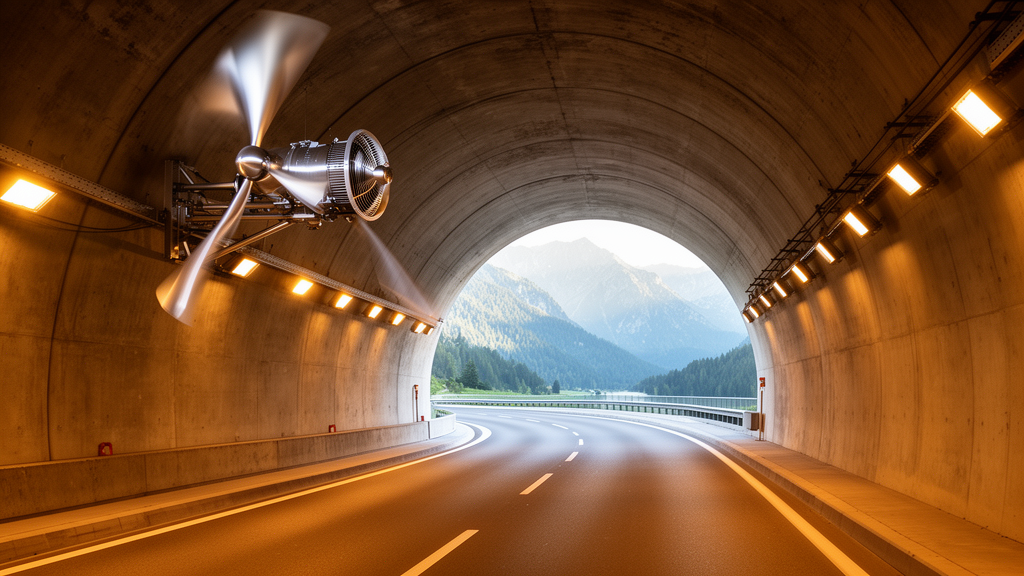
Converting natural and buoyancy-driven airflows within road tunnel infrastructure into usable electrical energy yields sharply limited returns and cannot be accomplished by simply operating existing ventilation fans in reverse, according to an engineering feasibility study conducted on highway networks in Austria. Researchers led by Peter Sturm evaluated whether meteorologically induced pressure differences between tunnel portals or vertical thermal gradients across exhaust shafts could drive electromechanical turbines to offset operational power demands. Analyzing empirical pressure data collected across Austrian expressway routes alongside aerodynamic modeling, the team determined that existing ventilation equipment is poorly suited for power generation because the force required to clear toxic smoke during emergencies exceeds the aerodynamic potential of natural drafts by multiple orders of magnitude.
The investigation arose from operational challenges faced by highway management authorities seeking local renewable energy options to shrink operating expenses and reduce associated carbon footprints. In Austria, the expressway operator ASFINAG recorded 108 gigawatt-hours of electricity consumption across its motorway tunnels in 2018 alone, representing 76 percent of the entire motorway network’s electrical usage, with an additional 12.8 gigawatt-hours consumed by control centres and related operational structures. With strategic targets established to lower energy consumption by 20 percent relative to 2024 levels, achieve full operational self-supply, and expand installed renewable capacity to 100 megawatts peak, engineers examined whether atmospheric gradients across mountainous terrain could transform passive airways into generation conduits under the Austrian Future Mobility Funding Program MdZ-VIT.
To establish baseline conditions, the research team gathered meteorological observations from portal and shaft locations across 18 road tunnels ranging between 1.5 and 14.0 kilometres in length, comprising 17 twin-tube structures and one single-tube roadway with bidirectional traffic. Measurement campaigns monitored static barometric air pressure, air temperature via negative temperature coefficient sensors, relative humidity through capacitive instruments, and wind metrics utilizing ultrasonic transit-time difference instruments over 365-day periods with sensor data availability exceeding 98 percent. Because static barometric readings exceed 100,000 pascals while portal pressure variations typically span only a few to 250 pascals, strict quality assurance maintained sensor drift below 5 pascals, yielding an overall pressure measurement uncertainty of 7.5 pascals after adjusting for portal altitude disparities that shift static pressure by roughly 10 pascals per vertical metre.
Aerodynamic modeling relied on an extended formulation of Bernoulli’s equation applied to one-dimensional turbulent channel flows within long duct geometries, accounting for portal entrance losses, friction against tunnel walls, and vehicle interaction. The mathematical framework explicitly dismissed extracting kinetic energy from vehicle-induced air movement, noting that internal combustion propulsion operates at low thermal efficiency near 35 percent and that extracting vehicle wake power creates aerodynamic drag that forces motors to consume far more fuel than any downstream turbine could recover. Natural thermal pressure differences, which scale with elevation differentials and the temperature divergence between interior air and ambient atmospheric conditions, were calculated assuming adiabatic shaft flow wherein heat transfer to surrounding rock remains negligible.
Calculations demonstrated that achievable turbine output scales as a cubic function of air velocity and with the acting pressure difference raised to the power of 1.5, meaning that maximum theoretical power production requires high pressure differences paired with minimal tunnel resistance and short airway lengths. However, real-world highway infrastructure presents an inverse operational constraint: substantial meteorologically induced portal pressure differences occur almost exclusively in long tunnels penetrating major mountain ridges with heavy overburden, where extended tunnel lengths introduce high wall-friction losses. Setting a threshold of 50 pascals of pressure differential—the minimum required to yield between 3 and 5 kilowatts of theoretical output and overcome base mechanical machine losses—narrowed viable candidates from the initial cohort down to seven tunnels, as 95th-percentile portal pressure gradients in most locations remained under 50 pascals.
When assessing existing machinery for dual-purpose operation, the researchers identified severe electromechanical mismatches between normal emergency smoke extraction and reverse generation. Longitudinal tunnels use jet fans driven by induction motors via direct online starting or non-regenerative inverter drives, while transverse systems utilize multi-speed, pole-changing induction motors or pitch-controlled axial units designed to move immense air volumes during catastrophic fires. In the Gleinalm tunnel, existing jet fans utilize 90-kilowatt induction motors, yet maximum expected generation output from natural airflow reaches only 1.9 kilowatts, with typical conditions supplying roughly 350 watts. Similarly, the 450-kilowatt northern ventilation fan of the Plabutsch tunnel would capture an estimated maximum of 68 kilowatts, dropping to approximately 5 kilowatts during typical operating hours.
Because running massive emergency induction machines at fractional loads incurs severe internal electromagnetic losses that completely consume the small power yields produced by low-pressure airflows, the authors determined that retrofitting existing installations with grid-side regenerative inverters is technically unviable. Evaluating a theoretical alternative employing dedicated, speed-adjustable permanent magnet synchronous machines of efficiency class IE4 equipped with complete drive modules, the study modeled realistic grid output across 4-pascal measurement bins. This performance model established that internal motor and inverter losses still absorb the entire aerodynamic yield generated at low pressure gradients, preventing turbines from harvesting the frequent low-wattage air movements that occur throughout the calendar year.
Annual electricity modeling for longitudinally ventilated tubes equipped with jet fans indicated a total potential yield of only around 260 kilowatt-hours per year, a negligible fraction of operational demand. Transverse ventilation designs yielded slightly higher estimates, generating between 520 and 5,390 kilowatt-hours per year across traffic tubes, or between 1,645 and 5,323 kilowatt-hours annually if dedicated air ducts above false ceilings were converted into continuous unobstructed airways connecting opposing portals. These annual generation volumes remain comparable to the typical annual electrical consumption of an average Austrian two-person household, which ranged between 2,000 and 3,100 kilowatt-hours in 2022, underscoring the limited utility of horizontal portal airflow exploitation relative to the civil engineering modifications required.
Vertical shafts within transversely ventilated systems demonstrated greater technical promise, driven by continuous thermal buoyancy forces across substantial elevation differences. The northern shaft of the Plabutsch tunnel, characterized by a large cross-sectional area and a vertical height of 280 metres, exhibited high operational availability and projected annual yields reaching up to 24,540 kilowatt-hours because twin-tube unidirectional traffic relies largely on vehicle piston effects for regular ventilation, leaving the shaft dampers closed and accessible for energy capture. Conversely, the 780-metre Albona shaft of the Arlberg tunnel recorded the greatest recorded buoyancy-induced pressure differences but remains largely unusable for generation, as continuous active exhaust operations in the single-tube bidirectional roadway occupy the shaft for two-thirds of the year to maintain statutory passenger air quality standards.
The authors concluded that wide-scale power extraction from road tunnel ventilation systems cannot be achieved through simple adjustments to existing electrical infrastructure, and that economically meaningful energy generation is restricted to select transverse shafts with tall vertical geometries and minimal routine air exchange duties. Because the calculations assumed optimized, low-resistance ductwork without accounting for internal flow bends or air-damper intake losses, real-world yields would require tailored engineering designs, dedicated small-scale turbine installations, and rigorous project-level cost-benefit analyses before any local generation projects could be justified.
The researchers contextualized their findings against previous industrial energy recovery studies, such as underground mine exhaust ventilation systems evaluated by Yeboah and colleagues. Although mine exhaust shafts demonstrate substantial power yields, that power remains available nearly year-round at flow rates around 200 cubic metres per second. In road tunnels, by comparison, such immense air movements occur only during rare fire emergencies, whereas natural buoyancy drafts induce far lower flow rates over brief seasonal windows. Aerodynamic modeling also differentiated between installation environments based on flow bypass. Drawing on principles documented by Betz and Schaffarczyk, free-standing jet fans suspended along tunnel soffits were assigned a capture fraction of 60 percent due to air bypassing the rotor, whereas turbines installed within enclosed transverse ceiling ducts utilize the complete cross section without bypass, achieving a 100 percent capture fraction.
The study also addressed measurement constraints across Austria’s expressway network, where roughly 170 tunnels span 400 kilometres and national guidelines mandate mechanical ventilation for tubes exceeding 700 metres. Field monitoring distinguished between static barometric pressure and dynamic wind pressure to prevent double-counting errors in shared valleys, where barometric pressure differences automatically manifest as ambient wind. Portal sensor elevations required exacting geometric alignment because static atmospheric pressure shifts by approximately 10 pascals for each vertical metre under ISO standard atmosphere conditions. To maintain comparability across diverse tunnel geometries, aerodynamic baseline calculations standardized the tunnel cross section at 48.7 square metres, hydraulic diameter at 6.9 metres, air density at 1.1 kilograms per cubic metre, portal entrance loss at 0.6, shaft entrance loss at 1.0, and wall friction at 0.016.
Finally, electromechanical modeling detailed specific drive components under standard complete drive module specifications. The evaluation modeled a two-pole-pair permanent magnet synchronous machine operating at 1,500 revolutions per minute, incorporating an intermediate direct-current link voltage of 679 volts and a switching frequency of four kilohertz under a maximum torque per ampere strategy. Because the researchers applied constant maximum allowable power losses across all operating states, the resulting annual yields represent conservative lower-bound estimates. The authors noted that installing dedicated small turbines tailored to real shaft drafts, rather than repurposing oversized emergency hardware, could overcome these internal losses.
Subject of Research: Feasibility of electricity generation from natural and buoyancy airflows in road tunnels
Article Title: Generation of electricity through thermal and pressure-driven airflows in road tunnels and ventilation shafts
Article References: Sturm, P., Harbauer, D., Seebacher, R., Fruhwirt, D., & Krischan, K. (2026). Generation of electricity through thermal and pressure-driven airflows in road tunnels and ventilation shafts. Energy, Sustainability and Society, 16(1), Article 38. https://doi.org/10.1186/s13705-026-00586-8
Image Credits: AI Generated
DOI: 10.1186/s13705-026-00586-8
Keywords: tunnel ventilation, energy harvesting, wind energy, fluid dynamics, Bernoulli equation, thermal buoyancy, ASFINAG, electromechanical systems, Generation, electricity, thermal, pressure-driven
News Source: Denise Maddox. (November 10, 2026). Study Assesses Generating Electricity from Natural Airflows in Austrian Road Tunnels. Scienmag.