


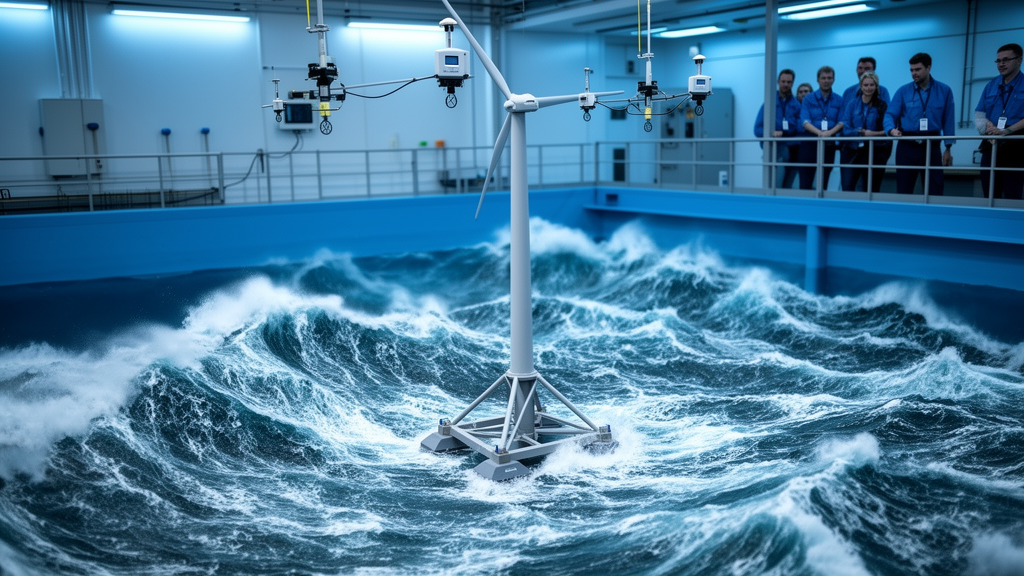
A new preprint posted for discussion in the journal Wind Energy Science reports that modelling the submerged surface of a floating offshore wind platform as it actually moves—as opposed to at its fixed resting position—introduces additional higher-harmonic hydrodynamic radiation loads that standard linear tools do not capture. The study, by Ronja Lucia Margareta Olsmats Baumeister, Joseph Saverin, and Christian Oliver Paschereit of the Chair of Fluid Dynamics at Technische Universität Berlin, uses a time-domain Rankine source boundary element method to compare the two modelling approaches directly.
Floating wind turbines and their platforms are growing larger, and optimisation to reduce cost makes platforms lighter and more flexible. Their design and fatigue analysis require accurate load calculations, yet common tools compute hydrodynamic loads at the platform’s resting position. The new work compares this linear formulation with a body-exact formulation that updates the wetted body surface and the free surface intersection at each time step of the simulation.
An important detail of the method is that the free surface boundary conditions remain linearised about the mean water level in both cases. That means any differences in the computed responses can be attributed specifically to the treatment of the instantaneous wetted surface, isolating the effect the authors wanted to study.
The researchers ran radiation problems for a vertical cylinder as a reference geometry, and for two real floating platform designs: the OC3-Hywind spar buoy and the UMaine VolturnUS-S semi-submersible, each in surge, heave, and pitch motion. In the body-exact simulations, the unsteady pressure loads contained higher-harmonic contributions entirely absent from the linear formulation.
For the axisymmetric cylinder and spar, these higher harmonics followed a symmetry-dependent structure: a leading second harmonic appeared in heave motion, while leading third harmonics appeared in surge and pitch. The second harmonic scaled with the square of the motion amplitude and the third harmonic with the cube, a signature of nonlinear interaction between the moving body and the surrounding water.
The magnitude of these effects was substantial for the spar buoy. At the largest motion amplitude investigated, the unsteady pressure contribution to the second harmonic in heave reached 99 to 126 percent of the linear fundamental load across the investigated wave numbers. Including the quadratic term in Bernoulli’s equation reduced the total second harmonic to 56 to 73 percent of the fundamental for the same cases, showing that this quadratic term, though it differed only slightly between the linear and body-exact formulations, is not negligible because it acts nearly out of phase with the unsteady pressure second harmonic.
The radiated wave field of the spar showed corresponding higher-harmonic content, meaning the nonlinear loads also propagate outward as waves at frequencies beyond the imposed motion frequency. For the non-axisymmetric VolturnUS-S semi-submersible, the unsteady pressure second harmonic was smaller but still measurable, reaching 3.7 percent of the fundamental in surge, 18 percent in heave, and 19 percent in pitch. For the axisymmetric geometries, the second-harmonic contributions of the quadratic term vanished in surge and pitch due to symmetry.
The authors conclude that the instantaneous wetted geometry, combined with linearised free surface boundary conditions, introduces symmetry-dependent higher-harmonic radiation loads. Because fatigue analysis of lighter, more flexible platforms depends on accurate load spectra, loads at these higher frequencies could matter for future designs even when they are modest relative to the fundamental.
The study is a computational comparison of idealised radiation problems rather than a measurement on an operating turbine, and it is a preprint currently under open review, with discussion open until 26 November 2026. The body-exact formulation is presented as a basis for further development of accelerated weak-scatterer simulations coupled with flexible structural models, a step toward hydroelastic analysis of floating offshore wind platforms in which the platform structure and the water it moves through are simulated together.
Subject of Research: Higher-harmonic hydrodynamic radiation loads from instantaneous wetted surface modelling of floating wind platforms
Article Title: Higher-harmonic radiation loads and wave fields from instantaneous wetted surface modelling: A time-domain Rankine source study of floating wind platforms
Article References: Olsmats Baumeister, R. L. M., Saverin, J., & Paschereit, C. O. (2026). Higher-harmonic radiation loads and wave fields from instantaneous wetted surface modelling: A time-domain Rankine source study of floating wind platforms. https://doi.org/10.5194/wes-2026-195
Image Credits: AI Generated
DOI: 10.5194/wes-2026-195
Keywords: floating offshore wind, hydrodynamics, radiation loads, higher harmonics, Rankine source method, boundary element method, OC3-Hywind, VolturnUS-S, spar buoy, semi-submersible, time-domain simulation, fatigue analysis
News Source: Faith Mcneil. (October 29, 2026). Floating Wind Platform Model Reveals Hidden Higher-Harmonic Hydrodynamic Loads. Scienmag.



