In an era where the devastating impacts of global warming have become increasingly apparent, the urgent need to develop sustainable energy solutions is more critical than ever. The global scientific community has rallied behind the goal of limiting global temperature rise to within 1.5 degrees Celsius above preindustrial levels, a threshold widely recognized as necessary to avoid catastrophic climate consequences. Achieving this objective demands bold commitments, including the ambition of numerous countries to reach net-zero carbon emissions by 2050. This paradigm shift necessitates unprecedented international cooperation, innovative policy frameworks, and rapid advancements in clean energy technologies.
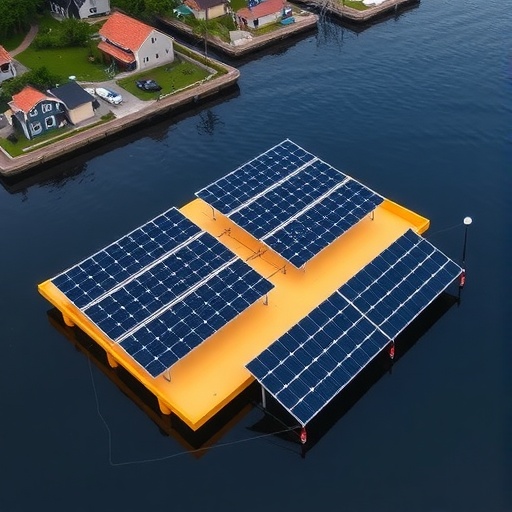
Among renewable energy technologies, solar power has emerged as a leading candidate due to its scalability and declining costs. However, many densely populated or geographically constrained nations face a significant challenge: limited land availability for large-scale photovoltaic (PV) installations. To address this, researchers have turned their attention to alternative PV deployment sites, such as inland water bodies and offshore areas, pioneering floating photovoltaic systems that could transform the energy landscape. Floating photovoltaics offer a promising avenue to harness solar energy without competing for precious land resources, potentially revolutionizing how nations expand their renewable energy portfolios.
Despite the growing interest and deployment of floating photovoltaic systems, comprehensive understanding of their environmental impacts remains incomplete, particularly in comparison with conventional land-based solar farms. Most previous studies have predominantly focused on the energy management and performance characteristics of these systems, leaving a critical gap in lifecycle environmental assessments. Addressing this knowledge void, a team of researchers from National Taipei University of Technology in Taiwan conducted an in-depth comparative study to analyze the carbon footprints of onshore and offshore photovoltaic systems, providing much-needed clarity on their relative sustainability.
Taiwan presents a unique case study, given its compact size and geographical limitations, which complicate large-scale renewable energy expansion. The research led by Ching-Feng Chen and Shih-Kai Chen, published in the Journal of Renewable and Sustainable Energy, represents the nation’s first comprehensive lifecycle assessment comparing a traditional land-based solar farm with its pioneering offshore floating photovoltaic (OFPV) installation. By employing an integrated approach, the study offers vital insights into the potential advantages of water-based solar infrastructure in land-constrained contexts.
One of the seminal findings from the study is the superior electricity generation capacity of offshore floating solar systems compared to their land-based counterparts. Specifically, the researchers discovered that OFPV installations can yield approximately 12% more electricity over their operational lifetimes under identical environmental and operational conditions. This enhanced performance is largely attributed to the cooling effect of the surrounding water, which mitigates excessive heat accumulation on solar panels—a known factor that diminishes photovoltaic efficiency. Thus, the marine environment contributes not only as a physical platform but also supports optimal panel operation through thermal regulation.
The researchers adopted a rigorous lifecycle energy assessment methodology to compare systems on an equal footing. To ensure fairness in the comparison, they normalized energy output and environmental impact metrics to a functional unit of 100 megawatt-peak (MWp), corresponding to the maximum power output achievable under standard test conditions. Although the land-based PV system examined in Changbin Industrial Park had a capacity of exactly 100 MWp, the offshore floating system analyzed—which is inherently larger at 181 MWp—was scaled down proportionally. This normalization is pivotal to accurately juxtaposing the energy yields, efficiency parameters, and carbon emission profiles of the two different systems without bias stemming from capacity disparities.
The study’s lifecycle approach encompasses embodied energy inputs, operational energy yield, maintenance, and end-of-life considerations, providing a holistic viewpoint of each system’s environmental footprint. Through this methodology, offshore floating photovoltaics demonstrated not only higher energy production but also superior carbon emission reduction potential. The higher output directly translates into a greater offset of fossil fuel-derived electricity generation, thereby amplifying overall sustainability benefits. This finding carries profound implications for policy makers and industry stakeholders aiming to optimize renewable energy strategies amid competing resource constraints.
Beyond the empirical results, this research underscores the strategic value of integrating OFPV systems into national energy plans, especially for island nations and countries with dense populations and limited arable land. The work reveals that innovative deployment strategies, including harnessing aquatic spaces for solar development, can circumvent traditional land-use conflicts and expedite the transition to cleaner energy grids. Moreover, offshore solar installations may coexist harmoniously with other marine activities, potentially creating synergies with aquaculture and fisheries if carefully managed.
The significance of this study extends internationally, proposing a replicable model for countries worldwide that face similar geographic and demographic challenges. By demonstrating enhanced efficiency and carbon footprint advantages of OFPV, the research advocates for a paradigm shift in renewable energy infrastructure planning. This shift prioritizes not merely increasing solar capacity but also maximizing the efficacy and environmental integrity of solar systems, aligning with broader sustainability and climate goals.
Moreover, the cooling phenomenon enabled by water surfaces represents an important physical mechanism facilitating improved photovoltaic performance, as elevated temperatures are known to degrade solar cell efficiency through increased resistance and reduced open-circuit voltage. This thermal regulation effect thus offers a natural means of performance optimization, complementing technological innovations in panel materials and design.
The findings also raise considerations for future research directions, including detailed assessments of ecological impacts related to floating structures in marine environments, long-term durability under oceanic conditions, and economic feasibility studies in diverse geographic contexts. These factors will be crucial to fully unlock the potential of offshore floating photovoltaics as a scalable, sustainable energy solution.
In summary, this study by Chen and Chen marks a pivotal advance in renewable energy science, providing compelling evidence for the benefits of offshore floating solar systems over conventional land-based arrays. Their integrated lifecycle analysis conveys that, beyond technical viability, OFPV installations represent a transformative approach to expanding renewable energy capacity while adhering to stringent environmental and land-use constraints. For nations grappling with limited space and climate imperatives, floating photovoltaics illuminate a promising path toward a cleaner, greener future.
Subject of Research: Comparative lifecycle assessment of carbon footprints in onshore and offshore photovoltaic systems.
Article Title: Using an integrated approach for a comparative analysis of carbon footprints in onshore and offshore photovoltaic systems
News Publication Date: May 19, 2026
Web References: https://doi.org/10.1063/5.0268803
Image Credits: Courtesy of Ching-Feng Chen
Keywords
Solar energy, Photovoltaics, Offshore floating photovoltaic systems, Renewable energy, Carbon footprint, Lifecycle assessment, Energy efficiency, Climate change mitigation, Land-use constraints, Thermal regulation, Environmental impact, Taiwan renewable energy
Tags: climate change mitigation technologiesfloating photovoltaic technologyfloating solar power systemsglobal warming and sustainable energyinland water solar farmsinternational clean energy cooperationland scarcity for solar installationsnet-zero carbon emissions by 2050offshore solar power solutionsrenewable energy innovationsolar energy scalability challengessolar power cost reduction strategies