Credit: Bao Lab
As electronics become increasingly pervasive in our lives – from smart phones to wearable sensors – so too does the ever rising amount of electronic waste they create. A United Nations Environment Program report found that almost 50 million tons of electronic waste were thrown out in 2017–more than 20 percent higher than waste in 2015.
Troubled by this mounting waste, Stanford engineer Zhenan Bao and her team are rethinking electronics. "In my group, we have been trying to mimic the function of human skin to think about how to develop future electronic devices," Bao said. She described how skin is stretchable, self-healable and also biodegradable – an attractive list of characteristics for electronics. "We have achieved the first two [flexible and self-healing], so the biodegradability was something we wanted to tackle."
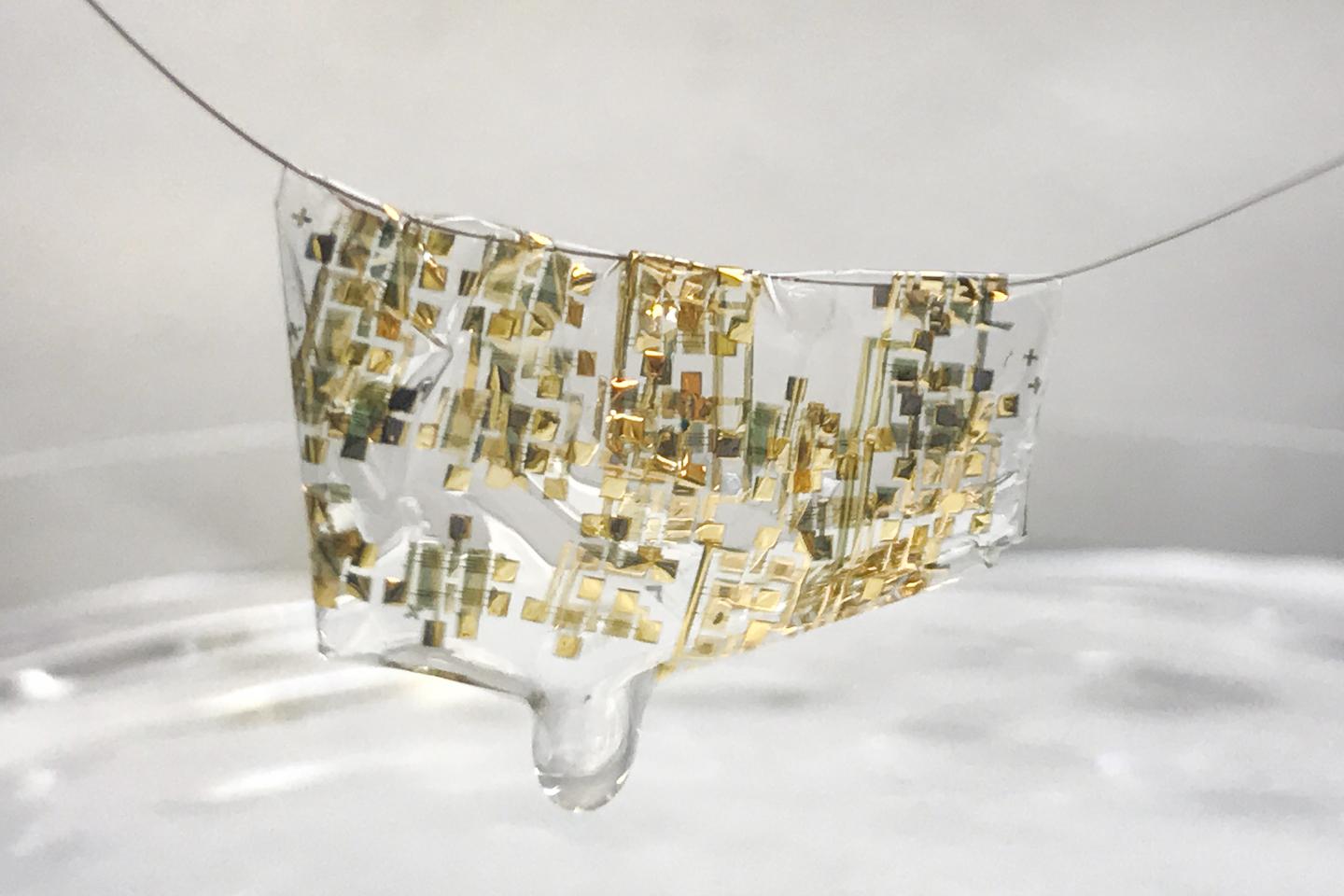
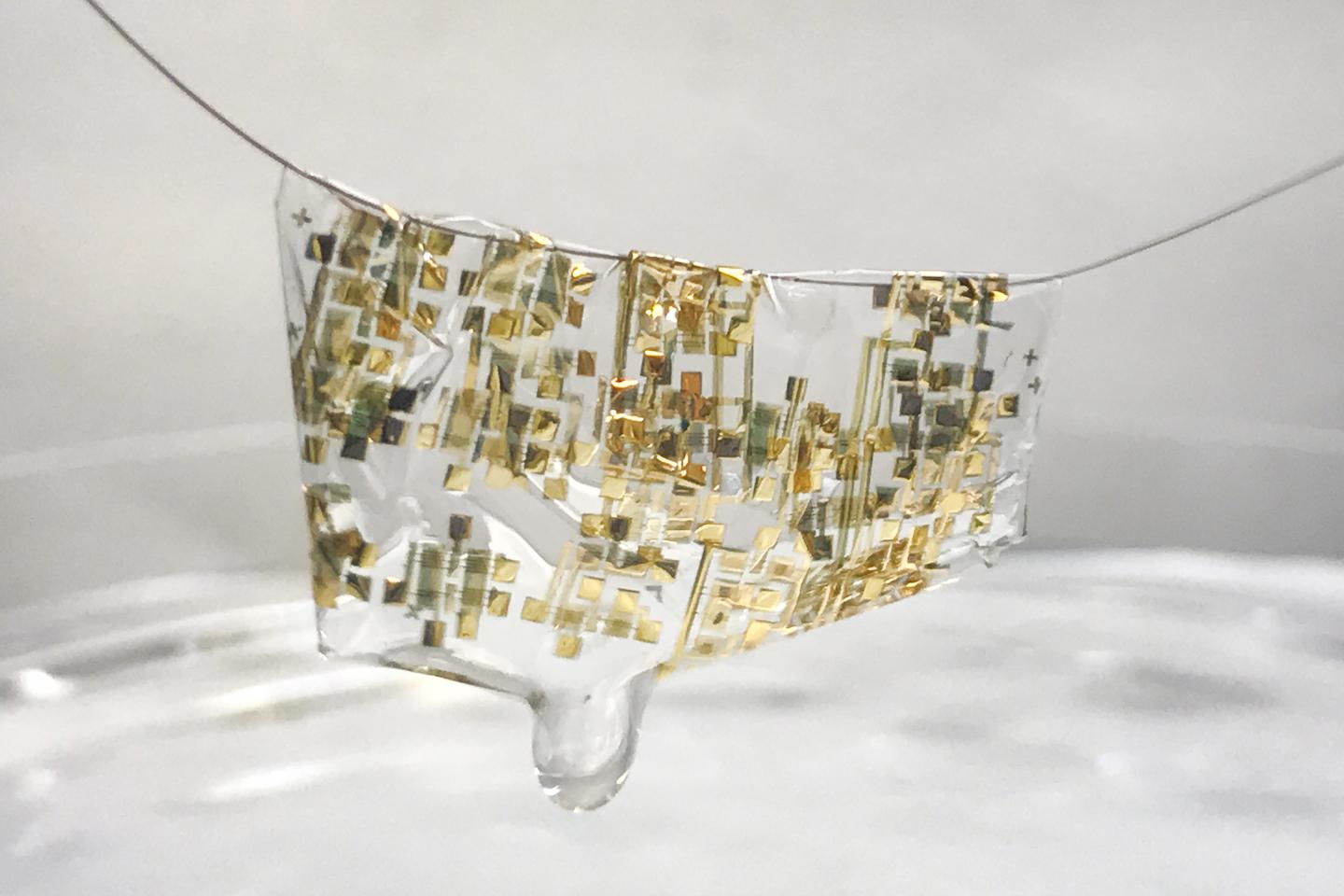
The team created a flexible electronic device that can easily degrade just by adding a weak acid like vinegar. The results were published May 1 in the Proceedings of the National Academy of Sciences.
"This is the first example of a semiconductive polymer that can decompose," said lead author Ting Lei, a postdoctoral fellow working with Bao.
In addition to the polymer – essentially a flexible, conductive plastic – the team developed a degradable electronic circuit and a new biodegradable substrate material for mounting the electrical components. This substrate supports the electrical components, flexing and molding to rough and smooth surfaces alike. When the electronic device is no longer needed, the whole thing can biodegrade into nontoxic components.
Biodegradable bits
Bao, a professor of chemical engineering and materials science and engineering, had previously created a stretchable electrode modeled on human skin. That material could bend and twist in a way that could allow it to interface with the skin or brain, but it couldn't degrade. That limited its application for implantable devices and – important to Bao – contributed to waste.
Bao said that creating a robust material that is both a good electrical conductor and biodegradable was a challenge, considering traditional polymer chemistry. "We have been trying to think how we can achieve both great electronic property but also have the biodegradability," Bao said.
Eventually, the team found that by tweaking the chemical structure of the flexible material it would break apart under mild stressors. "We came up with an idea of making these molecules using a special type of chemical linkage that can retain the ability for the electron to smoothly transport along the molecule," Bao said. "But also this chemical bond is sensitive to weak acid – even weaker than pure vinegar." The result was a material that could carry an electronic signal but break down without requiring extreme measures.
In addition to the biodegradable polymer, the team developed a new type of electrical component and a substrate material that attaches to the entire electronic component. Electronic components are usually made of gold. But for this device, the researchers crafted components from iron. Bao noted that iron is a very environmentally friendly product and is nontoxic to humans.
The researchers created the substrate, which carries the electronic circuit and the polymer, from cellulose. Cellulose is the same substance that makes up paper. But unlike paper, the team altered cellulose fibers so the "paper" is transparent and flexible, while still breaking down easily. The thin film substrate allows the electronics to be worn on the skin or even implanted inside the body.
From implants to plants
The combination of a biodegradable conductive polymer and substrate makes the electronic device useful in a plethora of settings – from wearable electronics to large-scale environmental surveys with sensor dusts.
"We envision these soft patches that are very thin and conformable to the skin that can measure blood pressure, glucose value, sweat content," Bao said. A person could wear a specifically designed patch for a day or week, then download the data. According to Bao, this short-term use of disposable electronics seems a perfect fit for a degradable, flexible design.
And it's not just for skin surveys: the biodegradable substrate, polymers and iron electrodes make the entire component compatible with insertion into the human body. The polymer breaks down to product concentrations much lower than the published acceptable levels found in drinking water. Although the polymer was found to be biocompatible, Bao said that more studies would need to be done before implants are a regular occurrence.
Biodegradable electronics have the potential to go far beyond collecting heart disease and glucose data. These components could be used in places where surveys cover large areas in remote locations. Lei described a research scenario where biodegradable electronics are dropped by airplane over a forest to survey the landscape. "It's a very large area and very hard for people to spread the sensors," he said. "Also, if you spread the sensors, it's very hard to gather them back. You don't want to contaminate the environment so we need something that can be decomposed." Instead of plastic littering the forest floor, the sensors would biodegrade away.
As the number of electronics increase, biodegradability will become more important. Lei is excited by their advancements and wants to keep improving performance of biodegradable electronics. "We currently have computers and cell phones and we generate millions and billions of cell phones, and it's hard to decompose," he said. "We hope we can develop some materials that can be decomposed so there is less waste."
###
Other authors on the study include Ming Guan, Jia Liu, Hung-Cheng Lin, Raphael Pfattner, Leo Shaw, Allister McGuire, and Jeffrey Tok of Stanford University; Tsung-Ching Huang of Hewlett Packard Enterprise; and Lei-Lai Shao and Kwang-Ting Cheng of University of California, Santa Barbara.
Media Contact
Amy Adams
[email protected]
650-796-3695
@stanford
############
Story Source: Materials provided by Scienmag