• HOME
  • NEWS
  • EXPLORE
    • CAREER
      • Companies
      • Jobs
    • EVENTS
    • iGEM
      • News
      • Team
    • PHOTOS
    • VIDEO
    • WIKI
  • BLOG
  • COMMUNITY
    • FACEBOOK
    • INSTAGRAM
    • TWITTER
Thursday, July 16, 2026
BIOENGINEER.ORG
No Result
View All Result
  • Login
  • HOME
  • NEWS
  • EXPLORE
    • CAREER
      • Companies
      • Jobs
        • Lecturer
        • PhD Studentship
        • Postdoc
        • Research Assistant
    • EVENTS
    • iGEM
      • News
      • Team
    • PHOTOS
    • VIDEO
    • WIKI
  • BLOG
  • COMMUNITY
    • FACEBOOK
    • INSTAGRAM
    • TWITTER
  • HOME
  • NEWS
  • EXPLORE
    • CAREER
      • Companies
      • Jobs
        • Lecturer
        • PhD Studentship
        • Postdoc
        • Research Assistant
    • EVENTS
    • iGEM
      • News
      • Team
    • PHOTOS
    • VIDEO
    • WIKI
  • BLOG
  • COMMUNITY
    • FACEBOOK
    • INSTAGRAM
    • TWITTER
No Result
View All Result
Bioengineer.org
No Result
View All Result
Home NEWS Science News Biology

Flexible batteries a highlight for smart dental aids

Bioengineer by Bioengineer
October 25, 2017
in Biology
Reading Time: 2 mins read
0
Share on FacebookShare on TwitterShare on LinkedinShare on RedditShare on Telegram
IMAGE

Credit: © 2017 KAUST

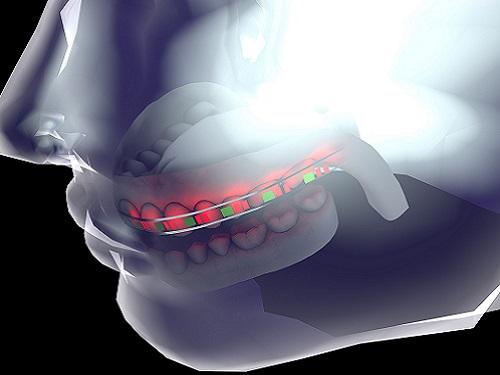
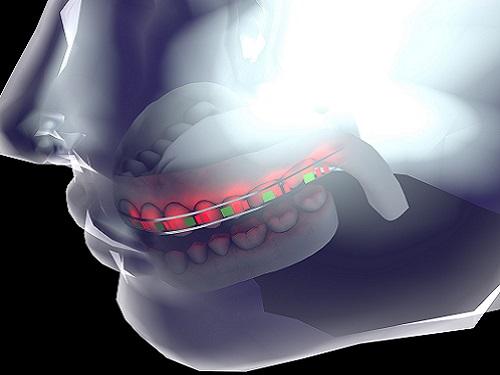
Smart 3D-printed braces that incorporate nontoxic batteries and lights could reduce the time and costs involved in realigning and straightening teeth.

The orthodontic system, conceptualized by researchers at KAUST, involves placing two near-infrared light-emitting diodes (LEDs) and one lithium-ion battery on every tooth in a semitransparent, 3D-printed dental brace.

The batteries provide energy to turn the near-infrared LEDs on and off, depending on how they are programmed by a dentist, to provide localized light therapy according to the needs of each tooth. Phototherapy enhances bone regeneration and can reduce the time and costs involved in corrective orthodontics. The brace would be removable to allow the batteries to be recharged.

"We started embedding flexible LEDs inside 3D-printed braces, but they needed a reliable power supply," explains Muhammad Hussain who led the study together with PhD student Arwa Kutbee. "After the incidents with the Samsung Galaxy 7 batteries exploding, we realized that traditional batteries in their current form and encapsulation don't serve our purpose. So we redesigned the state-of-the-art lithium-ion battery technology into a flexible battery, followed by biosafe encapsulation within the braces to make a smart dental brace."

The battery was redesigned using a dry-etching technique, which removes the silicon substrate normally found on its back. This process thinned the battery to 2.25mm x 1.7mm and made it flexible. Tests showed that the volumetric energy — the ratio of energy to device size–of the redesigned batteries remained high even after many cycles of continuous operation.

Batteries were then encapsulated in biocompatible soft polymeric materials to prevent the possibility of leakage, making them safe to place in the mouth. As a testament to their biocompatibility, when human embryonic kidney cells were cultured on these batteries over a period of days, they thrived and proliferated. The batteries' electrochemical performance increased linearly with rising temperature, up to 90°C, making them stable.

Hussain says the system is a preliminary prototype, "which is more than a proof of concept." The next step, he says, is to conduct clinical trials.

###

Media Contact

carolyn unck
[email protected]

http://kaust.edu.sa/

Related Journal Article

http://dx.doi.org/10.1038/s41528-017-0008-7

Share12Tweet7Share2ShareShareShare1

Related Posts

Blood Test Detects 90% of Early-Stage Pancreatic Cancer

Blood Test Detects 90% of Early-Stage Pancreatic Cancer

July 16, 2026
New Advances in ALS and Alzheimer’s Treatments

New Advances in ALS and Alzheimer’s Treatments

July 16, 2026

Trinh and Ryu Win DOW Funding for Fungal Biotech Research

July 16, 2026

New algorithm boosts gene expression marker detection across diverse biological systems

July 16, 2026
Please login to join discussion

POPULAR NEWS

  • New Drug Candidate Developed at McMaster Shows Potential for Treating Brain Cancer

    58 shares
    Share 23 Tweet 15
  • Scientists Overcome Antimicrobial Resistance in Bacteria Linked to Cystic Fibrosis

    42 shares
    Share 17 Tweet 11
  • Porcine Heart Transplant

    50 shares
    Share 20 Tweet 13
  • A varied menu

    51 shares
    Share 22 Tweet 12

About

We bring you the latest biotechnology news from best research centers and universities around the world. Check our website.

Follow us

Recent News

Modular In Vivo Antibody–ADC Click Reaction Reverses Tumor Drug Resistance

Study Links Early PFAS Exposure to Childhood Intestinal Inflammation at Mount Sinai

Blood Test Detects 90% of Early-Stage Pancreatic Cancer

Subscribe to Blog via Email

Enter your email address to subscribe to this blog and receive notifications of new posts by email.

Join 85 other subscribers
  • Contact Us

Bioengineer.org © Copyright 2023 All Rights Reserved.

Welcome Back!

Login to your account below

Forgotten Password?

Retrieve your password

Please enter your username or email address to reset your password.

Log In
No Result
View All Result
  • Homepages
    • Home Page 1
    • Home Page 2
  • News
  • National
  • Business
  • Health
  • Lifestyle
  • Science

Bioengineer.org © Copyright 2023 All Rights Reserved.