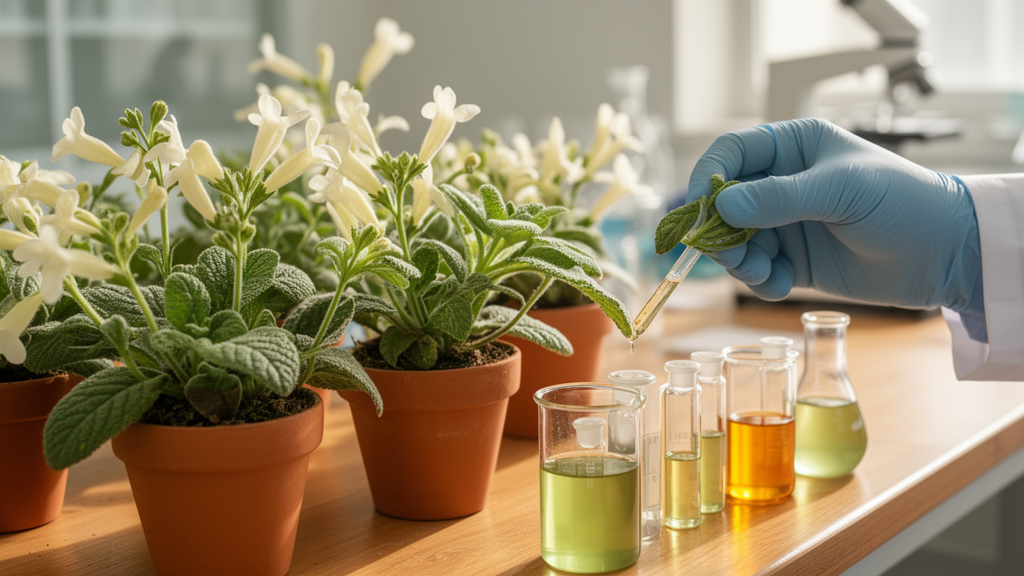
Two South African medicinal plants in the mint family have long been defined by their diterpenoids, but a new computational metabolomics study shows that flavonoids carry far more of the chemical signature that separates the species than anyone had appreciated. Researchers compared the leaf metabolomes of Plectranthus hadiensis, known in isiXhosa as iLozane, and Plectranthus ambiguus, known in isiZulu as iBoza elincane, using an untargeted liquid chromatography–tandem mass spectrometry platform coupled to an integrated suite of computational annotation tools. The analysis, published open access in the journal Metabolomics, revealed that while prenol lipids such as diterpenoids remain a major discriminatory chemical class, distinct flavonoid architectures distinguish the two species: glycosylated flavones predominate in P. hadiensis, whereas methylated flavones and glycosylated flavonols are enriched in P. ambiguus.
The genus Plectranthus, commonly called spurflowers, comprises roughly 300 species distributed across tropical and warm regions including Africa, India and Australia. Both species examined in the study grow freely in southern KwaZulu-Natal and the northern Eastern Cape provinces of South Africa and are traditionally used for overlapping but not identical purposes. Plectranthus species in the region are applied to respiratory conditions, skin infections, fever and inflammation, yet P. ambiguus has been particularly associated with respiratory ailments, while P. hadiensis has also been reported for digestive and gastrointestinal conditions. Prior phytochemical work on these plants focused heavily on abietane-type diterpenoids, leaving the broader chemical repertoire largely unexplored and, according to the authors, no comprehensive metabolomic comparison of the two species had previously been conducted.
For the experiment, 60-day-old plants of both species were grown outdoors under natural South African summer conditions, with average daytime temperatures between 25 and 29 degrees Celsius and nighttime temperatures between 14 and 17 degrees Celsius. Leaves were harvested, air-dried and powdered, and 200 milligrams of each sample were extracted in 10 millilitres of 80 percent methanol on a rotating tube apparatus overnight. Five independent biological replicates per species were prepared. The extracts were then analysed on a liquid chromatography–quadrupole time-of-flight mass spectrometer operated in negative electrospray ionization mode, with tandem mass spectra acquired by data-dependent acquisition using collision-induced dissociation at a collision energy of 30 electronvolts.
Raw data were processed in MZmine 4, which produced an aligned and gap-filled feature list of 3531 detected metabolite features. Comparative analysis showed that 1421 of these features were shared between the two species, indicating a conserved metabolic inventory, but the species diverged substantially beyond that common core. Plectranthus hadiensis exhibited 1472 unique features, while P. ambiguus displayed 638 unique features, suggesting both a higher metabolite diversity and a greater degree of divergence in P. hadiensis. To quantify this chemodiversity, the researchers borrowed ecological diversity metrics, treating each metabolite feature as a unique entry and its relative abundance as a species abundance. Plectranthus hadiensis scored higher on both the Shannon index, which reflects richness and evenness, and the Simpson index, which emphasizes dominant metabolites. Wilcoxon rank-sum tests returned a p-value of 4.11 x 10^-5 for both indices, confirming a statistically significant difference in metabolic complexity between the species.
The annotation pipeline combined feature-based molecular networking on the GNPS2 ecosystem with MS2Query, a tool that detects both exact spectral matches and structural analogues, and MS2LDA 2.0, which discovers shared substructures called Mass2Motifs within fragmentation spectra. Of the verified annotations, 43 percent were identified as exact matches by MS2Query with a mass-to-charge difference of no more than 0.003 and prediction scores of at least 0.5. ClassyFire-based classification assigned the annotated features to chemical classes including cinnamic acids, flavonoids, prenol lipids, benzodioxanes, glycerophospholipids, coumarins and tannins. All metabolite annotations were carried out at levels 2 and 3 of the Metabolomics Standards Initiative, and the validated annotations were compiled in the study’s supplementary table.
To identify which features actually drove the species separation, the team built unsupervised and supervised chemometric models. A principal component analysis of the Pareto-scaled dataset showed clear grouping of P. ambiguus samples apart from P. hadiensis. An orthogonal partial least squares-discriminant analysis model, validated by 7-fold cross-validation, CV-ANOVA with a p-value below 0.05, receiver operator characteristic curves and response permutation testing, acted as a reliable binary classifier with no signs of overfitting. Loading S-plots, cross-checked with variable importance in projection scores and jackknife confidence intervals, pinpointed the strongest discriminant markers. Features with VIP scores above 2, a deliberately stricter threshold than the commonly used cutoff of 1, were retained. Markers enriched in P. ambiguus included m/z 313.0706, 447.0871, 271.0602, 625.3220, 299.0551 and 304.9130, while m/z 389.1958, 589.1187, 461.0715, 351.1804 and 445.0766 discriminated P. hadiensis. These markers belonged chiefly to the prenol lipid and flavonoid classes.
Within the flavonoids, the structural detail emerged from substructure discovery. The baicalin molecular family, enriched in P. hadiensis, contained the top-ranked discriminant feature baicalin at m/z 445.0766 with a VIP score of 7.45, alongside luteolin-3-O-glucuronide and two unknown features. MS2LDA detected 399 Mass2Motifs across the dataset, 18 of them in this family. One motif, motif_14 at 285.03 daltons, corresponded to a luteolin-related substructure and appeared in the fragmentation spectra of the unknown m/z 605.1135, luteolin-3-O-glucuronide and luteolin-3-O-hexoside, supported by a diagnostic glucuronide neutral loss of 176 daltons, although the authors note that further validation experiments are required to fully verify the aglycone identity. A second motif, motif_187 at 445 daltons, was matched by Spec2Vec-powered annotation guidance to apigenin-7-O-glucuronide, with diagnostic apigenin fragments at m/z 269.04 and 117.02, leading the team to postulate that the unknown m/z 589.1187 is a glycosylated apigenin-7-O-glucuronide analogue carrying an additional rhamnosyl sugar. Motif_187 was found across 68 different metabolite features in the dataset. Simple aglycones, apigenin and luteolin, were also abundant discriminants in P. hadiensis.
Plectranthus ambiguus told a different chemical story. Its top flavonoid discriminant after baicalin was sorbifolin at m/z 299.0551 with a VIP score of 6.62, a methylated flavone. In the sorbifolin molecular family, which contained 16 discovered Mass2Motifs, motif_4 was matched to 5,7-dihydroxy-3-(4-hydroxyphenyl)-6-methoxychromen-4-one, an isomer of sorbifolin, with probability and overlap scores of 0.326 and 0.559, and its pseudospectra overlapped with the PubChem fragmentation pattern of sorbifolin. This raised confidence in the annotation of the neighbouring node m/z 315.0499 as 6-methoxyluteolin. Glycosylated flavonols also favoured P. ambiguus, including kaempferol-3-O-hexoside and two quercetin-3-O-hexoside metabolites, potentially a glucoside and a galactoside, some bearing additional acetyl or malonyl conjugates on their sugar moieties. The flavanone naringenin, with a VIP score of 3.89, was likewise enriched in P. ambiguus, together with two unknown features whose spectra showed a 32-dalton neutral loss consistent with methoxy groups and an MS2Query analogue match to naringenin 5,7-dimethyl ether.
The authors stress that these compositional patterns reflect underlying variation in flavonoid biosynthetic modifications, pointing to divergent metabolic regulation between the species, but they caution that the observations may be influenced by growing conditions as well as by biosynthetic pathways, and that further studies are needed to evaluate the biological activities of each species in relation to its enriched flavonoid subclasses. They also note that glycosylation is known to increase the solubility, stability and bioavailability of flavonoid aglycones, while methylation can alter polarity and accumulation of hydrophobic flavones, though such functional interpretations remain hypotheses rather than demonstrated outcomes in this study. What the work delivers is a scalable, untargeted framework for resolving species-specific metabolic architectures in medicinal plants, with implications for chemotaxonomy, natural product discovery and the rational exploration of plant-derived bioactives, and it bridges indigenous knowledge of these spurflowers with modern analytical science by revealing a previously underappreciated layer of chemical specialization beyond their famous diterpenoids.
Subject of Research: Comparative untargeted metabolomics of flavonoid structural diversity in two medicinal Plectranthus species
Article Title: Computational metabolomics reveals flavonoid architectures underlying species-specific chemical identity in medicinal Plectranthus
Article References: Myoli, A., Madala, N. E., Allie, F., van der Hooft, J. J. J., & Tugizimana, F. (2026). Computational metabolomics reveals flavonoid architectures underlying species-specific chemical identity in medicinal Plectranthus. Metabolomics, 22(6), 173. https://doi.org/10.1007/s11306-026-02546-x
Image Credits: AI Generated
DOI: 10.1007/s11306-026-02546-x
Keywords: metabolomics, Plectranthus, flavonoids, diterpenoids, LC-MS/MS, molecular networking, MS2LDA, chemotaxonomy, medicinal plants, South Africa, ethnopharmacology, flavones
News Source: Drew Townsend. (October 25, 2026). Flavonoids, not just diterpenoids, give South African medicinal spurflowers their chemical identities. Scienmag.