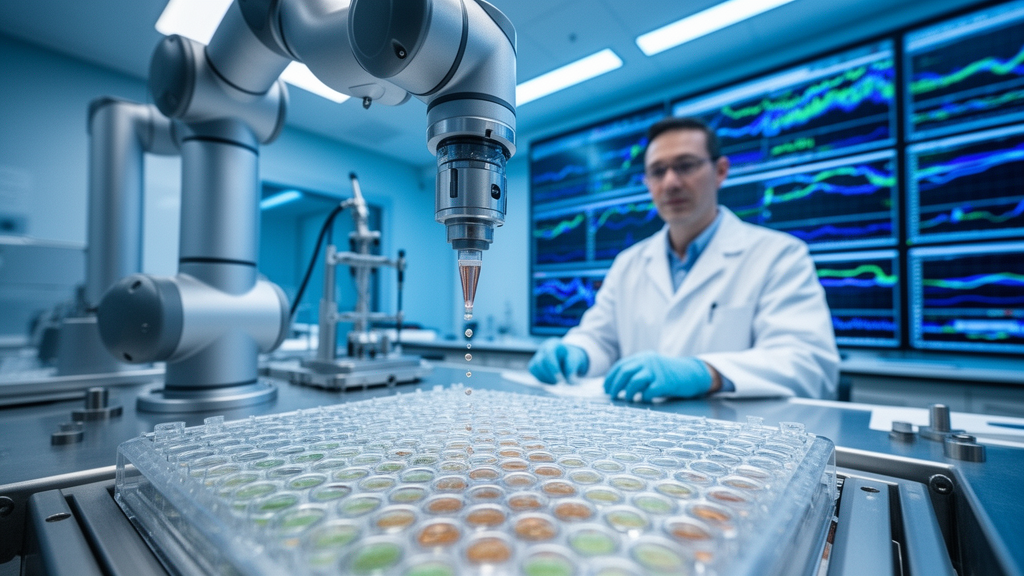
A team of pharmaceutical scientists has built an end-to-end high-throughput platform that pairs automated microplate experiments with a custom data-analysis algorithm, cutting LC data-processing times from days to hours while measuring solubility, lipophilicity, and amorphous solid dispersion (ASD) formulation performance in a single closed-loop workflow. The study, published in AAPS Open, reports that the algorithm, named FLASH (Functional LC Analysis & Sequencing Hub), increased analytical efficiency by more than tenfold and reduced compound material consumption by roughly 20-fold compared with conventional approaches.
The motivation lies in a mismatch that has long plagued high-throughput screening. Instrument automation now allows hundreds of solubility and LogD measurements to be run in parallel, but the downstream data processing has lagged far behind. Manual analysis of large chromatographic datasets becomes a bottleneck in large-scale campaigns, introduces the risk of human error, and leaves expensive instruments idle while scientists crunch numbers. The authors note that data processing in high-throughput solubility and LogD experiments has been widely recognized as the throughput-limiting step, and that without efficient and scalable solutions the practical utility of automated screening platforms is severely constrained.
FLASH addresses the problem with two integrated modules. The first generates liquid chromatography analytical sequences with a single click: scientists upload a list of compound IDs and select test media, and the algorithm maps compound names, microplate positions, replicate identifiers, and LC methods one-to-one, producing a ready-to-load sequence file. For a single solubility assay of 48 compounds across four buffers in duplicate, this means generating a sequence of more than 500 lines automatically. The second module tackles the data itself, performing automated peak identification based on retention time, selecting the most appropriate detection channel by comparing signal-to-noise ratios across multiple UV wavelengths, applying one-point calibration with automatic standard selection, calculating concentrations with dilution factors, and averaging replicate results.
The scale of the data involved explains why automation matters. After that 48-compound solubility run, more than 5,000 lines of multidimensional raw data are exported; FLASH processes them in roughly two hours, where the authors estimate manual handling previously took about three days. For a LogD assay of 32 compounds in triplicate, the algorithm generates over 400 sequence lines and processes more than 25,000 lines of data, cutting processing time from an estimated five days to approximately four hours. Beyond raw speed, FLASH includes an anomaly-flagging system that detects peak splitting, retention-time shifts outside tolerance windows, and large variability between replicates, then visualizes the chromatograms so scientists can re-integrate peaks and recalculate results within the same interface rather than returning to the LC software.
Some of those flagging rules emerged from problems the team observed directly. In solubility assays conducted in FeSSIF, a fed-state simulated intestinal medium rich in surfactants, the short three-minute analytical run could push compound peaks outside the standard 98 to 102 percent retention-time window, which a basic rule set would incorrectly report as zero solubility. FLASH now checks for peaks outside the window with larger areas than those inside it and automatically corrects or flags the results, expanding the tolerance to 80 to 120 percent for FeSSIF samples. The algorithm also flags potential degradation by analyzing peak-area percentages and alerts scientists when replicate variability suggests a compound may have crystallized during equilibration.
The experimental workflow itself was redesigned to eliminate a subtle source of error. Compounds are dispensed from DMSO stock solutions into 96-well plates, and the solvent is removed by centrifugal evaporation to cast solid films, minimizing the influence of residual organic solvent on the measurements. Gas chromatography confirmed residual DMSO stayed below 300 ppm across compounds and plate positions. However, in flat-bottom microplates, the team found that radial position relative to the rotor axis produced non-uniform centrifugal forces and dramatically different film surface areas. For one test compound in fasted-state gastric medium, solubility readings climbed monotonically from plate edge to center, with differences up to twofold persisting even after 20 hours of shaking, a discrepancy the authors attribute to insufficient equilibration time given the varying dissolution rates predicted by the Noyes–Whitney equation.
The solution was geometric: U-bottom plates, whose curved wells give solids a single lowest point, form circular coin-like pellets and more uniform films. Across 28 experiments with different compounds and media, supernatant concentrations measured from plate edge to center showed peak-area ratios close to 100 percent, indicating no significant position-related differences. A whole-plate test measuring the same compound in FaSSIF across all 96 wells yielded a relative standard deviation of just 2.2 percent. The solubility workflow, which uses 5 microliters of a 10 mM DMSO stock and 150 microliters of medium per well, was further validated against six marketed drugs in four biorelevant media, showing close agreement with published benchmark values, and an internal control compound measured 27 times by different operators on different days gave closely aligned results across all four media.
The LogD workflow adapts the gold-standard shake-flask method to a microplate format. After film casting, compounds dissolve in n-octanol, equilibrate with pH 7.4 buffer, and the two phases are separated by centrifugation before automated sampling. A key refinement is a two-step aqueous-phase transfer: the first withdrawn portion, which can be contaminated by octanol clinging to the pipette tip and bias LogD downward, is discarded, and only the second is quantified. Equilibration tests on five in-house compounds with LogD7.4 values from 2.0 to 6.5 showed 30-minute results were not significantly different from 20-hour results, so a 2-hour shaking period was adopted. Across eight compounds run in triplicate on three different days, intra-run variability was minimal, and the high-throughput results correlated strongly with the conventional manual workflow, with an R-squared of 0.9896 and a slope of 0.9560.
The platform was then extended to ASD formulation screening, an early-stage developability test that identifies which polymer carriers best release poorly soluble drugs. Drug and polymer stock solutions are mixed in wells and evaporated to cast films at four drug loadings, from 5.3 to 30.8 percent, then dissolved in FaSSIF-V2 and analyzed by UPLC after centrifugation. Each plate screens 11 polymers at four drug loadings with duplicate wells. Screening of the marketed drugs itraconazole and celecoxib produced polymer rankings consistent with previously published film-casting studies: for itraconazole at 18.2 percent drug loading, Soluplus led with 54.3 percent release, followed by HPMCAS-M, CAP, PVP VA64, Eudragit L100, and PVP K30, mirroring the qualitative order reported by an independent group despite differences in absolute release levels attributable to different target concentrations.
The authors position the platform as a fit-for-purpose screening tool for early discovery rather than a definitive measurement method. They caution that a universal 20-hour equilibration time is difficult to justify for chemically diverse compounds: it may be too short for poorly soluble or slowly dissolving molecules and unnecessarily long for crystallization-prone ones. Because the workflow starts from DMSO-derived films, measured solubility generally corresponds to amorphous rather than crystalline solubility, which the authors consider sufficient for early discovery needs. Current limitations also include the inability to automatically translate mass-scan results into compound-specific SIR acquisition methods, a step that still requires manual configuration in commercial LC software. Future plans include deeper software integration, automated polarized-light imaging with AI-based crystallization detection, and extension of the algorithmic framework to other high-throughput applications such as stability testing, flow cytometry sequence editing, and ADME property profiling.
Subject of Research: An algorithm-assisted high-throughput platform for solubility, LogD, and ASD formulation screening in early drug discovery
Article Title: Develop an algorithmic analytics-enabled end-to-end high-throughput platform for solubility, LogD, and ASD formulation screening
Article References: Zhou, Y., Li, Q., Wang, S., Yue, Y., Chen, Z., Su, Y., Hu, M., Shan, X., & Zhou, D. (2026). Develop an algorithmic analytics-enabled end-to-end high-throughput platform for solubility, LogD, and ASD formulation screening. AAPS Open, 12(1), Article 59. https://doi.org/10.1186/s41120-026-00192-0
Image Credits: AI Generated
DOI: 10.1186/s41120-026-00192-0
Keywords: high-throughput screening, solubility, LogD, liquid chromatography, FLASH algorithm, data processing automation, amorphous solid dispersion, film casting, drug discovery, preformulation, microplate assay, UPLC
News Source: Louis Brooks. (October 29, 2026). FLASH Algorithm Breaks Data Bottleneck in High-Throughput Drug Screening. Scienmag.