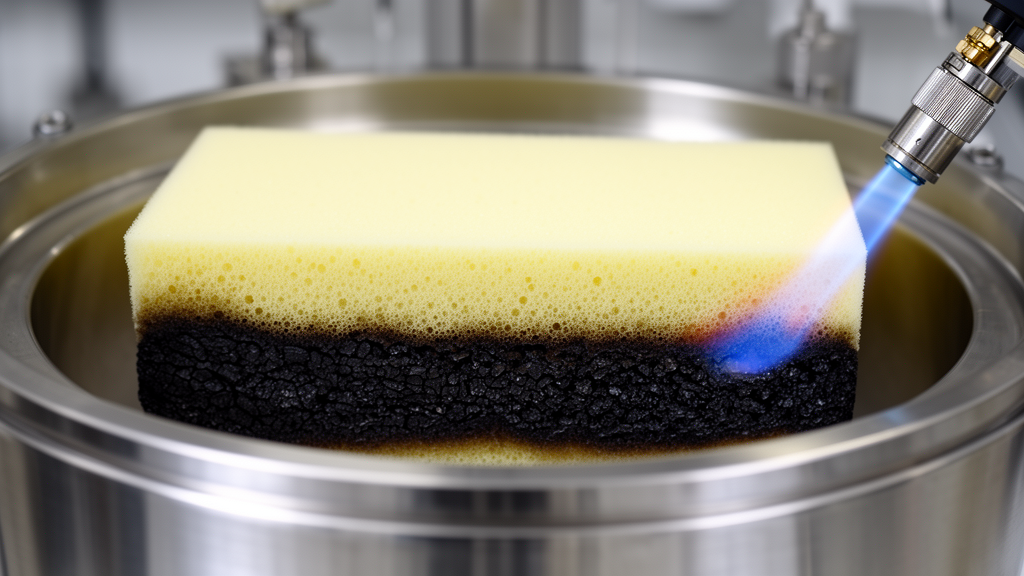
Rigid polyurethane foams are widely utilized across various industrial sectors, yet their inherently high flammability presents significant safety challenges that require the introduction of effective flame-retardant additives. To examine how distinct halogen-free additive chemistries affect these materials, researchers incorporated one liquid agent and two solid particles into identical rigid foam formulations. The experimental investigation compared triethyl phosphate alongside zinc borate and expandable graphite at concentrations of 10 and 20 weight percent, tracking their immediate consequences on foaming kinetics, cellular structure, mechanical resistance, thermal decomposition profiles, and relative flammability.
The physical state of the additives exerted immediate differences during the initial mixing and reaction stages of foam preparation. Incorporating liquid triethyl phosphate decreased the overall viscosity of the polyol mixture, leading to a shortened cream time during initial reaction steps while prolonging the subsequent tack-free times. When incorporated at 20 weight percent, triethyl phosphate also extended the gel time. Conversely, the introduction of solid zinc borate and expandable graphite increased polyol viscosity and extended both the gel and tack-free durations, while causing little observable change in the cream time.
Microstructural examinations performed through scanning electron microscopy revealed that every evaluated additive altered the internal cellular architecture of the cured polyurethane matrix. Neat rigid polyurethane foam produced an apparent average cell diameter of 153 micrometers according to image analysis. In comparison, incorporating the flame retardants broadened the pore structure across all formulations, resulting in larger apparent cell diameters ranging between 184 and 240 micrometers.
Mechanical testing demonstrated that the additives markedly shifted foam density and compressive behavior under load. Rigid polyurethane foam containing 20 weight percent expandable graphite exhibited an increase in compressive stress up to 440.55 kilopascals, an effect largely attributed to a corresponding rise in overall foam density to 71.5 kilograms per cubic meter. However, when evaluating compressive stress normalized against foam density, none of the additive systems produced an increase over the control formulation, and the addition of zinc borate actively reduced normalized compressive strength.
Thermal stability evaluated via thermogravimetric analysis showed altered breakdown dynamics across the composite formulations. All additive-modified foams exhibited reduced maximum degradation temperature values relative to baseline measurements. Most formulations demonstrated an increased residual mass when heated to 700 degrees Celsius, with the greatest residue of 20.91 percent recorded for the foam containing 20 weight percent expandable graphite, a figure that includes the unvolatilized mineral filler material itself.
Screening-level flammability assessments established a clear performance ranking among the three tested additives, ordered from highest to lowest efficacy as expandable graphite, followed by triethyl phosphate, and lastly zinc borate. The measured limiting oxygen index increased from a baseline of 19.1 percent for neat foam to 26.9 percent upon the addition of 20 weight percent expandable graphite, while 20 weight percent triethyl phosphate achieved an intermediate index of 23.0 percent. Zinc borate exerted no meaningful effect on oxygen demand, recording an index of 19.5 percent at 20 weight percent loading.
Standardized vertical flammability screening via UL-94 testing corroborated the differences in fire resistance across duplicate specimens prepared in non-standard sample dimensions. Under these screening parameters, the formulation incorporating 20 weight percent expandable graphite satisfied the criteria for a V-0 rating, whereas the foam prepared with 20 weight percent triethyl phosphate achieved a V-1 rating. All other tested formulations, including all foams loaded with zinc borate, failed to meet the vertical burn criteria.
The researchers noted that the findings represent an application-oriented, phenomenological comparison conducted on a single baseline rigid polyurethane foam formulation. The study does not establish or propose novel chemical flame-retardant mechanisms, and the fire evaluation results reflect screening-level testing rather than full-scale or standardized industrial fire certifications.
Subject of Research: Flame-retardant performance and thermal-mechanical behaviour of rigid polyurethane foams
Article Title: Improving flame resistance and thermal–mechanical performance of polyurethane foams through triethyl phosphate, zinc borate, and expandable graphite additives
Article References: Gürkan, E. H., & Yaman, B. (2027). Improving flame resistance and thermal–mechanical performance of polyurethane foams through triethyl phosphate, zinc borate, and expandable graphite additives. Polymer Bulletin, 84(1), Article 28. https://doi.org/10.1007/s00289-026-06789-5
Image Credits: AI Generated
DOI: 10.1007/s00289-026-06789-5
Keywords: rigid polyurethane foams, flame retardants, triethyl phosphate, zinc borate, expandable graphite, fire performance, limiting oxygen index, UL-94 vertical test, compressive properties, cell morphology, thermal degradation, thermogravimetric analysis, polyol viscosity, scanning electron microscopy, halogen-free additives, polymer additives, cellular plastics, foaming behaviour
News Source: Bethany Barker. (November 12, 2026). Flame retardant additives alter rigid polyurethane foam structure and fire performance. Scienmag.