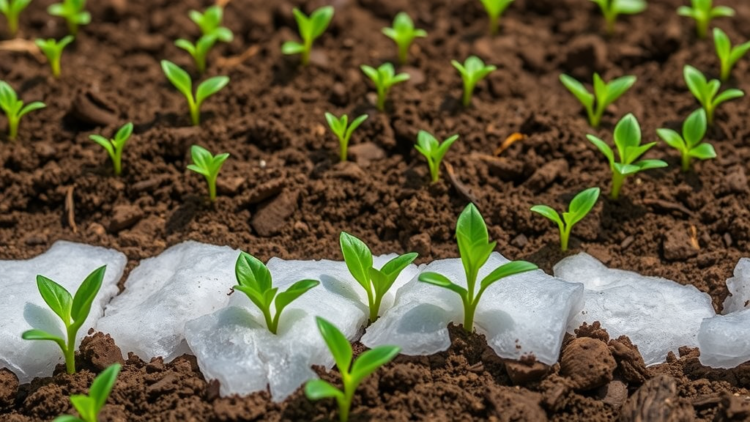
Across the planet, more than a billion hectares of farmland are quietly being poisoned by salt. As irrigation water evaporates and rising seas push saline groundwater inland, dissolved salts accumulate in the root zone of crops, stunting growth and degrading the soil’s capacity to sustain life. The consequences have long been understood in terms of lost harvests, but a new global analysis published in Nature Food reveals a second, hidden cost: salt-affected croplands are leaking enormous quantities of reactive nitrogen into the atmosphere and waterways, undermining both food security and environmental health on a scale that has never before been quantified.
The study, led by Wen Wen and Baojing Gu of Zhejiang University together with colleagues at the International Institute for Applied Systems Analysis and the University of Maryland, set out to close a conspicuous gap in the global nitrogen accounting. Scientists have long known that salinity disrupts the microbial processes that govern nitrogen cycling in soil, but the combined effect of salinization on crop productivity and nitrogen losses had not been comprehensively measured at the global scale. To do so, the team built a spatially explicit nitrogen budget for the world’s saline croplands, combining a global soil salinity map derived from Hassani and colleagues with cropland extent data from the European Space Agency’s Climate Change Initiative land-use product. Nitrogen flows were modelled at a resolution of 0.5 degrees by 0.5 degrees using the IMAGE integrated assessment model and the CHANS nitrogen budget model, while satellite-derived vegetation indices from MODIS helped characterize crop conditions across affected regions.
The headline findings are stark. The researchers applied a pairwise comparison framework, matching observations from salt-affected and non-affected fields to isolate the salinity signal, and found that soil salinity raises nitrogen inputs on saline croplands by 13 percent while reducing the nitrogen actually harvested in crops by 7 percent. That mismatch, more nitrogen going in and less coming out as food, has to go somewhere. The analysis shows it escapes into the environment: reactive nitrogen losses from saline croplands are amplified by 61 percent compared with what would be expected from non-saline conditions. In practical terms, farmers on salt-affected land are applying more fertilizer to compensate for poor yields, yet the stressed soil microbial communities and impaired crop uptake mean a far larger share of that nitrogen ends up as ammonia volatilization, nitrous oxide emissions, nitrogen oxides and nitrate leaching.
The mechanisms behind this leakage are increasingly well documented in the underlying literature. Salt stress suppresses the genes and microbial communities responsible for nitrification and denitrification, shifting the balance of nitrogen transformations in the rhizosphere. Previous meta-analyses have shown that salinization drives concomitant increases in soil ammonia volatilization and nitrous oxide emission, a particularly troubling combination because nitrous oxide is a greenhouse gas roughly 300 times more potent than carbon dioxide over a century. Salinity also impairs root development and water uptake, reducing the plant’s ability to capture nitrogen before it escapes, and altered soil chemistry changes how ammonium exchanges between soil particles and soil water in the root zone.
What distinguishes the new work is not merely the diagnosis but the prescription. The researchers synthesized ten categories of salinity-management practices, ranging from improved irrigation and drainage schemes that leach salts below the root zone, to the application of soil amendments such as biochar, to biological approaches including halophytoremediation and the use of salt-tolerant crop varieties. Their meta-analysis of field studies found that widespread adoption of these practices could reduce annual reactive nitrogen losses from saline croplands by 59 percent, equivalent to 2.5 million tonnes of nitrogen per year, while simultaneously increasing crop production. The scale of that reduction is comparable to the total nitrogen mitigation potential of some entire national agricultural systems, suggesting that saline soil management deserves a place alongside fertilizer optimization and manure management in the global toolkit for nitrogen pollution control.
The economics are equally compelling. The team’s cost-benefit analysis estimates net global benefits of 24.5 billion US dollars per year, with an uncertainty range of plus or minus 11.8 billion, once increased crop output, avoided nitrogen losses and implementation costs are all accounted for. Because saline soils are concentrated in some of the world’s most productive irrigated regions, the benefits are not evenly distributed. China, Pakistan and Indonesia emerge as the countries with the largest aggregate mitigation opportunities, reflecting the vast extent of salt-affected irrigated cropland in their major river basins. Egypt, by contrast, stands out as the leading hotspot for per-hectare benefits, a reflection of the intensity of its irrigated agriculture and the severity of salinity in the Nile Delta, where every hectare restored delivers outsized gains in both yield and pollution reduction.
These findings arrive at a moment of growing urgency. The Food and Agriculture Organization’s 2024 Global Status of Salt-Affected Soils report documented the accelerating spread of salinization, driven by climate change, sea-level rise, over-extraction of groundwater and unsustainable irrigation. Climate models suggest that arid and semi-arid farming regions will face increasing pressure to irrigate with water of declining quality, while coastal deltas from Bangladesh to Egypt face saltwater intrusion. Left unmanaged, this trajectory threatens both the yields on which growing populations depend and the environmental integrity of the watersheds that drain from salt-affected basins. The new analysis reframes salinization not only as a production problem but as a pollution problem, adding a substantial and previously uncounted flux to the global reactive nitrogen budget.
The study also carries implications for climate policy. Because nitrous oxide from saline croplands is a significant contributor to agricultural greenhouse gas emissions, the finding that management practices can cut reactive nitrogen losses by more than half positions saline soil restoration as a candidate for inclusion in climate-smart agriculture frameworks. The authors argue that interventions which simultaneously raise productivity, reduce emissions and deliver positive economic returns are precisely the kind of no-regret investments that international climate finance mechanisms are designed to support. The methodological foundation of the work, drawing on established nitrogen budget models previously used to assess cost-effective mitigation of nitrogen pollution from global croplands, gives the projections a degree of credibility that purely correlative studies lack.
Challenges remain, of course. The ten categories of management practices vary widely in cost, technical difficulty and suitability across different soil types, water regimes and farming systems, and the meta-analytic effect sizes drawn from field trials may not translate uniformly to every salt-affected landscape. Implementing drainage and leaching schemes requires water infrastructure that many smallholder systems lack, and some amendments such as biochar remain expensive at scale. Yet the study’s central message is difficult to ignore: the world’s saline soils, long written off as marginal land, represent one of the largest untapped opportunities to grow more food while polluting less. As nations prepare to strengthen their commitments on both food security and nitrogen pollution, the humble salt-affected hectare may prove to be among the most valuable real estate in global agriculture.
Subject of Research: Global quantification of soil salinity impacts on crop yields and reactive nitrogen losses, and the mitigation potential of saline soil management practices
Article Title: Global management of saline soils to boost crop yields and halve nitrogen losses
Article References: Wen, W., Cheng, L., Zou, Y., Wang, C., Zhang, X., Gao, Y., Cui, J., & Gu, B. (2026). Global management of saline soils to boost crop yields and halve nitrogen losses. Nature Food. https://doi.org/10.1038/s43016-026-01428-8
Image Credits: AI Generated
DOI: 10.1038/s43016-026-01428-8
Keywords: soil salinity, nitrogen pollution, crop yields, saline croplands, reactive nitrogen, nitrous oxide, climate-smart agriculture, irrigation, biochar, food security, Nature Food, cost-benefit analysis
Cite Scienmag News
APA MLA Chicago
Alan Morgan. (September 23, 2026). Fixing Salty Soils Could Halve Nitrogen Pollution and Add Billions in Crop Value. Scienmag. https://scienmag.com/fixing-salty-soils-could-halve-nitrogen-pollution-and-add-billions-in-crop-value/
Alan Morgan. “Fixing Salty Soils Could Halve Nitrogen Pollution and Add Billions in Crop Value.” Scienmag, 23 September 2026, https://scienmag.com/fixing-salty-soils-could-halve-nitrogen-pollution-and-add-billions-in-crop-value/. Accessed 23 September 2026.
Alan Morgan. “Fixing Salty Soils Could Halve Nitrogen Pollution and Add Billions in Crop Value.” Scienmag. September 23, 2026. https://scienmag.com/fixing-salty-soils-could-halve-nitrogen-pollution-and-add-billions-in-crop-value/
Copy citation Download RIS
Tags: Biocharclimate-smart agriculturecost-benefit analysiscrop yieldseconomic benefits of soil salinity managementenvironmental consequences of soil salinityFood securityglobal nitrogen budget and salt-affected agricultureglobal nitrogen pollution from salt-affected landsirrigationirrigation-induced salinizationNature Foodnitrogen cycling disruption in saline soilsnitrogen losses and climate change mitigationnitrogen pollutionnitrous oxidereactive nitrogensaline croplandssaline groundwater intrusion and crop yieldSaline soil impacts on crop productivitysoil salinitysoil salinity and environmental healthstrategies for fixing salty soilssustainable agriculture in salt-affected regions