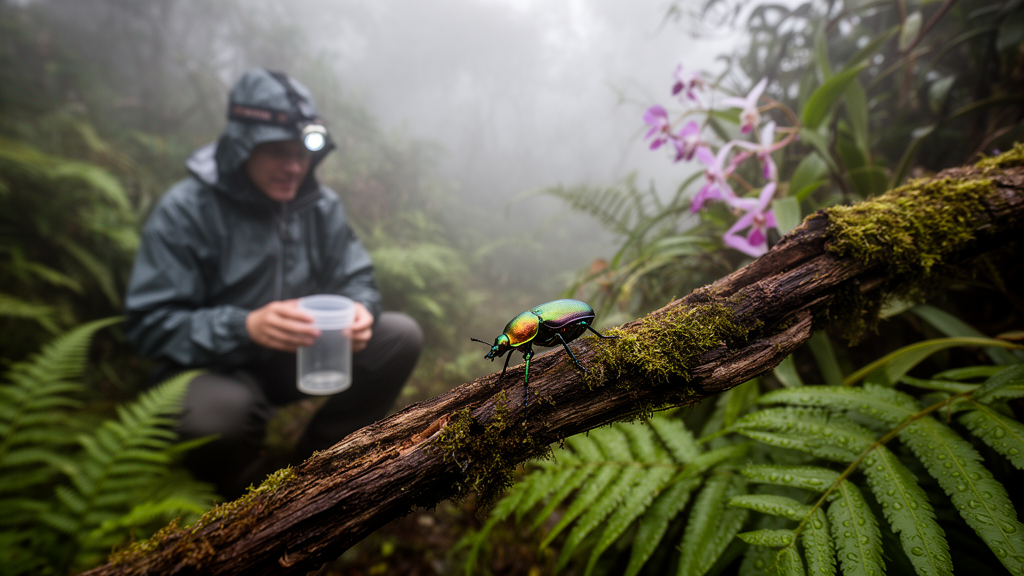
High on the mossy slopes of Gunung Kinabalu, the granite peak that dominates the northern tip of Borneo, entomologists have identified five species of jumping plant lice that science has never seen before. The discovery, published in the journal Alpine Entomology, lifts the number of psyllid species known from the mountain to 22 and offers a rare glimpse into one of the least explored corners of tropical insect diversity. All five belong to the subfamily Psyllinae, a group of plant-feeding bugs whose closest relatives live thousands of kilometres away in the temperate north, making their presence on a tropical equatorial mountain both unexpected and scientifically tantalising.
Psyllids, often called jumping plant lice, are small sap-sucking insects related to aphids and scale insects. Unlike their aphid cousins, adult psyllids are always winged and can survive for long stretches without feeding, an adaptation that allows them to disperse widely and locate even rare or scattered host plants. This mobility helps explain why psyllids reach their greatest diversity in the tropics and the southern hemisphere, while aphids dominate the temperate north. Worldwide, just over 4,000 psyllid species have been formally described, but researchers studying undescribed material in museum collections believe this figure represents less than half of the species that actually exist. The tropics, in particular, remain poorly surveyed, and current ideas about psyllid host preferences and distribution patterns may shift dramatically as tropical faunas become better known.
Gunung Kinabalu is a natural laboratory for biogeography. Rising to almost 4,100 metres, it is the highest mountain between the Himalayas and Mount Wilhelm in New Guinea, and its plant communities change dramatically with altitude. Below 2,500 metres, much of the original vegetation has been destroyed by human activity, but the flora there is composed predominantly of Oriental elements, species with tropical Asian affinities. Above 2,500 metres, the mountain shares plant taxa with the Himalayas, such as the heath family Ericaceae, and with Australia, such as the myrtle family Myrtaceae. This layered biogeographic signature, long recognised in the mountain’s flora, is now shown to be mirrored in its psyllid fauna, where Oriental, Australian and Himalayan faunal elements each occupy distinct altitudinal zones.
The newly described species belong to two genera of north temperate affinity: Cacopsylla, one of the largest psyllid genera with over 450 species, and Psylla, a genus recently redefined to include only 24 species associated with birch family trees. Three of the new Cacopsylla species, C. graciliforceps, C. myrsines and C. photiniae, correspond closely to the established concept of the genus and are probably most closely related to species in the Himalayas and the temperate Palaearctic region. They represent Himalayan faunal elements, echoing the plant relationships found at high altitudes on the mountain. C. kinabaluensis and the new Psylla species, P. cirrita, differ more substantially from their temperate relatives, and their phylogenetic positions remain uncertain pending additional material, particularly immature stages.
The morphological evidence for these species is detailed and technically rigorous. C. graciliforceps, found between 2,600 and 4,000 metres, is a dark brown to almost black insect with slender genal processes, a weakly sinuous vein Rs on the forewing, and a straight, digitiform paramere, the male’s slender pincer-like structure. Its name derives from the Latin gracilis, meaning slender, and forceps, referring to those delicate parameres. Almost half of the adults collected were found on plants of the heath family, including Rhododendron, Styphelia and Vaccinium, which are likely host plants. C. kinabaluensis, discovered around 2,600 metres in moss forest, is a larger, multi-coloured species with remarkably long antennae more than three times the width of its head, tubular genal processes widely separated in the middle, and conspicuous long setae on the forewing veins.
Two of the five new species have confirmed host plants, and these associations carry significant biogeographic weight. C. myrsines develops on Myrsine dasyphylla, a shrub endemic to Borneo belonging to the family Primulaceae. This is remarkable because Myrsine has never before been reported as a host genus for any psyllid superfamily member anywhere in the world, and Primulaceae in general is considered an atypical psyllid host. C. photiniae, found between 3,200 and 4,000 metres in subalpine scrub and moss forest, develops on Photinia davidiana, a rosaceous shrub or tree native to Borneo, Sumatra, Vietnam, China and Taiwan. The discovery of a Cacopsylla species on a rosaceous host that morphologically resembles species associated with the heath family rather than other rose-feeding relatives suggests that host shifts and morphological convergence may be more complex than previously assumed.
The fifth new species, P. cirrita, is known from a single male collected at 3,300 metres on Rhododendron in moss forest. Its name derives from the Latin cirritus, meaning bearded or having filaments, referring to the conspicuous setae on its massive genal processes. A second, closely related species from the mountain remains undescribed because insufficient material is available. P. cirrita shares striking similarities with P. turpinae from southern China, including reddish body colour, massive genal processes, and an unusual arrangement of apical spurs on the hind tibia. The Chinese relative develops on Dalrympelea pomifera, a member of the family Staphyleaceae that is itself an unusual psyllid host, and six of the eight recognised Dalrympelea species occur in Borneo, hinting at a deeper biogeographic connection between the two regions.
The taxonomic work also prompted two nomenclatural changes. Two Philippine species previously placed in Psylla, P. aranetae and P. bakeri, have been transferred to Cacopsylla based on their morphological similarity to C. kinabaluensis. The three species share a multi-coloured body, a short vertex, long tubular genal processes, long antennae, the absence of a genual spine on the hind tibia, and oval forewings with a curved costal margin. Together they constitute a putatively monophyletic group, and the transfer reflects a careful reassessment of generic boundaries within the subfamily. Immature stages and molecular data will ultimately be necessary to confirm these placements and to clarify the phylogenetic relationships of the Southeast Asian Psyllinae as a whole.
The biogeographic patterns emerging from Gunung Kinabalu’s psyllid fauna are striking. Of the 22 species now known from the mountain, four represent Oriental elements found at lower altitudes, 13 represent Australian elements associated with Myrtaceae at mid to high altitudes, and three represent Himalayan elements at the highest zones. Two species remain of unknown affinity. Eighteen of the 22 species are known only from Gunung Kinabalu, a figure that likely reflects both genuine endemism and the simple fact that Borneo’s psyllid fauna, and tropical psyllid faunas in general, remain grossly undersampled. Targeted fieldwork elsewhere in Borneo and Southeast Asia will probably reveal that some of these apparently endemic species occur more widely, although the degree of endemism on the mountain is still expected to remain high.
The discovery underscores how much tropical insect diversity remains hidden in plain sight, even on well-studied mountains in well-studied regions. Museum collections assembled decades ago, in this case through fieldwork in the 1980s by researchers from Geneva, Basel and Taiwan, continue to yield new species when examined with modern taxonomic methods and fresh comparative frameworks. As climate change alters the distribution of tropical montane forests and the insects that depend on them, documenting this diversity before it is lost has become an urgent scientific priority. The five new species from Gunung Kinabalu are a reminder that even small, sap-sucking bugs can carry large stories about continental drift, mountain building, and the intricate evolutionary relationships between insects and the plants they feed on.
Subject of Research: The Psyllinae (Hemiptera, Psyllidae) from Gunung Kinabalu (Malaysia, Sabah)
Article Title: The Psyllinae ( Hemiptera , Psyllidae ) from Gunung Kinabalu (Malaysia, Sabah)
Article References: Burckhardt, D. (2024). The Psyllinae (Hemiptera, Psyllidae) from Gunung Kinabalu (Malaysia, Sabah). Alpine Entomology, 8, 1-17. https://doi.org/10.3897/alpento.8.113873
Image Credits: AI Generated
Keywords: Psyllinae, Hemiptera, Psyllidae, Gunung, Kinabalu, Malaysia, Sabah, scientific research
News Source: Gavin Prescott. (October 18, 2026). Five New Insect Species Revealed on Borneo’s Tallest Mountain. Scienmag.