


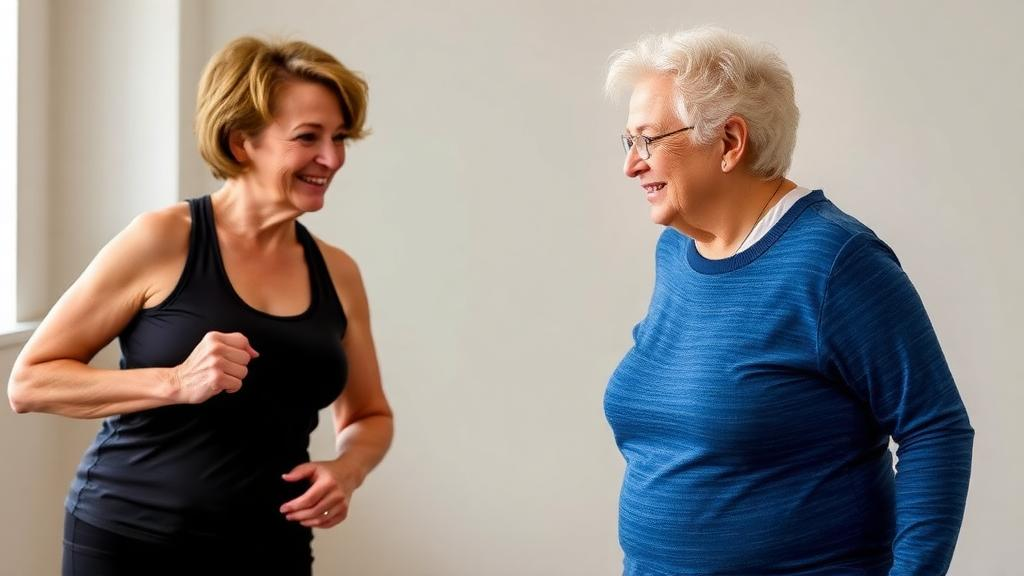
A cross-sectional observational study of 76 community-dwelling women, published in BMC Geriatrics, compared women in their seventh decade of life (60–69 years, n = 39) with those in their eighth decade (70–79 years, n = 37) and found that while fitness performance dropped significantly with age, psychometric test results did not differ significantly between the two groups.
The fitness gap showed up clearly in objective tests. Yet when the researchers assessed activities of daily living with the Barthel Index, fear of falling with the FES-I, depressive symptoms with the CES-D, quality of life with the WHOQOL-BREF, and physical activity levels with the IPAQ, the two age groups scored similarly.
To understand how these measures relate to one another, the team used Pearson’s correlations and backward multiple regression analysis to identify the best predictor of each test within each age group. The patterns differed markedly between decades. Among women aged 60–69, the best predictor of depressive symptoms (CES-D) was the global physical activity score from the IPAQ (p < 0.01); fear of falling (FES-I) was best predicted by depressive symptoms (p < 0.05); the overall quality-of-life score (WHOQOLog) was best predicted by the health-related quality-of-life subscore (p < 0.001); the health subscore was best predicted by the psychological subscore (p < 0.001); and global physical activity was best predicted by depressive symptoms (p < 0.01).
For women aged 70–79, a different set of relationships emerged. The best predictor of the Barthel Index, which captures independence in daily activities, was the somatic subscore of quality of life (WHOQOLsom, p < 0.001). Fear of falling was best predicted not by a psychological measure but by walking endurance on the 6-minute Walk Test (p < 0.05). Overall quality of life was best predicted by the social relationships subscore (WHOQOLsoc, p < 0.01), and global physical activity was best predicted by body mass (p < 0.01).
Two conclusions stand out from these findings. First, the self-reported physical activity level captured by the IPAQ did not reflect the women’s actual physical fitness in either decade, a caution for anyone relying on questionnaire-based activity data in this population. Second, women in the two age groups perceived differently the factors most responsible for fear of falling, depression level, and physical activity, suggesting that the psychological drivers of these outcomes shift with age rather than the measured levels themselves.
Because the study was cross-sectional, it captures a single moment in time and compares different groups of women rather than following the same individuals as they age; the observed decade differences therefore describe group contrasts rather than individual trajectories of change. The authors also note that little is known about how the results of commonly used psychometric tests in older adults interrelate across different decades of life in relation to physical fitness, which motivated the comparison. Within that scope, the study offers a practical message: fitness testing and psychometric testing probe distinct dimensions of healthy ageing, and the connections between them appear to be reorganised, not simply weakened, as women move from their sixties into their seventies.
Subject of Research: Physical fitness and psychometric test outcomes in community-dwelling women aged 60–79
Article Title: Relationships between physical fitness and psychometric test outcomes in community-dwelling women aged 60–79 years
Article References: Nawrat-Szołtysik, A., Piejko, L., Szołtys-Brzezowska, B., Zarzeczny, R., Nowakowska-Lipiec, K., & Polak, A. (2026). Relationships between physical fitness and psychometric test outcomes in community-dwelling women aged 60–79 years. BMC Geriatrics. https://doi.org/10.1186/s12877-026-08602-4
Image Credits: AI Generated
DOI: 10.1186/s12877-026-08602-4
Keywords: physical fitness, older women, psychometric tests, Timed Up and Go, 6-minute Walk Test, fear of falling, depression, quality of life, physical activity, cross-sectional study, ageing, BMC Geriatrics
News Source: Beatrice Stafford. (October 29, 2026). Fitness Falls but Mood Measures Hold Steady Across Older Women’s Seventies. Scienmag.



