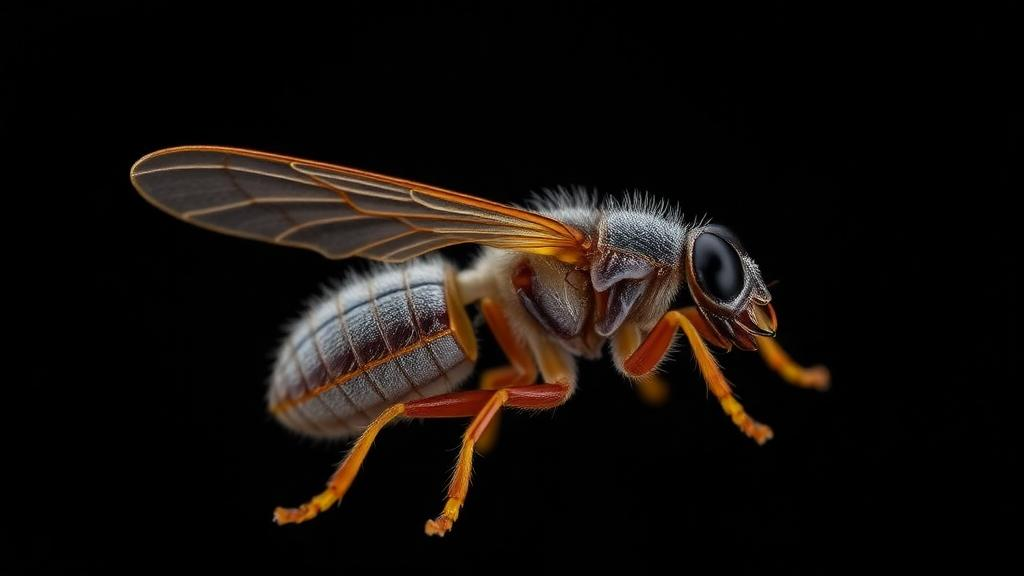
Deep in the mist-shrouded montane forests of Yunnan Province, southwestern China, an insect collector walking along a mountain road at 2,000 meters altitude picked up two small male webspinners from the road surface. Those specimens, gathered in Yingpan on Ailao Mountain in May 2018 and preserved in 75% ethanol, have now turned out to belong to an insect family never before recorded from China. A new study published in the Deutsche Entomologische Zeitschrift describes them as Ptilocerembia qiului sp. nov., a new species of webspinner that simultaneously extends the known range of the family Ptilocerembiidae northeastward into southwestern China and delivers the first complete mitochondrial genome ever sequenced for this enigmatic lineage.
Webspinners, the order Embioptera, are among the most peculiar insects alive today. They spin silk from specialized glands in the front legs — a trait unique among insects — and live in galleries woven beneath bark, in leaf litter, and in humid canopy niches. The family Ptilocerembiidae, erected by Miller and Edgerly in 2012 after molecular phylogenetic analysis recovered the genus Ptilocerembia as a distinct lineage separate from Notoligotomidae, was originally described from Indonesia, with the type species Ptilocerembia roepkei Friederichs, 1923. Until now, all known species of this monogeneric family came from Indonesia, Myanmar, and Thailand, with four additional species described from Thailand by Poolprasert and Edgerly in 2014. The discovery of a Chinese representative therefore fills a significant biogeographic gap and validates a prediction made by entomologist Ross as far back as 2007, who suspected that the montane regions of northern Myanmar, Laos, Vietnam, and southwestern China harbor undiscovered embiopteran taxa.
The new species is named after its collector, Dr. Lu Qiu of Mianyang, Sichuan. Morphologically, the male of P. qiului is about 15 millimeters long, pale to brown in color, with antennae of at least 26 segments bearing long erect setae and pale distal segments. The head capsule is dark brown, nearly 1.5 times longer than wide, with reticular pigmentation on the posterior third. The wings are pale brown with longitudinal stripes, and the anterior media vein (MA) is forked subbasally in all wings — a diagnostic feature of the genus. The hind basitarsus carries dense ventral setae and a single papilla. The body is deposited in the Insect Collection of Jiangsu University of Science and Technology in Zhenjiang, with a holotype and one paratype from the same collection event.
What truly separates P. qiului from its five known congeners is the elaborate architecture of the male terminalia, the genital structures that entomologists use as species-level fingerprints in webspinners. The tenth abdominal tergite is completely cleft, with hemitergites separated basally. The left hemitergal process (10LP) is constricted basally with a greatly projected left margin, while the right hemitergal process (10RP) is broad and subquadrate. The medial flap (MF) carries a long sickle-shaped epiproct-like hook and a raised nodule. The hypandrium process (HP) is nearly as long as the hypandrium itself, with a denticulate ridge on the apical half of the left margin — a feature that is relatively short and simple in all other described species. The submentum, a ventral head sclerite, has a truncate anterior margin rather than the concave margin seen in its closest relative, P. catherinae. These combinations of characters, examined under a stereomicroscope and photographed with a Canon EOS 5DSR camera and MP-E 65 mm macro lens, clearly distinguish the Chinese specimens from the four Thai species and the Indonesian P. roepkei.
To complement the morphological evidence, the team sequenced the complete mitochondrial genome from a single leg of the holotype using a paired-end Illumina library on the HiSeq X platform, yielding 1.56 gigabases of clean data. The mitogenome was assembled independently with two pipelines, GETORGANELLE v1.7.4 and MITOZ v3.6, whose consistency was confirmed by manual checking before deposition in GenBank under accession number PX232380. The resulting circular molecule is 15,443 base pairs long — slightly smaller than other reported webspinner mitogenomes, which typically range from about 15.7 to 17.3 kilobases — and comprises 13 protein-coding genes, 20 tRNA genes, 2 rRNA genes, and the A+T-rich control region. Base composition is strongly A+T-biased, with adenine at 39.2% and thymine at 25.1%, a pattern typical of insect mitochondrial genomes.
The mitogenome holds two genuine surprises. First, two tRNA genes — tRNA-Val (trnV) and tRNA-Ser(UGA) (trnS2) — were not detected in the assembly, a feature not seen in any other sequenced embiopteran mitogenome. The authors caution that missing tRNAs can sometimes result from annotation or sequencing limitations rather than true gene loss, so these absences should be interpreted cautiously until confirmed by additional data. Second, and more remarkably, the team detected approximately 5.4 tandem repeat units in the intergenic region between tRNA-Ile and tRNA-Gln, confirmed by Tandem Repeats Finder analysis. Tandem repeats are common in the control region of many insect mitogenomes, but their presence in this non-control intergenic spacer has never been reported in other webspinner mitogenomes and suggests lineage-specific evolution. The functional significance remains unclear — the repeats could be neutral structural features or potentially involved in replication dynamics — but they could serve as genetic markers if conserved across populations.
Analysis of selective pressure across all 13 protein-coding genes, comparing the new species against the outgroup Phasmotaenia lanyuhensis, yielded Ka/Ks values below 1.0 for every gene, indicating that all protein-coding genes evolve under purifying selection. COX1 shows the lowest Ka/Ks ratio and therefore the highest conservation, supporting its robustness as a DNA barcode marker, while ATP8 shows a relatively elevated rate — though still under 1 — suggesting relaxed constraint on this ATP synthase gene. This pattern, with COX1 as the slowest-evolving mitochondrial gene and ATP8 among the fastest, is consistent with findings from other Embioptera. Most protein-coding genes use standard invertebrate start codons (ATA, ATG, ATT) and terminate with TAA, while six genes end with an incomplete stop codon presumed to be completed by post-transcriptional polyadenylation. Relative synonymous codon usage analysis reveals a strong bias toward A/T-ending codons, with the most frequent codons encoding serine (UCU, UCA) and threonine (ACC).
The molecular species delimitation results are striking. The COX1 barcode of P. qiului was compared against all six available Ptilocerembia sequences from GenBank, and pairwise K2P genetic distances between the new species and its congeners ranged from 12.6% to 17.6% — far exceeding the widely adopted ~2% intraspecific thresholds used in webspinners and other insects. The smallest distance among any congeners was 4.2%, between P. catherinae and P. thaidina. In phylogenetic trees built with Bayesian inference, Neighbor-Joining, and Maximum Likelihood methods, P. qiului grouped with two unnamed Ptilocerembia specimens sequenced by Miller and colleagues in 2012 rather than with any formally described species, supported by a posterior probability of 0.82 in the Bayesian tree and bootstrap values of 66 and 52 in the Neighbor-Joining and Maximum Likelihood trees respectively. This congruence between morphology and genetics provides strong evidence that the Chinese specimens represent a distinct new species — and hints that the unnamed specimens from the 2012 study might themselves represent additional undescribed species.
The discovery carries substantial biogeographic weight. Although this record is not the northernmost known occurrence of the genus — Myanmar already hosted species of Ptilocerembia — it extends the family’s boundary into Yunnan and underscores the province’s significance as a biodiversity hotspot. The type locality sits in the Ailao Mountain region, a transitional boundary between the Yungui Plateau and the Hengduan Mountains that serves as a climatic divide between the Pacific Southeast Monsoon and the Indian Ocean Southwest Monsoon systems. The surrounding mid-elevation moist evergreen broad-leaved forests, dominated by Fagaceae, Theaceae, Lauraceae, and Magnoliaceae with rich epiphytes and lianas, create stable micro-habitats such as bark crevices, leaf-litter zones, and humid canopy niches favorable for webspinners. Given the pronounced vertical climate stratification, the new species may occupy a narrow elevational range with specific humidity and canopy cover conditions, and future field studies targeting mid-montane evergreen forest corridors across the Indochina–Yunnan region may reveal a broader distribution of the genus across similar habitats.
Only six species of Ptilocerembia are currently described worldwide, and the authors argue that the genus’s diversity is seriously underestimated. Ross suspected as early as 1963 that a complex of many species exists across the region, and the new findings confirm that even putative colonies in well-surveyed areas can yield new taxa. The study is based on male specimens from a single locality, and no females are yet known for the species; more fieldwork is needed to collect females and additional populations to study potential intraspecific variation and female morphology. The phylogenetic analysis relied solely on COX1, useful for species delimitation but limited for resolving deeper relationships, so future work should incorporate nuclear markers, transcriptomes, and full mitogenomes of multiple species to build a more comprehensive phylogeny of Ptilocerembiidae and Embioptera. Multi-gene phylogenomics could test the monophyly of Ptilocerembiidae and clarify its position relative to other families. As taxonomic work progresses, integrating classical morphology, DNA barcoding, and genomic data will be essential to achieve a robust classification of Embioptera and to document the evolutionary history of this silk-spinning insect order — a reminder that even in well-studied regions, hidden diversity awaits discovery.
Subject of Research: First record of the family Ptilocerembiidae (Insecta, Embioptera) from China, with morphological and molecular characterization of a new species
Article Title: First record of the family Ptilocerembiidae ( Insecta , Embioptera ) from China, with morphological and molecular characterization of a new species
Article References: Chen, Z.-T., Xiong, Y., & Jiang, C. (2025). First record of the family Ptilocerembiidae (Insecta, Embioptera) from China, with morphological and molecular characterization of a new species. Deutsche Entomologische Zeitschrift, 72(2), 569-579. https://doi.org/10.3897/dez.72.170313
Image Credits: AI Generated
Keywords: First, record, family, Ptilocerembiidae, Insecta, Embioptera, China, morphological, molecular, characterization, species, scientific research
News Source: Gavin Prescott. (October 17, 2026). First record of the family Ptilocerembiidae (Insecta, Embioptera) from China, with morphological and molecular characterization of a new species. Scienmag.