• HOME
  • NEWS
  • EXPLORE
    • CAREER
      • Companies
      • Jobs
    • EVENTS
    • iGEM
      • News
      • Team
    • PHOTOS
    • VIDEO
    • WIKI
  • BLOG
  • COMMUNITY
    • FACEBOOK
    • INSTAGRAM
    • TWITTER
Tuesday, September 1, 2026
BIOENGINEER.ORG
No Result
View All Result
  • Login
  • HOME
  • NEWS
  • EXPLORE
    • CAREER
      • Companies
      • Jobs
        • Lecturer
        • PhD Studentship
        • Postdoc
        • Research Assistant
    • EVENTS
    • iGEM
      • News
      • Team
    • PHOTOS
    • VIDEO
    • WIKI
  • BLOG
  • COMMUNITY
    • FACEBOOK
    • INSTAGRAM
    • TWITTER
  • HOME
  • NEWS
  • EXPLORE
    • CAREER
      • Companies
      • Jobs
        • Lecturer
        • PhD Studentship
        • Postdoc
        • Research Assistant
    • EVENTS
    • iGEM
      • News
      • Team
    • PHOTOS
    • VIDEO
    • WIKI
  • BLOG
  • COMMUNITY
    • FACEBOOK
    • INSTAGRAM
    • TWITTER
No Result
View All Result
Bioengineer.org
No Result
View All Result
Home NEWS Science News Biology

First observation of rubber-like elasticity in liquid glycerol

Bioengineer by Bioengineer
June 27, 2023
in Biology
Reading Time: 3 mins read
0
Laser-generated surface bubble of liquid glycero
Share on FacebookShare on TwitterShare on LinkedinShare on RedditShare on Telegram

It is the first time an elasticity dominating the flow behavior in a Newtonian liquid like glycerol has been observed. Its existence is difficult to reconcile with common ideas about the interactions in liquid glycerol and motivates the search for more comprehensive descriptions. Surprisingly, the elasticity persists over such long timescales of several microseconds that it could be important for very rapid engineering applications such as micrometer-confined flows under high pressure. Yet, the question remains unsettled whether this behavior is a specific property of liquid glycerol, or rather a phenomenon that occurs in many molecular liquids under similar conditions but has not been observed so far.
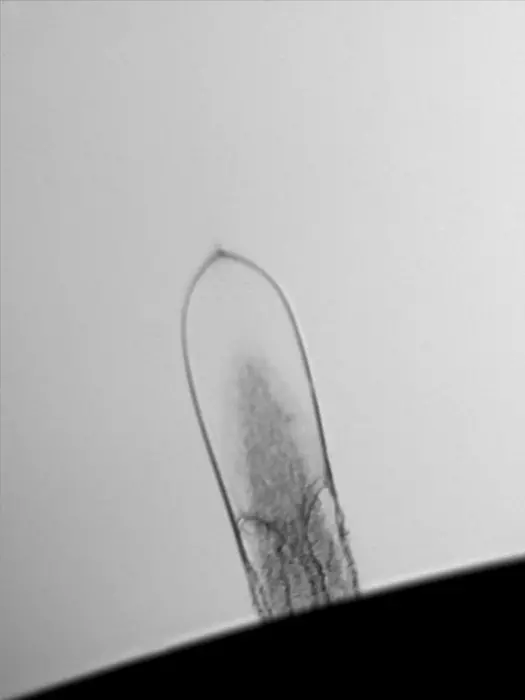
Laser-generated surface bubble of liquid glycero

Credit: Kayanattil / Huang

It is the first time an elasticity dominating the flow behavior in a Newtonian liquid like glycerol has been observed. Its existence is difficult to reconcile with common ideas about the interactions in liquid glycerol and motivates the search for more comprehensive descriptions. Surprisingly, the elasticity persists over such long timescales of several microseconds that it could be important for very rapid engineering applications such as micrometer-confined flows under high pressure. Yet, the question remains unsettled whether this behavior is a specific property of liquid glycerol, or rather a phenomenon that occurs in many molecular liquids under similar conditions but has not been observed so far.

The team proposes that the high straining rate and the confined thickness of the shell causes the individual molecules to form groups that are displaced in a correlated and collective manner. This change would stabilize the elastic state over a longer time than would be possible in glycerol’s equilibrium state, where the single molecules are subject to fast diffusion. “We want to reach a better understanding of this unusual state,” says lead author and doctoral student Meghanad Kayanattil, “because it could tell us a lot about collective excitations in disordered systems.”

The existence of such a rubber-like state in liquid glycerol raises the question: Are similar effects possible in other liquid substances? In particular the creation of elastic bubbles in water would be a major achievement because it is the most important and well-studied liquid with implications for multiple scientific fields. However, the glycerol bubbles only formed in a vacuum environment, as shown by the MPSD team. This poses some challenges for similar experiments involving water, because it begins to boil below the vapor pressure of 32 mbar – well above the pressure at which the experiments need to take place.

The research was carried out by members of the Institute’s Scientific Support Unit Ultrafast Beams and guest scientist Zhipeng Huang from the University of Duisburg-Essen. An innovative scientific approach and the right choice of parameters led to the discovery of this novel elastic behavior. “Our experiment invites us to rethink the correlations and the differences between liquids and solids,” says principal investigator Sascha Epp. “As a next step, we aim to investigate the molecular interaction and structure of the transient bubble shell and whether this effect can also be created in a range of other liquids whose molecular interactions are different from glycerol.”


Journal

Proceedings of the National Academy of Sciences

DOI

10.1073/pnas.2301956120

Method of Research

Experimental study

Subject of Research

Not applicable

Article Title

Rubber-like elasticity in laser-driven free surface flow of a Newtonian fluid

Article Publication Date

26-Jun-2023
Share12Tweet8Share2ShareShareShare2

Related Posts

Methylation puts parasites in motion

Methylation puts parasites in motion

August 31, 2026
Desiccation promotes DNA damage and rifampin resistance in Mycobacterium tuberculosis

Desiccation promotes DNA damage and rifampin resistance in Mycobacterium tuberculosis

August 31, 2026

Gastrointestinal Parasitism in Cattle and Water Buffaloes in Pakistan: Prevalence and Associated Risk Factors

August 31, 2026

Development of HPLC–PDA method for steviol glycosides analysis in food matrices

August 31, 2026

POPULAR NEWS

  • β-Sitosterol from Ipomoea carnea Jacq. As a promising anti-inflammatory agent: Evidence from in silico modeling and in vitro validation

    29 shares
    Share 12 Tweet 7
  • Design, fabrication and characterization of a wearable Fiber Bragg grating sensor for cardiorespiratory monitoring using finger plethysmography

    29 shares
    Share 12 Tweet 7
  • KAIST opens the era of industrial-scale microbial foods, proposing growth strategies for the next-generation protein market

    29 shares
    Share 12 Tweet 7
  • Virologist awarded $2 million NIH grant to investigate how virus-infected cells live and die

    29 shares
    Share 12 Tweet 7

About

We bring you the latest biotechnology news from best research centers and universities around the world. Check our website.

Follow us

Recent News

β-Sitosterol from Ipomoea carnea Jacq. As a promising anti-inflammatory agent: Evidence from in silico modeling and in vitro validation

Design, fabrication and characterization of a wearable Fiber Bragg grating sensor for cardiorespiratory monitoring using finger plethysmography

KAIST opens the era of industrial-scale microbial foods, proposing growth strategies for the next-generation protein market

Subscribe to Blog via Email

Enter your email address to subscribe to this blog and receive notifications of new posts by email.

Join 85 other subscribers
  • Contact Us

Bioengineer.org © Copyright 2023 All Rights Reserved.

Welcome Back!

Login to your account below

Forgotten Password?

Retrieve your password

Please enter your username or email address to reset your password.

Log In
No Result
View All Result
  • Homepages
    • Home Page 1
    • Home Page 2
  • News
  • National
  • Business
  • Health
  • Lifestyle
  • Science

Bioengineer.org © Copyright 2023 All Rights Reserved.