


Peptomyc’s Omomyc-based therapy against cancer put to the clinical test
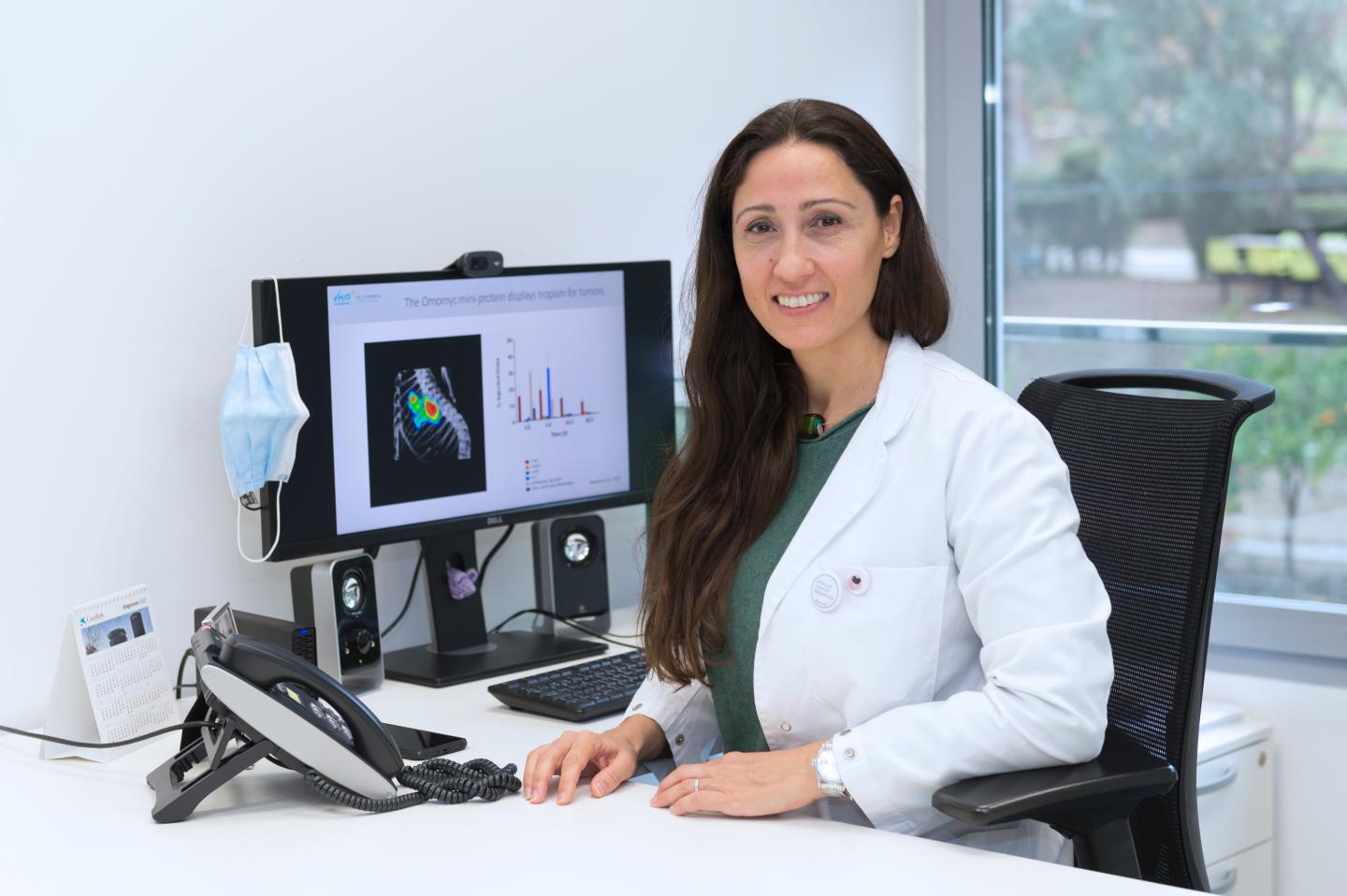
Credit: VHIO
Co-founded back in 2014 by VHIO’s Laura Soucek, CEO of the enterprise, and Marie-Eve Beaulieu, Chief Scientific Officer (CSO) of the company, VHIO-born spin-off Peptomyc S.L. has just announced that it has received approval from the Spanish Agency of Medicines and Medical Devices for conducting clinical trials in Spain (AEMPS), to initiate the first-in-human Phase I/II clinical trial with its first compound – a disruptive Myc inhibitor, Omomyc (OMO-103).
Building on the proven preclinical efficacy and safety of the Omomyc cell-penetrating peptide (CCP) in mouse models, and Peptomyc’s company’s successful development of anti-Myc peptides for the treatment of several tumor types, this latest milestone represents a greatly anticipated ‘leap’ into the clinical research setting and an important step forward in becoming the first ever clinically viable and direct inhibitor of Myc – a protein implicated in the formation of most tumor types.
Commenting for VHIO’s Global Communications, Laura Soucek, Principal Investigator of VHIO’s Mouse Models of Cancer Therapies and an ICREA Research Professor said, “MYC has been considered an ‘undruggable’ cancer target for many years. We have previously shown that Myc blockade has an excellent therapeutic effect in several mouse models, with mild side effects that are well tolerated and reversible. Now that we have received approval to initiate our early phase clinical trial, we can further progress in testing the safety and efficacy of our Omomyc-based therapy for the benefit of those who matter the most – our patients.”
Over the last 20 years Laura’s determined research efforts have centered on proving countless cynics wrong in her ambitions to combat resistance to therapy and combat cancer cell spread through clinically inhibiting the Myc oncogene. Found deregulated in most, if not all tumor types, and as a key driver of cancer progression and maintenance, Myc is consequently a major contender as a cancer target and yet, promise of its inhibition has not yet been successfully translated into benefits at the patient level.
While several factors including Myc’s nuclear localization, lack of identified ligand binding site, and its function in maintaining normal tissues, are responsible for both this frustrating scenario as well as the sustained belief that it is in fact an impossible cancer target, Laura and her team are now silencing the sceptics by finally pushing Myc inhibition into the clinic.
“At the preclinical level, we have reported the efficacy of Omomyc as a cell penetrating peptide – essentially, a mini-protein with the ability to enter cells and reach its target compartment, namely, the nucleus. The successful intravenous systemic administration of our mini-protein MYC inhibitor against lung cancer and other malignancies, has led to this week’s exciting development,” said Marie-Eve Beaulieu, Peptomyc’s Chief Scientific Officer.
She added, “Our strategy differs immensely from other previous approaches aimed at inhibiting Myc. Our Omomyc mini-protein is large enough to accurately fold and adapt to Myc’s disordered structure, which determines the specificity of inhibition. At the same time, it is small enough to penetrate tumor cells and nuclei in order to reach its target. By conducting our first-in-human early phase clinical trial, we hope to drive this novel therapy into the clinic for the more effective treatment of multiple tumor types”.
Twenty patients with advanced solid tumors across various cancer types, whose disease has progressed after previous treatments, will be enrolled in the Phase I study. This clinical trial will be carried out at three different Spanish sites: our Vall d’Hebron University Hospital (HUVH), also located within the Vall d’Hebron Barcelona Hospital Campus, the HM Sanchinarro University Hospital, and the Fundación Jiménez Díaz University Hospital (Madrid).
VHIO’s Elena Garralda, Director of our Research Unit for Molecular Therapy of Cancer (UITM) – “la Caixa” Foundation, and Head of Early Clinical Drug Development at our Institute, is the Principal Investigator of Peptomyc’s clinical study at Vall d’Hebron. She noted, “I am honored and privileged to participate in this study of a VHIO-developed molecule. Since Myc has traditionally been considered as an impossible drug target, this clinical trial represents a pivotal development. Confirmation of OMO-103’s safety and efficacy in patients would be extremely important for the future treatment of cancer”.
“To get to where we are today has been a long and challenging journey. While we have had to overcome many obstacles, we have successfully proven our hypothesis about Myc by achieving amazing results in animal models. We very much hope that Omomyc will meet the same expectations in clinical research so that we can ultimately provide new hope for cancer patients, particularly for those suffering from advanced disease,” concluded Laura Soucek.
The preclinical development of Omomyc was possible thanks to the support received from Worldwide Cancer Research (WCR/AICR), European Research Council (ERC) – one Consolidator and two Proof of Concept grants – Instituto de Salud Carlos III (Institute of Health Carlos III), Fondo de Investigación en Salud (FIS) grants, Fero Foundation, and the BBVA Foundation, among other funding entities.
###
Media Contact
Amanda Wren
[email protected]
Original Source
https:/



