For the first time, scientists have succeeded in the stabilisation and direct imaging of small clusters of noble gas atoms at room temperature. This achievement opens up exciting possibilities for fundamental research in condensed matter physics and applications in quantum information technology. The key to this breakthrough, achieved by scientists at the University of Vienna in collaboration with colleagues at the University of Helsinki, was the confinement of noble gas atoms between two layers of graphene. This method overcomes the difficulty that noble gases do not form stable structures under experimental conditions at ambient temperatures. Details of the method and the first ever electron microscopy images of noble gas structures (krypton and xenon) have now been published in Nature Materials.
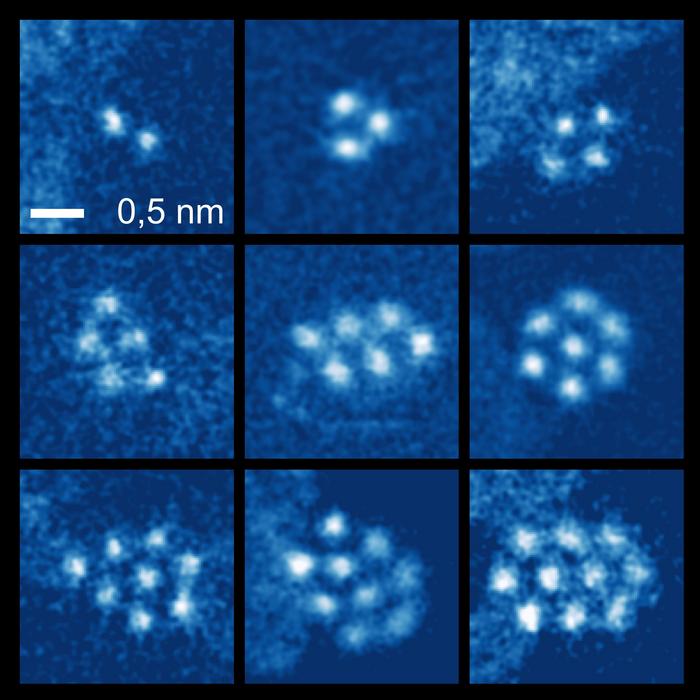
Credit: Manuel Längle
For the first time, scientists have succeeded in the stabilisation and direct imaging of small clusters of noble gas atoms at room temperature. This achievement opens up exciting possibilities for fundamental research in condensed matter physics and applications in quantum information technology. The key to this breakthrough, achieved by scientists at the University of Vienna in collaboration with colleagues at the University of Helsinki, was the confinement of noble gas atoms between two layers of graphene. This method overcomes the difficulty that noble gases do not form stable structures under experimental conditions at ambient temperatures. Details of the method and the first ever electron microscopy images of noble gas structures (krypton and xenon) have now been published in Nature Materials.
A Noble Trap
Jani Kotakoski’s group at the University of Vienna was investigating the use of ion irradiation to modify the properties of graphene and other two-dimensional materials when they noticed something unusual: when noble gases are used to irradiate, they can get trapped between two sheets of graphene. This happens when noble gas ions are fast enough to pass through the first but not the second graphene layer. Once trapped between the layers, the noble gases are free to move. This is because they do not form chemical bonds. However, in order to accommodate the noble gas atoms, the graphene bends to form tiny pockets. Here, two or more noble gas atoms can meet and form regular, densely packed, two-dimensional noble gas nanoclusters.
Fun with Microscope
“We used scanning transmission electron microscopy to observe these clusters, and they are really fascinating and a lot of fun to watch. They rotate, jump, grow and shrink as we image them”, says Manuel Längle, lead author of the study. “Getting the atoms between the layers was the hardest part of the work. Now that we have achieved this, we have a simple system for studying fundamental processes related to material growth and behavior “, he adds. Commenting on the group’s future work, Jani Kotakoski says: “The next steps are to study the properties of clusters with different noble gases and how they behave at low and high temperatures. Due to the use of noble gases in light sources and lasers, these new structures may in future enable applications for example in quantum information technology.”
Journal
Nature Materials
DOI
10.1038/s41563-023-01780-1
Article Title
Two-dimensional few-atom noble gas clusters in a graphene sandwich.
Article Publication Date
11-Jan-2024