Credit: Balint Nagy
Through their pattern of firing, neurons influence the behavior of the cells that upon maturation will provide insulation of neuronal axons, according to a new study publishing 22 August in the open access journal PLOS Biology by Balint Nagy, Maria Kukley and colleagues at the University of Tübingen, Germany. The findings suggest the existence of a complex and nuanced interplay between neurons and the non-neuronal cells that support and protect them.
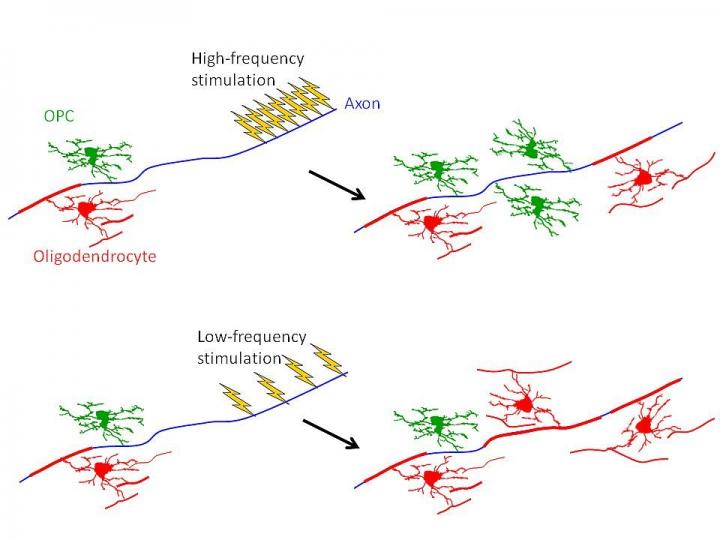
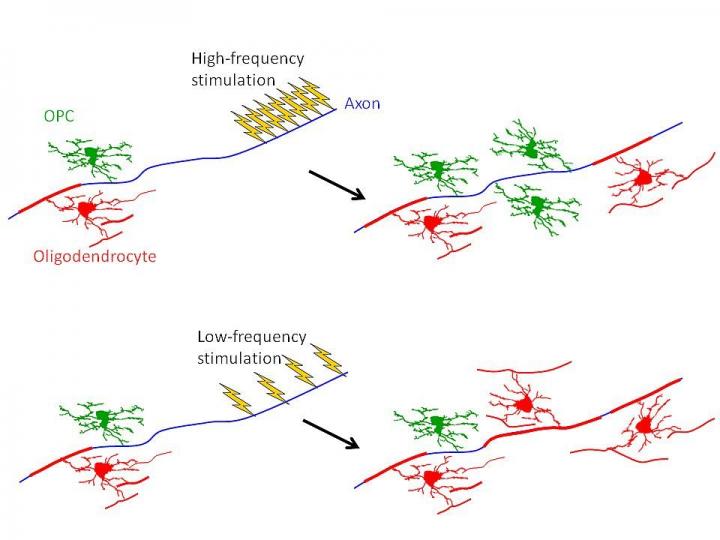
Oligodendrocyte precursor cells (OPCs) give rise to oligodendrocytes, which wrap the axons of neurons in the central nervous system with myelin to electrically insulate them. Neurons signal to OPCs through chemical synapses. Previous work has shown that electrical or optical stimulation of nerve fibers influences the proliferation of OPCs and their differentiation into oligodendrocytes, but whether that stimulation acts like an on-off switch, influencing OPCs only by its presence or absence, or more like a dimmer switch, inducing a graded response in the OPC, has been unclear.
To investigate that question, the authors studied oligodendroglial cells in the corpus callosum, a nerve tract which connects the two hemispheres of the brain, both in fresh brain slices and in living rodents. Using electrodes, they stimulated neurons to fire and recorded responses in the neighboring OPCs.
They found that stimulating neuronal fibers in brain slices at low frequencies led to a slowly oscillating movement of ions through the membrane of OPCs, while high-frequency stimulation caused a much more rapidly oscillating movement of ions. High-frequency stimulation of neuronal fibers in living animals led to greater OPC proliferation (creating more OPCs) over the course of a week than did low-frequency stimulation; low-frequency stimulation, in turn, led to more differentiation of OPCs into pre-myelinating oligodendrocytes, the cells that then go on to develop into oligodendrocytes which make myelin.
How OPCs translate different patterns of neuronal firing into differences in proliferation and differentiation is unknown, but differences in firing pattern have been seen to affect gene expression in neurons themselves in a graded rather than on-off way, suggesting that a similar mechanism may be at work in OPCs. Intriguingly, different neuronal firing patterns affect properties of chemical synapses between neurons and OPC, as well as intracellular concentrations of ions in OPCs such as sodium, potassium, and calcium, in a distinct fashion. Hence, it is possible that neurons use synapses with OPCs to influence OPCs behavior, including proliferation and maturation. It is not yet known whether the frequency-related differences in behavior of OPCs actually match the neuron's respective needs.
Myelination in the brain is plastic. It can be influenced by our everyday behavior and is responsive to environmental inputs, with physical activity increasing it and social isolation decreasing it. Understanding the mechanisms mediating the effects of activity on myelination may offer significant opportunities for therapeutic intervention in disorders in which myelination or remyelination are deficient. "This research may open new perspective to therapy of demyelinating disorders where remyelination strongly relies on the increased proliferation and differentiation of OPCs," commented Kukley.
###
In your coverage please use this URL to provide access to the freely available article in PLOS Biology: http://journals.plos.org/plosbiology/article?id=10.1371/journal.pbio.2001993
Citation: Nagy B, Hovhannisyan A, Barzan R, Chen T-J, Kukley M (2017) Different patterns of neuronal activity trigger distinct responses of oligodendrocyte precursor cells in the corpus callosum. PLoS Biol 15(8): e2001993. https://doi.org/10.1371/journal.pbio.2001993
Funding: Deutsche Forschungsgemeinschaft http://www.dfg.de (grant number EXC307). MK received funding for her research group and for this work from the Werner Reichardt Centre for Integrative Neuroscience (CIN) at the Eberhard Karls University of Tübingen. The CIN is an Excellence Cluster funded by the Deutsche Forschungsgemeinschaft (DFG) within the framework of the Excellence Initiative (EXC 307). The funder had no role in study design, data collection and analysis, decision to publish, or preparation of the manuscript. Deutsche Forschungsgemeinschaft http://www.dfg.de (grant number KU2569/1-1). Received by MK. The funder had no role in study design, data collection and analysis, decision to publish, or preparation of the manuscript.
Competing Interests: The authors have declared that no competing interests exist.
Media Contact
Maria Kukley
[email protected]
Related Journal Article
http://dx.doi.org/10.1371/journal.pbio.2001993