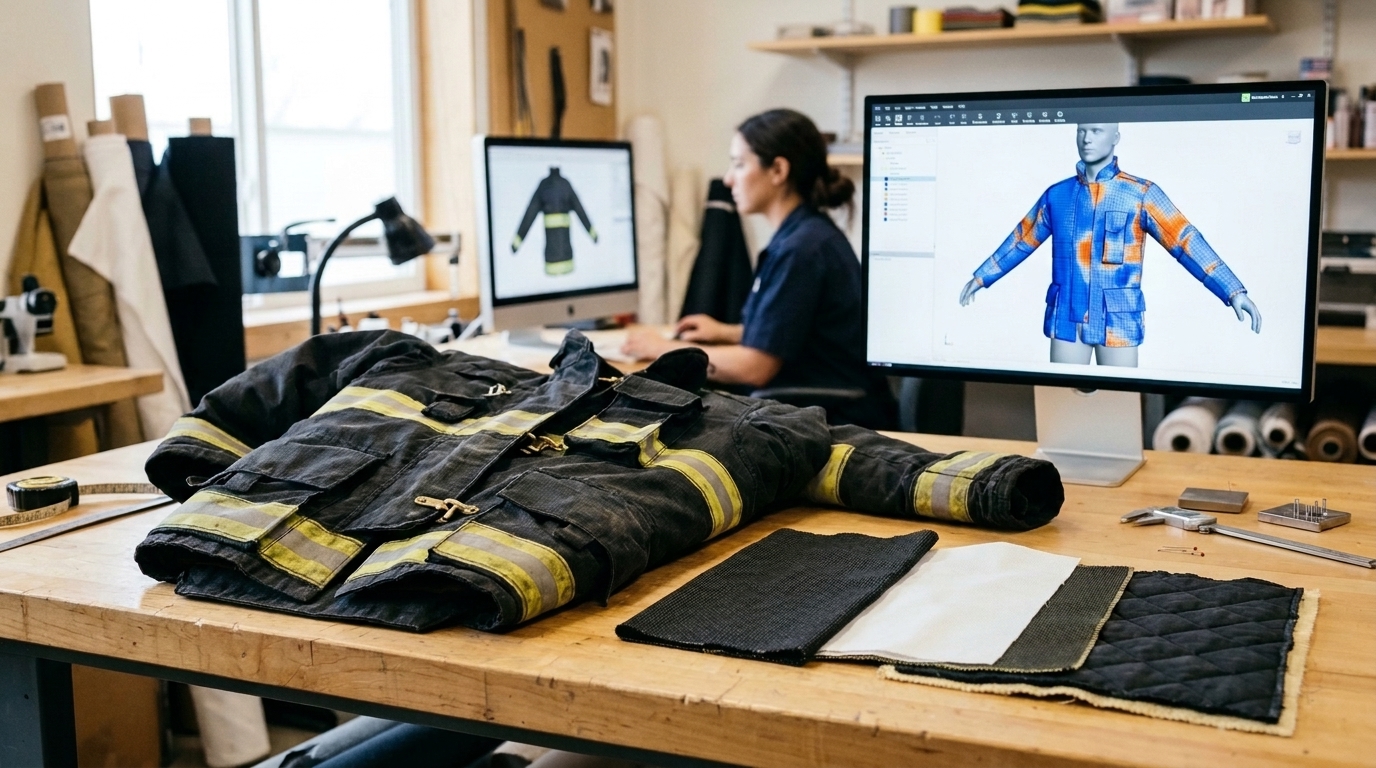
Firefighting gear manufacturers see real promise in 3D apparel visualization software for pattern optimization, air gap visualization, and communication with municipal customers, but they remain cautious about adopting it because current tools struggle to simulate the multilayer composites, substantial ease, and protective air gaps that define structural turnout gear. That is the central finding of a qualitative study published in Fashion and Textiles, in which researchers interviewed twelve experts from six U.S. firefighting gear manufacturers about how they perceive the technology and what shapes their intentions to adopt it.
The study, guided by the Technology-Organization-Environment (TOE) framework, was conducted by Uikyung Jung, Anne Porterfield, and Cassandra Kwon and published on 12 May 2026. Semi-structured interviews were held in March and April 2023 with pattern makers, designers, technical designers, and a business manager representing companies that produce wildland and structural turnout gear. The companies ranged from very small firms with fewer than 25 employees to a multinational with more than 10,000, and two had already implemented 3D apparel visualization software while four had not. The researchers used directed content analysis, coding transcripts against the three TOE domains and refining subcategories into seven overarching themes.
On the technological side, participants identified three relative advantages. First, the software was seen as an assistive tool for pattern optimization and sample development, useful for adjusting grading rules, fitting patterns on multi-size avatars, aligning pattern segments, interpreting draglines, and refining multilayered composites. Several participants highlighted the potential of dynamic avatars to assess firefighters’ range of motion and evaluate compliance with National Fire Protection Association (NFPA) fit requirements. Some noted that virtual fitting could reduce the time and cost of producing physical samples, particularly for high-value structural gear; one participant explained that structural garments cost between $3,000 and $4,000, so considerable effort goes into ensuring everything is correct before fabric is cut. Another participant, who had modeled three layers by individually constructing and stacking pattern components during turnout coat development, said the software enabled more precise evaluation of armscye, sleeve, and segment endpoint positioning, though the layering made realistic simulation of how the layers hang on the body difficult.
Second, participants valued the software’s ability to visualize air gap distribution between the wearer and the structural ensemble, particularly through cross-sectional views and transparent material settings. Air gaps are safety-relevant because they influence heat transfer, mobility, and comfort, and prior research has quantified air gap size and distribution using 3D body scanning and linked those characteristics to thermal performance. One participant noted that determining an optimal air gap balancing thermal protection and mobility remains an ongoing topic of discussion within the NFPA committee, and another stated that 3D virtual simulation images could clarify misunderstandings by visualizing garment-to-body space and showing how to balance mobility with functional air gaps. Third, some participants proposed using software-generated images to support sales discussions with municipalities, fire departments, and county agencies, allowing sales teams to present visual representations of gear without incurring fabric and labor costs before a department finalizes its purchase decision and specifications.
Despite these advantages, participants reported that adoption is hindered by a lack of technology maturity. A central concern among companies producing structural turnout gear was the limited capacity of current software to accurately simulate three-layer composite systems, seam construction, and the substantial ease and air gaps required for thermal protection. Structural turnout gear is composed of an outer shell, moisture barrier, and thermal liner, each contributing to overall performance, and the thickness of these layered materials influences seam construction, allowances, and sewing techniques. Participants noted that a wearer’s chest circumference might be 44 inches while the coat should measure 52 inches to maintain an adequate air buffer, and they questioned the relevance of garment-fit maps such as stress and strain indicators, which are more suited to body-conforming apparel than to protective garments designed with intentional and substantial ease. Participants also pointed to the need for improved functionality to simulate the multiple garment layers worn in conjunction with turnout gear, such as fire hoods, suspenders, aluminized gear, and self-contained breathing apparatus.
Beyond current limitations, participants articulated a strong perceived future potential. They emphasized the need for the technology to transition from a primarily visual design tool to a performance-oriented evaluation platform, highlighting the potential of integrating predictive capabilities for thermal performance metrics such as breathability and total heat loss. One participant noted that the company allocates substantial resources to third-party testing for NFPA certification and said it would be highly advantageous if the software could model how pattern modifications influence thermal and water penetration performance within a 3D simulation environment. Another indicated that predictive modeling could enhance design decision-making by anticipating water penetration patterns during shower tests, supporting ventilation design and more sophisticated pattern engineering. Participants also anticipated that future advancements could facilitate mass customization by enabling client-facing interfaces through which fire departments can directly specify gear configurations, reducing miscommunication and enhancing customer interaction; two companies were already providing customized firefighting gear and expressed interest in a 3D platform allowing customers to customize elements of their gear and submit designs for quotation.
Organizational conditions emerged as a pivotal factor. Participants unanimously identified cost as the predominant barrier, with smaller firms struggling to justify the high price of software licenses and peripheral hardware such as fabric testing devices and texture scanners against the perceived return on investment. One participant noted that the current system functions effectively, making it challenging to justify an annual software license fee previously quoted at $13,000. For small- or medium-scale manufacturers operating within budget constraints, funds were prioritized for essential manufacturing production operations rather than experimental 3D apparel visualization software. Larger firms, by contrast, were more willing to bear the cost if it could be proven that the software improves product quality, though one participant expected it would be challenging to communicate and prove the software’s effectiveness to company decision-makers. Beyond financial costs, participants reported that the human capital investment required for implementation presented a significant hurdle, with both current users and non-users highlighting the steep learning curve and substantial time required to upskill employees and divert limited staff hours away from immediate production tasks.
Environmental conditions also shaped adoption intentions. Unlike the fashion industry, where rapid style turnover drives quick digital sampling, firefighting gear designs remain static for decades; participants noted that once a well-fitted shirt and pants are achieved there is little need for alteration, that repeat customers typically return every five or ten years requesting identical products, and that some patterns have been in use for 30 years. This infrequent need to adjust patterns limits the utility of virtual fitting for pattern modifications or exploring fabric drapability and fit. Participants also perceived the firefighting gear industry as placing limited emphasis on design innovation and research, with decision-makers tending to be conservative and less open to new technologies partly due to the sector’s strong safety orientation. Some expressed concern that contract manufacturers bound to them under NFPA 1977 standards have not used this type of technology, and that training would be necessary along with a willingness to embrace the change. None of the participants viewed virtual simulation images as effective for marketing on websites, social media, or product catalogs, noting that the industry culture heavily favors real-world testimonials and physical handling of gear over digital simulations unless the technology can be proven to accurately reflect physical performance.
The authors conclude that adoption decisions emerge from the interaction of technological complexity, organizational capacity, and environmental demands rather than from the technology’s attributes alone. Even when 3D apparel visualization software is viewed as beneficial for design efficiency, manufacturers remain cautious if the tools do not clearly support, or are not formally recognized within, established performance evaluation and certification processes. The findings suggest that in regulated, high-risk manufacturing contexts, constructs such as relative advantage and compatibility are shaped by legitimacy and validation expectations that extend beyond the firm to the broader industry community and supply chain. The authors note that the study is based on qualitative interviews with a small sample of U.S. firefighting gear manufacturers and should be interpreted as exploratory and context-specific rather than representative of the broader industry, with the concentration of participant roles primarily among designers and technical specialists limiting insight into production, marketing, and executive perspectives. They recommend that software developers collaborate more closely with protective clothing manufacturers and textile laboratories to improve physics-based modeling of multilayer composites and strengthen validation by linking simulations to established metrics such as Thermal Protective Performance and Total Heat Loss, and that regulatory bodies consider how virtual prototyping tools may complement, rather than replace, existing certification processes, for example as a screening tool prior to physical testing.
Subject of Research: Firefighting gear manufacturers' perceptions of 3D apparel visualization software adoption
Article Title: Three-dimensional virtual prototyping for designing firefighting gear: an exploration of manufacturer perceptions
Article References: Jung, U., Porterfield, A., & Kwon, C. (2026). Three-dimensional virtual prototyping for designing firefighting gear: an exploration of manufacturer perceptions. Fashion and Textiles, 13(1), Article 22. https://doi.org/10.1186/s40691-026-00469-8
Image Credits: AI Generated
DOI: 10.1186/s40691-026-00469-8
Keywords: 3D apparel visualization, virtual prototyping, firefighting gear, structural turnout gear, wildland fire gear, TOE framework, NFPA standards, air gap, technology adoption, functional apparel, personal protective equipment, qualitative interviews
News Source: Denise Maddox. (November 6, 2026). Firefighting gear makers see promise and limits in 3D virtual prototyping. Scienmag.