• HOME
  • NEWS
  • EXPLORE
    • CAREER
      • Companies
      • Jobs
    • EVENTS
    • iGEM
      • News
      • Team
    • PHOTOS
    • VIDEO
    • WIKI
  • BLOG
  • COMMUNITY
    • FACEBOOK
    • INSTAGRAM
    • TWITTER
Tuesday, May 12, 2026
BIOENGINEER.ORG
No Result
View All Result
  • Login
  • HOME
  • NEWS
  • EXPLORE
    • CAREER
      • Companies
      • Jobs
        • Lecturer
        • PhD Studentship
        • Postdoc
        • Research Assistant
    • EVENTS
    • iGEM
      • News
      • Team
    • PHOTOS
    • VIDEO
    • WIKI
  • BLOG
  • COMMUNITY
    • FACEBOOK
    • INSTAGRAM
    • TWITTER
  • HOME
  • NEWS
  • EXPLORE
    • CAREER
      • Companies
      • Jobs
        • Lecturer
        • PhD Studentship
        • Postdoc
        • Research Assistant
    • EVENTS
    • iGEM
      • News
      • Team
    • PHOTOS
    • VIDEO
    • WIKI
  • BLOG
  • COMMUNITY
    • FACEBOOK
    • INSTAGRAM
    • TWITTER
No Result
View All Result
Bioengineer.org
No Result
View All Result
Home NEWS Science News Chemistry

Finding quvigints in a quantum treasure map

Bioengineer by Bioengineer
March 10, 2021
in Chemistry
Reading Time: 2 mins read
0
IMAGE
Share on FacebookShare on TwitterShare on LinkedinShare on RedditShare on Telegram

IMAGE

Credit: Markus Rambach

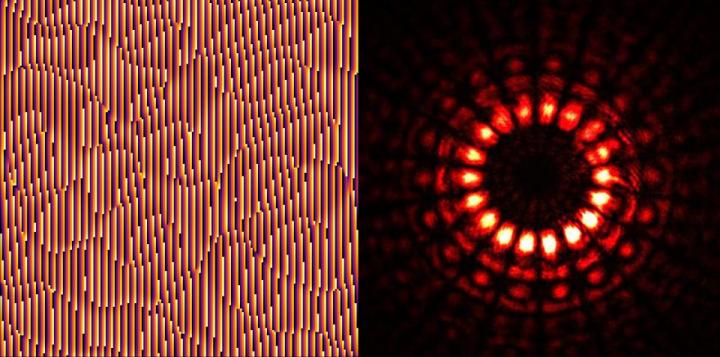
Researchers have struck quantum gold–and created a new word–by enlisting machine learning to efficiently navigate a 20-dimensional quantum treasure map.

Physicist Dr Markus Rambach from the ARC Centre of Excellence for Engineered Quantum Systems (EQUS) at The University of Queensland said the team was able to find unknown quantum states more quickly and accurately, using a technique called self-guided tomography.

The team also introduced the ‘quvigint’, which is like a qubit (the quantum version of a classical bit that takes on the values ‘0’ or ‘1’) except that it takes on not two, but 20 possible values.

Dr Rambach said high-dimensional quantum states such as quvigints were ideal for storing and sending large amounts of information securely.

However, finding unknown states becomes increasingly difficult in higher dimensions, because the same scaling that gives quantum devices their power also limits our ability to describe them.

He said this problem was akin to navigating a high-dimensional quantum treasure map.

“We know where we are, and that there’s treasure, but we don’t know which way to go to get to it,” Dr Rambach said.

“Using standard tomography, this problem would be solved by first determining which directions you need to look in to ensure you cover the whole map, then collecting and storing all the relevant data, and finally processing the data to find the treasure.

“Instead, using self-guided tomography, we pick two directions at random, try them both, pick the one that gets us closer to the treasure based on clues from the machine learning algorithm, and then repeat this until we reach it.

“This technique saves a huge amount of time and energy, meaning we can find the treasure–the unknown quvigint–much more quickly and easily.”

To illustrate the technique, the team simulated a quvigint travelling through the atmosphere, as it would when being used to send quantum information between two points on Earth or to a satellite.

As the quvigint travels, it is modified by atmospheric turbulence.

Standard tomography is very susceptible to this type of noise, but by using self-guided tomography the team was able to reconstruct the original quvigint with high accuracy.

Dr Jacq Romero, also at EQUS and UQ, said self-guided tomography was unlike other methods for finding unknown quantum states.

“Self-guided tomography is efficient, accurate, robust to noise and readily scalable to high dimensions, such as quvigints,” Dr Romero said.

“Self-guided tomography is a robust tomography method that is agnostic to the physical system, so it can be applied to other systems such as atoms or ions as well.”

###

Media Contact
Dr. Markus Rambach
[email protected]

Tags: Atomic PhysicsChemistry/Physics/Materials SciencesParticle Physics
Share13Tweet8Share2ShareShareShare2

Related Posts

Humans and Zebra Finches Share Similar Speech Learning Techniques #ASA190 — Chemistry

Humans and Zebra Finches Share Similar Speech Learning Techniques #ASA190

May 11, 2026
Unveiling Dark Matter Through Molecular Insights — Chemistry

Unveiling Dark Matter Through Molecular Insights

May 11, 2026

From Touch to Sight: A Bioinspired Multisensory Framework Endows Robots with Human-Like Perception

May 11, 2026

Announcing the 2026 Carbon Future Young Investigator Award Winners

May 11, 2026
Please login to join discussion

POPULAR NEWS

  • Research Indicates Potential Connection Between Prenatal Medication Exposure and Elevated Autism Risk

    841 shares
    Share 336 Tweet 210
  • New Study Reveals Plants Can Detect the Sound of Rain

    728 shares
    Share 290 Tweet 182
  • Salmonella Haem Blocks Macrophages, Boosts Infection

    62 shares
    Share 25 Tweet 16
  • Breastmilk Balances E. coli and Beneficial Bacteria in Infant Gut Microbiomes

    57 shares
    Share 23 Tweet 14

About

We bring you the latest biotechnology news from best research centers and universities around the world. Check our website.

Follow us

Recent News

Humans and Zebra Finches Share Similar Speech Learning Techniques #ASA190

New Study Uncovers How Fungal Parasites Attack Strawberries and Raspberries

City of Hope Researchers to Present Groundbreaking Immunotherapy and Precision Medicine Advances Across Multiple Cancer Types at ASCO 2026

Subscribe to Blog via Email

Enter your email address to subscribe to this blog and receive notifications of new posts by email.

Join 82 other subscribers
  • Contact Us

Bioengineer.org © Copyright 2023 All Rights Reserved.

Welcome Back!

Login to your account below

Forgotten Password?

Retrieve your password

Please enter your username or email address to reset your password.

Log In
No Result
View All Result
  • Homepages
    • Home Page 1
    • Home Page 2
  • News
  • National
  • Business
  • Health
  • Lifestyle
  • Science

Bioengineer.org © Copyright 2023 All Rights Reserved.