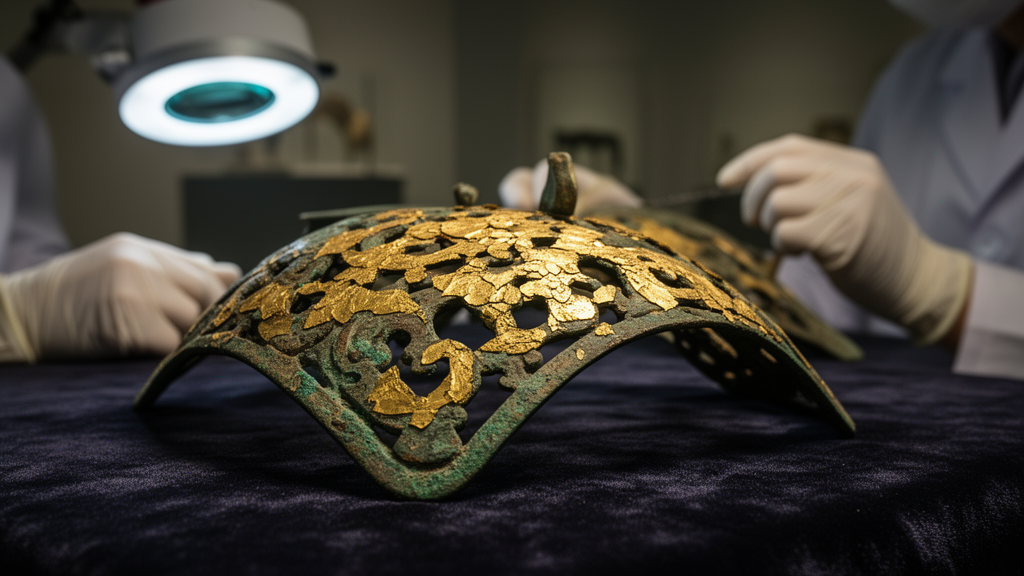
A single polished cross section through a fifth-century Silla horse-harness fitting has yielded rare microstructural evidence about how goldsmiths in the ancient Korean kingdom applied and finished their gilded decorations. The artifact, excavated from the grave-goods compartment of Hwangnam-dong Tomb No. 120-2 in Gyeongju, consists of two joined components: a gilded copper decorative plate and an iron rivet wrapped in gilded silver sheet. Researchers examined this one specimen with stereomicroscopy, reflected-light metallurgical microscopy, scanning electron microscopy, and energy-dispersive X-ray spectroscopy, and the resulting images and chemical data now document gilding on both faces of the silver covering, granular residues at its bent ends, and measurable thickness differences between the gilding on copper and silver substrates.
The tomb itself sits in the center of the former Silla royal capital. Tomb No. 120 was known by a number assigned during the Japanese colonial period, and excavations began in May 2018. Two tombs, Nos. 120-1 and 120-2, constructed by cutting into part of the mound of Tomb No. 120, were identified in 2019. In Tomb No. 120-2, ornaments including a crown, earrings, glass beads, and a silver belt were arranged in the burial chamber, while horse-harness fittings such as gilt-bronze saddle bows and strap-junction fittings called unju were recovered from a separate grave-goods compartment. The fitting examined in the new study is one of those strap-junction pieces, which both decorated and secured harness-strap junctions. Personal ornaments worn by the deceased were considered to have been produced in the fifth century, anchoring the artifact’s chronology.
The analytical specimen contained the joined decorative copper plate and the iron rivet with its silver covering, prepared as a single polished cross section. The sample was mounted in epoxy resin and ground sequentially with abrasives from P200 through P4000, then final-polished with 6-micrometer and 1-micrometer diamond suspensions. At each stage, three five-minute ultrasonic cleaning cycles in distilled water removed powdered contamination and polishing residues. After optical examination, the polished section was carbon-coated for scanning electron microscopy, and backscattered electron images were acquired at an accelerating voltage of 20 kilovolts. Metallurgical micrographs and backscattered images were compared to identify component arrangements, bending of the silver sheet, coating continuity and internal boundaries, granular microstructures, cracks, and pores.
Chemical compositions were determined by energy-dispersive X-ray spectroscopy with a detector attached to the electron microscope. Point analyses were acquired at 20 kilovolts with a working distance of 10 millimeters and an acquisition time of 120 seconds, and selected gilded regions were analyzed at 8000-fold magnification to help place the beam precisely within the gilding. Quantification was performed in fundamental-parameters mode and checked against reference alloys of nominal compositions 80 weight percent gold with 20 weight percent silver, and 70 weight percent gold with 30 weight percent silver. Elemental maps were acquired for the silver, gold, mercury, and iron characteristic X-ray lines. The authors note an important limitation: magnification aided site selection but did not exclude X-ray contributions from adjacent materials at 20 kilovolts, so measured compositions are reported without subtracting copper or silver contributions from neighboring substrates.
The overall cross section showed the gilded copper plate attached to the iron rivet, whose curved head was covered with silver sheet along its outer contour. Both ends of the sheet bent inward at the edges of the rivet, and although locally discontinuous, the sheet retained an outline that largely enclosed the rivet head. Corrosion products, cracks, and voids within and around the iron region were interpreted as deterioration during burial. On the copper plate, the substrate contained a mean copper concentration of 99.84 plus or minus 0.24 weight percent and a mean lead concentration of 0.14 plus or minus 0.25 weight percent. Gilding extended along the upper surface of the observed cross section, with a corroded region above it, and no gilding layer was observed on the opposite surface.
The gilding morphology varied along the same plate. One region exhibited a relatively uniform bright band along the substrate surface, while a locally thick layer showed a dark internal boundary between an inner portion adjoining the copper substrate and an outer portion toward the surface. The authors emphasize that these inner and outer terms identify spatial portions of one thick layer and do not indicate separately applied coatings. Elsewhere, parts of the gilding protruded or curved toward the substrate, with granular microstructures that did not form a thin continuous band. Point analyses detected gold and mercury in all of these regions, together with copper whose contribution from the adjacent substrate could not be separated. The detection of mercury together with gold in both uniform and non-uniform gilded regions supports the use of mercury-amalgam gilding, though the dark boundary and granular structures document only local variations in the preserved coating and do not establish two successive gilding applications.
The silver sheet told a complementary story. Its interior contained a mean silver concentration of 96.93 plus or minus 0.38 weight percent, along with 2.72 plus or minus 0.41 weight percent gold, 0.25 plus or minus 0.09 weight percent copper, and 0.10 plus or minus 0.18 weight percent mercury, confirming it was predominantly silver. Gold-colored microstructures ran along the upper and lower boundaries of the sheet in reflected-light micrographs, appearing brighter than the sheet interior in backscattered images as both continuous segments and discrete granules. Elemental maps showed silver distributed throughout the sheet while gold and mercury appeared in microstructures along its boundaries, and the iron signal occurred mainly below the sheet, matching the arrangement of the covering and the underlying rivet.
Most striking were the sheet’s bent ends. Both ends of the silver sheet wrapped inward around the rivet head, carrying gold-colored remnants on the surfaces of the bends and around the ends. These remnants sometimes followed the sheet contour, while aggregates of granules sat beyond the ends. At higher magnification, dark voids were visible between rounded particles and irregularly interconnected particles. The researchers propose that these porous granular remnants may represent gold-mercury amalgam residues associated with incomplete burnishing or finishing, since recessed regions of the rounded rivet head would have been less accessible to finishing tools and the small residual particles may have been difficult to recognize by unaided inspection. They stress this is a possible explanation for the location and morphology, not proof of an omission by the maker, and later alteration or preparation effects remain possible.
Gilding thickness measurements added a quantitative dimension. Measured in image-analysis software on calibrated backscattered electron images, with ten local measurements per image taken perpendicular to the interface and excluding pores, cracks, and ambiguous boundaries, the gilding on two regions of the copper plate averaged 1.33 plus or minus 0.53 micrometers and 1.01 plus or minus 0.23 micrometers. The bright gilded regions on the upper and lower faces of the silver sheet measured 3.69 plus or minus 1.04 micrometers and 3.52 plus or minus 0.63 micrometers. The silver-sheet regions were approximately 2.65 to 3.65 times as thick as those on the copper plate, though the authors caution this ratio reflects differences between the selected observation sites rather than a systematic survey. For context, previous studies reported mean gilding thicknesses of 2.2 to 25.2 micrometers for copper-based artifacts from a Han tomb in Qufu and roughly 4 to 6 micrometers for coronet ornaments with pure copper substrates excavated in Xi’an. The copper-plate means fell below both reported ranges, while the silver-sheet means fell below the Xi’an range but within the wider Qufu range.
The gilding distribution carries the clearest technological implication. Because the silver sheet retained gilding on both faces, including the face directed toward the iron rivet, and gilding-related remnants extended around the inward-bent ends, the evidence supports a manufacturing sequence in which the sheet was gilded before being wrapped around the rivet. In this interpretation, a previously gilded silver sheet served as the decorative covering of an iron structural component that joined the copper plate, linking surface treatment with assembly in a single composite Silla fitting. Earlier studies have also shown that residual mercury distributes differently between silver and copper substrates, underscoring the value of examining coating and substrate together. The authors note that elemental migration between gilding and substrate during heating has been discussed in prior work, and such processes may have contributed to the copper detected in the gilded regions, but their data cannot independently distinguish actual diffusion from substrate contributions within the X-ray generation volume. Together, the terminal granular remnants and the substrate-associated differences in local gilding thickness offer microstructural evidence for reconstructing the gilding sequence and finishing practices of fifth-century Silla metalworkers.
Subject of Research: Microstructural and chemical analysis of gilding on a fifth-century Silla horse-harness fitting from Gyeongju, Korea
Article Title: Microstructural characteristics of fifth-century Silla gilded artifacts from Hwangnam-dong Tomb No. 120-2 in Gyeongju, Korea
Article References: Kim, S., Kim, E., & Kim, G. (2026). Microstructural characteristics of fifth-century Silla gilded artifacts from Hwangnam-dong Tomb No. 120-2 in Gyeongju, Korea. Applied Microscopy, 56(1), Article 26. https://doi.org/10.1186/s42649-026-00146-6
Image Credits: AI Generated
DOI: 10.1186/s42649-026-00146-6
Keywords: Silla, gilding, mercury amalgam, Hwangnam-dong Tomb No. 120-2, Gyeongju, horse harness, archaeometry, scanning electron microscopy, energy-dispersive X-ray spectroscopy, silver sheet, copper plate, ancient metalworking
News Source: William Thompson. (October 27, 2026). Fifth-century Silla gilding secrets revealed in ancient Korean horse-harness fitting. Scienmag.