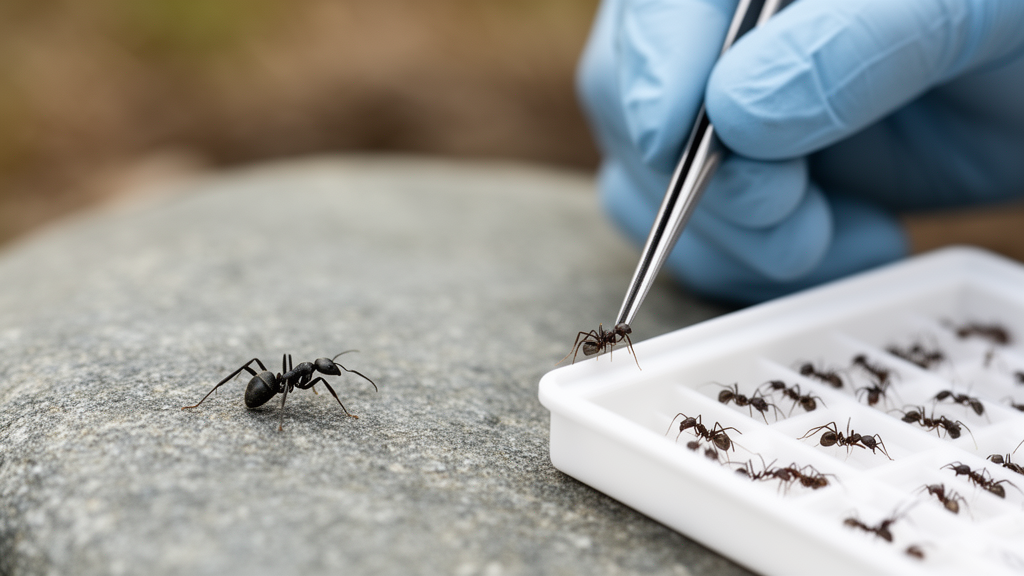
A literature review, 2016 field survey and mitochondrial DNA-barcode analysis indicate that 12 ant species have reliable records in Kamchatka, although much of the peninsula remains poorly explored. The study assessed published species records, collected ants at eight localities, examined their distribution across habitats and elevations, and sequenced 57 specimens representing the nine species found during fieldwork.
At least 25 ant taxa had been reported from Kamchatka in publications extending back more than a century, but the historical lists disagreed about which species were present. The researchers reviewed 14 literature sources containing substantial information about ants in the region and divided records into two reliability categories. Twelve species were classified as reliable because they were supported by at least two independent sources, including sources published within the previous two decades. These species belonged to four genera: Camponotus, Formica, Leptothorax and Myrmica.
The other 13 reported species and the genus Lasius were classified as questionable. Their records came from either single or dated sources and were contradicted by more recent work. The study noted that disagreements in older lists could reflect incorrect collection information, taxonomic revisions or misidentifications, but the evidence did not establish which explanation applied to each disputed record.
Manual fieldwork in 2016 at eight localities found nine ant species from sea level to approximately 1,000 metres above sea level. The ants occurred in lowland meadows, stone birch forests, larch and birch forests and the dwarf-pine zone. No ants were observed in alpine tundra or plantless habitat above 1,200 metres. Larch and birch forests at intermediate elevations contained the largest number of species, whereas low-elevation stone birch forests contained only three observed species. Among the nine field-collected taxa, three had Holarctic, three trans-Palearctic and three East Palearctic distributions.
For the genetic component, the researchers generated mitochondrial COI barcodes for 47 specimens and combined them with 10 previously published sequences, producing a dataset of 57 sequenced specimens. High-quality barcodes distinguished all nine species with a clear barcode gap. Interspecific raw genetic distances ranged from 2.3% between Formica candida and F. gagatoides to 22.5% between Camponotus herculeanus and Leptothorax acervorum.
Genetic variation within most species was low. Six of the nine species had only one COI haplotype, while Formica lemani and Myrmica displicentia had two each. L. acervorum was the exception: its seven sequenced specimens each had a different haplotype, two haplogroups were detected, and within-species raw distances ranged from 0.15% to 2.13%. One specimen belonged to a haplogroup previously known only from North America. The authors presented a long-term refuge in Kamchatka and long-distance dispersal of the species’ small sexual castes as possible explanations, not established causes.
Comparisons with the Barcoding of Life Data System showed that every Kamchatka haplotype except one had not been recorded elsewhere in the database at the time of the analysis. The exception was the sole haplotype found in Formica lugubris, which also occurred in Finland. Closely related sequences were found for the three Holarctic species in North America, or in both Europe and North America, indicating a closer genetic association across Beringia than between western and eastern Palearctic populations for those taxa. By contrast, the East Asian Myrmica species M. displicentia and M. kamtschatica had their closest available matches in unidentified Myrmica specimens from the Russian Far East.
A separate morphometric analysis examined 110 Formica specimens to determine whether Kamchatka workers that resembled F. fusca or F. lemani represented one or both species. The analysis included 34 Kamchatka workers, 33 European F. lemani and 43 European F. fusca. A published discriminant placed the Kamchatka workers between the European reference groups: 68% produced negative values, as European F. fusca, and 32% produced positive values, as European F. lemani. These values were results of the composite discriminant and did not directly measure the presence or absence of pronotal setae.
The study classified the Kamchatka ants as F. lemani, with the qualification that a future treatment of the taxa as one species would give priority to the older name F. fusca. Specimens assigned to both morphologies occurred in the same nests, and no nest contained only workers with the F. lemani pattern. All but one sequenced colony shared the same COI haplotype, while the remaining sequence differed by one nucleotide, or 0.15%. All three available Kamchatka gynes had discriminant values and a shiny first tergite consistent with F. lemani; in F. fusca, that tergite is covered by dense pubescence and appears matt. Two of the gynes shared nests with workers assigned the F. fusca pattern. Previous work using nuclear microsatellites, mitochondrial COI and Cyt-b had also not separated the two taxa, leaving their taxonomic relationship unresolved.
The authors cautioned that the checklist of 12 reliable species is conservative because Kamchatka is large and most of it remains poorly explored. The study was also geographically and temporally limited: field sampling covered eight localities in one year, while the DNA analysis represented nine species and 57 specimens. Its clearest conclusions are therefore the separation of reliable from questionable records, documentation of nine species across the sampled habitats, the distinct barcodes among those nine taxa and the limited genetic diversity observed within most of them.
Subject of Research: Taxonomic, ecological and mitochondrial genetic assessment of ants in Kamchatka
Article Title: Ants of Kamchatka: checklist, DNA-barcoding and key ( Hymenoptera , Formicidae )
Article References: Schär, S. (2024). Ants of Kamchatka: checklist, DNA-barcoding and key (Hymenoptera, Formicidae). Alpine Entomology, 8, 19-28. https://doi.org/10.3897/alpento.8.114185
Image Credits: AI Generated
Keywords: Kamchatka ants, species checklist, DNA barcoding, COI haplotypes, Formica taxonomy, Leptothorax acervorum, Myrmica, ant biogeography, field survey, Ants, Kamchatka, checklist
News Source: Drew Townsend. (October 20, 2026). Field survey and DNA barcoding narrow Kamchatka ant fauna to 12 reliable species. Scienmag.