• HOME
  • NEWS
  • EXPLORE
    • CAREER
      • Companies
      • Jobs
    • EVENTS
    • iGEM
      • News
      • Team
    • PHOTOS
    • VIDEO
    • WIKI
  • BLOG
  • COMMUNITY
    • FACEBOOK
    • INSTAGRAM
    • TWITTER
Monday, August 31, 2026
BIOENGINEER.ORG
No Result
View All Result
  • Login
  • HOME
  • NEWS
  • EXPLORE
    • CAREER
      • Companies
      • Jobs
        • Lecturer
        • PhD Studentship
        • Postdoc
        • Research Assistant
    • EVENTS
    • iGEM
      • News
      • Team
    • PHOTOS
    • VIDEO
    • WIKI
  • BLOG
  • COMMUNITY
    • FACEBOOK
    • INSTAGRAM
    • TWITTER
  • HOME
  • NEWS
  • EXPLORE
    • CAREER
      • Companies
      • Jobs
        • Lecturer
        • PhD Studentship
        • Postdoc
        • Research Assistant
    • EVENTS
    • iGEM
      • News
      • Team
    • PHOTOS
    • VIDEO
    • WIKI
  • BLOG
  • COMMUNITY
    • FACEBOOK
    • INSTAGRAM
    • TWITTER
No Result
View All Result
Bioengineer.org
No Result
View All Result
Home NEWS Science News Chemistry

Fibre-integrated, high-repetition-rate water window soft X-ray source

Bioengineer by Bioengineer
February 23, 2021
in Chemistry
Reading Time: 2 mins read
0
IMAGE
Share on FacebookShare on TwitterShare on LinkedinShare on RedditShare on Telegram

IMAGE

Credit: by Gebhardt, M., Heuermann, T., Klas, R. et al.

Bright, coherent soft X-ray radiation (SXR) is used in many scientific applications such as advanced absorption spectroscopy or lens-less imaging, and in fundamental research e.g. to produce extremely short isolated optical pulses. Therefore, the generation, control, and detection of this type of short-wavelength light is highly important in fields like fundamental atomic physics, solid-state physics, the semiconductor industry, material science and biology.
To date, high photon flux in the soft X-ray spectral region is mostly delivered by large-scale facilities like synchrotrons or free electron lasers. An alternative is to use high-order harmonic generation (HHG) sources, which are currently driven by pulsed laser systems with very high peak powers. It is highly desired to increase the repetition rate of such sources beyond 1000 shots per second (e.g. to allow for a faster data acquisition/increase the signal-to-noise ratio) and to make them simpler, more compact and easier to operate.

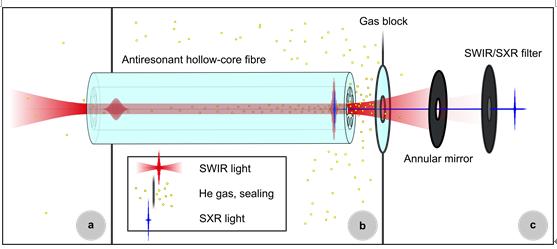
In a new paper published in Light Science & Application, a team of scientists, led by Professor Jens Limpert from the Friedrich-Schiller-University Jena, and co-workers have developed a laser-driven soft X-ray source, which is based on high-order harmonic generation inside of an antiresonant gas-filled hollow core fibre (ARHCF). They designed the source such that the intensity of the driving laser pulses is enhanced by temporal self-compression inside of the hollow fibre before the soft X-rays are generated. The integration of laser enhancement and high-order harmonic generation in a single gas-filled hollow core fibre allows “compact, high repetition rate laser technology, including commercially available systems, to drive simple and cost-effective, coherent high-flux SXR sources”, the scientists state in their paper. In their work, they have optimized the input laser parameters and the gas particle density inside of the fibre such that a macroscopic HHG signal builds up towards the fibre end. This soft X-ray light emerges directly from the output of a potentially flexible hollow-core fibre. The reported method opens new avenues for simple and powerful laser-driven soft X-ray sources based on fibre technology. This allows moderate peak power laser systems with high repetition rates to drive HHG directly.

The authors state, “This enables the first 100 kHz-class repetition rate, table-top SXR source, that delivers an application-relevant flux of 2.8×10⁶ Photons/s/eV around 300 eV.”. They go on to demonstrate a proof-of-principle spectroscopy measurement at the carbon K-edge. Furthermore, they show a long term run of the source over more than 20 minutes. While this source is based on a high repetition rate 2 μm wavelength fibre laser, it is applicable to any laser technology in the short-wavelength infrared.

The scientists forecast that their results are “most interesting for a variety of applications, which significantly benefit from compact and easy-to-use high repetition rate SXR sources”. They add: “These sources could use ARHCFs for beam delivery, self-compression and HHG in a single apparatus, making them more affordable, and available to a much broader community in fundamental and applied sciences with medical applications in reach.”

###

Media Contact
Martin Gebhardt
[email protected]

Related Journal Article

http://dx.doi.org/10.1038/s41377-021-00477-x

Tags: Chemistry/Physics/Materials SciencesOptics
Share12Tweet8Share2ShareShareShare2

Related Posts

Round-robin tests quantify catalyst activity and deactivation in CO2 hydrogenation modelling

Round-robin tests quantify catalyst activity and deactivation in CO2 hydrogenation modelling

August 30, 2026
Researchers reveal guiding principles for electrochemical synthesis of multimetallic nanocrystals

Researchers reveal guiding principles for electrochemical synthesis of multimetallic nanocrystals

August 30, 2026

How microbes strip halogens from organic pollutants

August 30, 2026

Quantum Dot Catalysts Boost Solar-Powered Hydrogen Fuel Production

August 30, 2026
Please login to join discussion

POPULAR NEWS

  • Aging reshapes RNA isoforms and coding potential in the mouse ovary

    29 shares
    Share 12 Tweet 7
  • MicroRNA-182 targets IL-6 and HCN4, driving human atrial electrical remodelling

    29 shares
    Share 12 Tweet 7
  • Multi-scale transformer with dynamic attention detects group behavior in volleyball matches

    29 shares
    Share 12 Tweet 7
  • Microbial Team Speeds Rice Straw Breakdown and Boosts Soil Fertility

    29 shares
    Share 12 Tweet 7

About

We bring you the latest biotechnology news from best research centers and universities around the world. Check our website.

Follow us

Recent News

Aging reshapes RNA isoforms and coding potential in the mouse ovary

MicroRNA-182 targets IL-6 and HCN4, driving human atrial electrical remodelling

Multi-scale transformer with dynamic attention detects group behavior in volleyball matches

Subscribe to Blog via Email

Enter your email address to subscribe to this blog and receive notifications of new posts by email.

Join 85 other subscribers
  • Contact Us

Bioengineer.org © Copyright 2023 All Rights Reserved.

Welcome Back!

Login to your account below

Forgotten Password?

Retrieve your password

Please enter your username or email address to reset your password.

Log In
No Result
View All Result
  • Homepages
    • Home Page 1
    • Home Page 2
  • News
  • National
  • Business
  • Health
  • Lifestyle
  • Science

Bioengineer.org © Copyright 2023 All Rights Reserved.