• HOME
  • NEWS
  • EXPLORE
    • CAREER
      • Companies
      • Jobs
    • EVENTS
    • iGEM
      • News
      • Team
    • PHOTOS
    • VIDEO
    • WIKI
  • BLOG
  • COMMUNITY
    • FACEBOOK
    • INSTAGRAM
    • TWITTER
Wednesday, October 28, 2026
BIOENGINEER.ORG
No Result
View All Result
  • Login
  • HOME
  • NEWS
  • EXPLORE
    • CAREER
      • Companies
      • Jobs
        • Lecturer
        • PhD Studentship
        • Postdoc
        • Research Assistant
    • EVENTS
    • iGEM
      • News
      • Team
    • PHOTOS
    • VIDEO
    • WIKI
  • BLOG
  • COMMUNITY
    • FACEBOOK
    • INSTAGRAM
    • TWITTER
No Result
View All Result
Bioengineer.org
No Result
View All Result
Home NEWS Science News Technology

Fewer holes, tighter landings: 36-hole pickleball prototype shows more compact flight dispersion

by
October 28, 2026
in Technology
Reading Time: 2 mins read
0
Fewer holes, tighter landings: 36-hole pickleball prototype shows more compact flight dispersion

Fewer holes, tighter landings: 36-hole pickleball prototype shows more compact flight dispersion

Share on FacebookShare on TwitterShare on LinkedinShare on RedditShare on Telegram

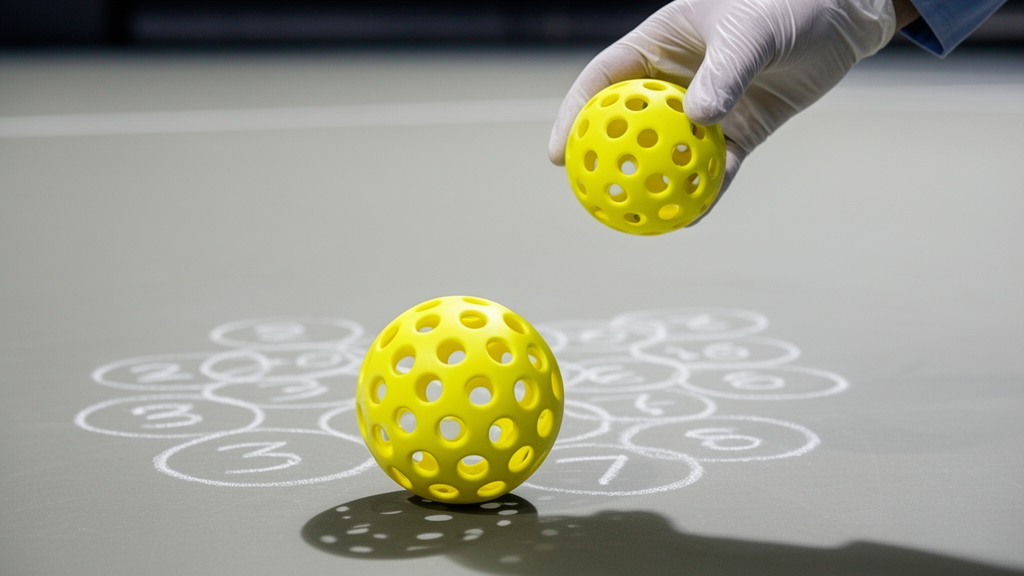
A new study in Sports Engineering reports that an experimental 36-hole outdoor pickleball landed more consistently than a 40-hole reference ball when both were launched repeatedly under identical outdoor conditions.

Researchers compared an author-designed and manufactured 36-hole outdoor prototype with a 40-hole reference based on the geometry commonly used for commercial outdoor balls. Thirty balls of each design were launched over four loading cycles, producing 120 launches per design.

Landing positions were digitised from high-speed video and analysed using coordinate dispersion, distance from the design-specific centroid, and 95% bivariate data ellipses, a set of measures that together describe how tightly repeated landings cluster around a central point.

The 36-hole design showed a smaller mean centroid distance than the 40-hole reference: 43.41 ± 24.81 cm versus 54.56 ± 28.74 cm. The mean difference was −11.15 cm, with a 95% confidence interval of −17.97 to −4.32 cm and p = 0.0015.

Further analyses supported the same pattern. The X-axis standard deviation ratio for the 36-hole ball was 0.792 (95% bootstrap CI 0.674–0.931), and its 95% data-ellipse area ratio was 0.707 (95% bootstrap CI 0.531–0.930), indicating a landing distribution roughly 29% smaller in ellipse area under the tested conditions.

The authors note that the comparison concerns two complete ball configurations and does not isolate the causal effect of hole number or layout. Differences in manufacturing, surface characteristics, or other design features could contribute alongside the perforation count itself.

The study was conducted under monitored outdoor conditions and fixed launcher settings, so the results apply to that specific setup rather than to all playing environments or launch conditions.

Perforation geometry may influence pickleball flight, but the authors emphasise that repeated-launch evidence has remained limited, which motivated this controlled comparison of two complete ball designs.

The findings suggest that, under the tested conditions, the tested 36-hole configuration was associated with a more compact landing distribution, a result that may interest equipment designers studying how perforation patterns affect outdoor ball behaviour.

Subject of Research: Landing dispersion comparison of 36-hole and 40-hole outdoor pickleballs under repeated launches

Article Title: Landing dispersion of 36- and 40-hole pickleballs

Article References: Lin, P., Huang, D., Chen, Y., & Zheng, Z. (2026). Landing dispersion of 36- and 40-hole pickleballs. Sports Engineering, 29(2), Article 43. https://doi.org/10.1007/s12283-026-00577-0

Image Credits: AI Generated

DOI: 10.1007/s12283-026-00577-0

Keywords: pickleball, landing dispersion, perforation geometry, ball flight, sports engineering, outdoor balls, high-speed video, centroid distance, data ellipses, launch testing, Landing, dispersion

News Source: Denise Maddox. (October 28, 2026). Fewer holes, tighter landings: 36-hole pickleball prototype shows more compact flight dispersion. Scienmag.

Tags: ball flightcentroid distancedata ellipsesdispersionhigh-speed videoLandinglanding dispersionlaunch testingoutdoor ballsperforation geometrypickleballSports Engineering
Share12Tweet7Share2ShareShareShare1

Related Posts

CO2-derived vitrimer epoxy matches conventional carbon fiber composites in tensile strength while adding recyclability

CO2-derived vitrimer epoxy matches conventional carbon fiber composites in tensile strength while adding recyclability

October 28, 2026
Explainable AI framework adds semantic rule layer to network intrusion detection

Explainable AI framework adds semantic rule layer to network intrusion detection

October 28, 2026

AI learns to fix CT scans by protecting what algorithms actually measure

October 28, 2026

Neural network predicts Kerr resonator solitons 20 times faster than simulations

October 28, 2026

POPULAR NEWS

  • Scoping review finds clinical supervision of radiography students in Africa lacks structure and training

    Scoping review finds clinical supervision of radiography students in Africa lacks structure and training

    29 shares
    Share 12 Tweet 7
  • Three Suicide Risk Subtypes Identified in Adolescents with Major Depression

    29 shares
    Share 12 Tweet 7
  • Adding a Skin Bilirubin Scan to Visual Jaundice Checks Cuts Costs in Clinics

    29 shares
    Share 12 Tweet 7
  • AI in public health remains pre-emergent in one Congolese health zone, study finds

    29 shares
    Share 12 Tweet 7

About

We bring you the latest biotechnology news from best research centers and universities around the world. Check our website.

Follow us

Recent News

CO2-derived vitrimer epoxy matches conventional carbon fiber composites in tensile strength while adding recyclability

Malaria metabolomics review maps metabolic signatures in hosts, parasites and mosquitoes

Explainable AI framework adds semantic rule layer to network intrusion detection

Subscribe to Blog via Email

Enter your email address to subscribe to this blog and receive notifications of new posts by email.

Join 85 other subscribers
  • Contact Us

Bioengineer.org © Copyright 2023 All Rights Reserved.

Welcome Back!

Login to your account below

Forgotten Password?

Retrieve your password

Please enter your username or email address to reset your password.

Log In
No Result
View All Result
  • Homepages
    • Home Page 1
    • Home Page 2
  • News
  • National
  • Business
  • Health
  • Lifestyle
  • Science

Bioengineer.org © Copyright 2023 All Rights Reserved.