Credit: Akihisa Koga
Scientists at Tokyo Institute of Technology (Tokyo Tech) and Yokohama National University (YNU) uncover the peculiar mechanism by which spin perturbations travel through a seemingly unpassable region of a quantum spin liquid system. This new insight may represent another building block in next-generation electronics and even quantum computers.
Electronic devices as we know them are close to reaching their theoretical limits, meaning that radically new technology will be required to obtain better performance or higher miniaturization. The problem is that modern electronics is centered around manipulating electric currents and is therefore mainly concerned about the collective charge of moving electrons. But what if signals and data could be coded and sent in a more efficient way?
Enter spintronics, an emerging technological field envisioned to revolutionize electronics and, hopefully, become a key player in the development of quantum computers. In spintronic devices, the most important characteristic of electrons is their spin, an intrinsic property that can be broadly seen as their angular momentum and that is the underlying cause of magnetic phenomena in solids. However, physicists worldwide are struggling to find practical ways to generate and transport ‘spin packets’ through materials. In a recent study, scientists at Tokyo Tech and YNU, Japan, conducted a theoretical analysis of the peculiar spin transport characteristics of a particular system called the ‘Kitaev model’.
This two-dimensional model comprises a honeycomb network where each vertex hosts a spin. What’s special about the Kitaev system is that, because of the peculiar interactions between spins, it behaves as a quantum spin liquid (QSL). This broadly means that it is impossible in this system for spins to be arranged in a unique optimal way that ‘keeps every spin happy.’ This phenomenon, called spin frustration, causes spins to behave in a particularly disordered fashion. Professor Akihisa Koga, who led the study, says: “The Kitaev model is an interesting playground for studying QSLs. However, not much is known about its intriguing spin transport properties.”
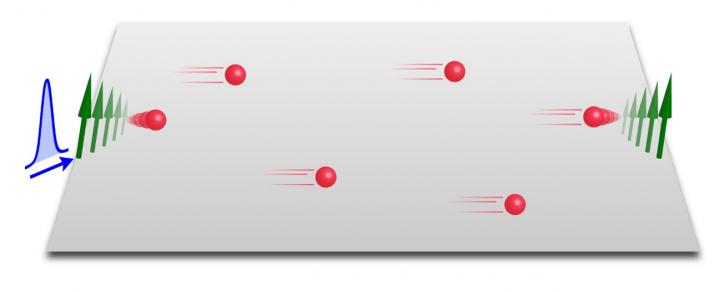
An important characteristic about the Kitaev model is that it has local symmetries; such symmetries mean that spins are correlated only with their nearest neighbors and not with far-away spins, thus implying that there should be a barrier to spin transport. However, in reality, small magnetic perturbations on one edge of a Kitaev system do manifest as changes in the spins at the opposite edge, even though the perturbations do not seem to cause any changes in the magnetization of the central, more symmetrical region of the material. This intriguing mechanism is what the team of scientists clarified in their study, which is published in Physical Review Letters.
They applied an impulse magnetic field on one edge of a Kitaev QSL to trigger ‘spin packet’ transport and numerically simulated the real-time dynamics that consequently unfolded. It turns out that the magnetic perturbation is carried across the central region of the material by travelling ‘Majorana fermions.’ These are quasiparticles; they are not real particles but precise approximations of the collective behavior of the system.
Notably, Majorana-mediated spin transport cannot be explained by classic spin-wave theory and therefore warrants further experimental studies. But Koga is hopeful of the application potential of the results of this study. He says: “Our theoretical results should be relevant in real materials as well, and the setup of our study could be implemented physically in certain candidate materials for Kitaev systems.”
In their article, the scientists discuss possible materials, ways of creating the spin perturbations, and ways to experimentally find evidence of the Majorana fermions travelling through the bulk of the material to reach the other edge. It may even be possible to control the motion of the static (non-travelling) Majorana fermions in the system, which could be of practical use. Only time will tell how many more mysteries of the quantum world physicists will solve and how we will benefit from them.
###
Media Contact
Emiko Kawaguchi
[email protected]
Related Journal Article
http://dx.