• HOME
  • NEWS
  • EXPLORE
    • CAREER
      • Companies
      • Jobs
    • EVENTS
    • iGEM
      • News
      • Team
    • PHOTOS
    • VIDEO
    • WIKI
  • BLOG
  • COMMUNITY
    • FACEBOOK
    • INSTAGRAM
    • TWITTER
Saturday, November 14, 2026
BIOENGINEER.ORG
No Result
View All Result
  • Login
  • HOME
  • NEWS
  • EXPLORE
    • CAREER
      • Companies
      • Jobs
        • Lecturer
        • PhD Studentship
        • Postdoc
        • Research Assistant
    • EVENTS
    • iGEM
      • News
      • Team
    • PHOTOS
    • VIDEO
    • WIKI
  • BLOG
  • COMMUNITY
    • FACEBOOK
    • INSTAGRAM
    • TWITTER
No Result
View All Result
Bioengineer.org
No Result
View All Result
Home NEWS Science News Agriculture

Fermented Quinoa Starch Conjugates Effectively Replace Fat in Low-Fat Yogurt

by
November 13, 2026
in Agriculture
Reading Time: 2 mins read
0
Fermented Quinoa Starch Conjugates Effectively Replace Fat in Low-Fat Yogurt

Fermented Quinoa Starch Conjugates Effectively Replace Fat in Low-Fat Yogurt

Share on FacebookShare on TwitterShare on LinkedinShare on RedditShare on Telegram

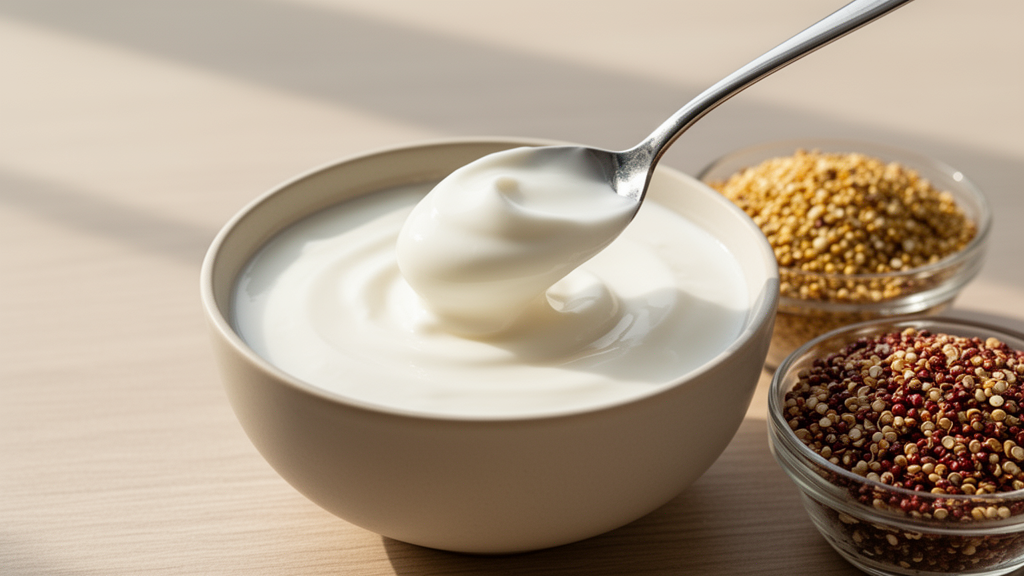
Food scientists have developed composite fat replacers using fermented quinoa starch and whey protein, demonstrating their potential to replicate the mouthfeel and structure of full-fat yogurt. Starch-protein composites have long been recognized as promising candidates for fat substitution, but achieving structural stability and desirable interfacial functionality in reduced-fat foods has presented substantial processing hurdles. By utilizing an anti-solvent precipitation method across starch-to-protein mass ratios ranging from 1:0 to 1:0.5, researchers evaluated whether microbial fermentation could modify starch surface properties to overcome these longstanding functional barriers.

Comparative structural assessments revealed that fermentation significantly enhanced the binding performance between quinoa starch and whey protein. At a mass ratio of 1:0.2, the fermented complexes achieved a complexation efficiency of 84.99 percent, markedly outperforming the 74.48 percent efficiency observed in their native counterparts. Spectroscopic and physical dissociations confirmed that this elevated affinity stemmed from stronger hydrogen bonding, enhanced hydrophobic effects, and robust electrostatic interactions, which were accompanied by pronounced changes in zeta potential across the formulated particles.

The physical characteristics of the composites varied according to the precise formulation ratio, with optimal properties emerging at a 1:0.3 starch-to-protein ratio. Under these parameters, fermented complexes attained a nanoscale particle size of 134.01 nanometers, compared to 250.40 nanometers in native starch complexes. Furthermore, the fermented particles exhibited a larger contact angle of 82.17 degrees compared to 74.25 degrees for native versions, alongside superior emulsifying capacity, denser microstructural networks, and enhanced stability in rheological testing.

To assess practical dairy performance, investigators incorporated the optimized conjugates into reduced-fat milk at concentrations spanning from 0.5 to 8 percent by weight during yogurt production. Formulations containing a 4 percent addition of the fermented composites delivered the highest performance, yielding yogurt with a peak water-holding capacity of 85.18 percent and minimized whey separation. The resulting gel network exhibited textural and rheological profiles that closely mirrored conventional full-fat yogurt, providing an effective clean-label strategy for improving low-fat fermented dairy systems.

Subject of Research: Evaluation of fermented quinoa starch and whey protein conjugates as fat replacers in low-fat yogurt

Article Title: Fermented quinoa starch-whey protein conjugate as an effective fat substitute in low-fat yogurt

Article References: Chen, W., Gu, W., Zhang, J., Wang, T., Zhang, W., Wang, Y., & Qiao, H. (2026). Fermented quinoa starch-whey protein conjugate as an effective fat substitute in low-fat yogurt. npj Science of Food. https://doi.org/10.1038/s41538-026-01222-7

Image Credits: AI Generated

DOI: 10.1038/s41538-026-01222-7

Keywords: quinoa starch, whey protein, fat replacer, low-fat yogurt, fermentation, starch-protein conjugate, anti-solvent precipitation, water-holding capacity, emulsifying capacity, dairy rheology, food microstructure, zeta potential, contact angle, clean-label ingredients, dairy science, food biopolymers

News Source: Alan Morgan. (November 13, 2026). Fermented Quinoa Starch Conjugates Effectively Replace Fat in Low-Fat Yogurt. Scienmag.


Tags: anti-solvent precipitationclean-label ingredientscontact angledairy rheologydairy scienceemulsifying capacityfat replacerfermentationfood biopolymersfood microstructurelow-fat yogurtquinoa starchstarch-protein conjugatewater-holding capacitywhey proteinzeta potential
Share12Tweet7Share2ShareShareShare1

Related Posts

New 71k SNP Array Enables Genomic Prediction for Arctic Charr Disease Resistance

New 71k SNP Array Enables Genomic Prediction for Arctic Charr Disease Resistance

November 14, 2026
Controlled Dehydration-Rehydration Selectively Enriches Ginsenoside F2 in Hydroponic Ginseng Sprouts

Controlled Dehydration-Rehydration Selectively Enriches Ginsenoside F2 in Hydroponic Ginseng Sprouts

November 14, 2026

Increasing Beer Ethanol Content Alters Cannabinoid and Terpene Extraction from Hemp

November 14, 2026

Pig Study Links Feeding Behavior Genetics to Efficiency and Human Fat Intake

November 14, 2026

POPULAR NEWS

  • Look-Ahead Genomic Mating Optimizes Simulated Aquaculture Breeding Across Varying Horizons

    Look-Ahead Genomic Mating Optimizes Simulated Aquaculture Breeding Across Varying Horizons

    29 shares
    Share 12 Tweet 7
  • Renewable Nanomedicines Require Rigorous Performance Metrics Beyond Natural Origin Alone

    29 shares
    Share 12 Tweet 7
  • Multiparametric MRI Tracks Rapid Early Adaptation in Remaining Donor Kidneys

    29 shares
    Share 12 Tweet 7
  • Controlled Dehydration-Rehydration Selectively Enriches Ginsenoside F2 in Hydroponic Ginseng Sprouts

    29 shares
    Share 12 Tweet 7

About

We bring you the latest biotechnology news from best research centers and universities around the world. Check our website.

Follow us

Recent News

New 71k SNP Array Enables Genomic Prediction for Arctic Charr Disease Resistance

Bacterial Evolution Chooses Cheaper Genetic Defenses Under Lower Chemical Stress Levels

Isoimperatorin Impairs Breast Cancer Growth by Targeting miR-874-3p and POU2F1 Axis

Subscribe to Blog via Email

Enter your email address to subscribe to this blog and receive notifications of new posts by email.

Join 87 other subscribers
  • Contact Us

Bioengineer.org © Copyright 2023 All Rights Reserved.

Welcome Back!

Login to your account below

Forgotten Password?

Retrieve your password

Please enter your username or email address to reset your password.

Log In
No Result
View All Result
  • Homepages
    • Home Page 1
    • Home Page 2
  • News
  • National
  • Business
  • Health
  • Lifestyle
  • Science

Bioengineer.org © Copyright 2023 All Rights Reserved.