Why do so many people reach for a bag of chips or a slice of cake when they are not remotely hungry? Scientists call this hedonic feeding—eating driven by pleasure and palatability rather than by the body’s physiological need for energy—and it has long been suspected as a major engine of the obesity epidemic. Now a new study in rats offers a rigorous, quantitative portrait of how this pleasure-driven eating differs between males and females, and probes whether the trillions of microbes living in the gut help explain the gap. The answer to that second question, perhaps surprisingly, appears to be no, at least under the conditions tested.
The research, conducted by Christopher J. Petty of the University of Georgia, Mindy Isaman and Linnea R. Freeman of Furman University, and colleagues at Furman and Clemson University, was published in the journal Biology of Sex Differences. The team set out to address two intertwined problems: the persistent excess of severe obesity among women compared with men, and the growing but still murky evidence that the gut microbiome shapes feeding behavior. Individuals with obesity are known to carry an altered gut microbiome, but whether those microbial differences actually drive overeating—or merely accompany it—has remained an open question, particularly with respect to sex differences.
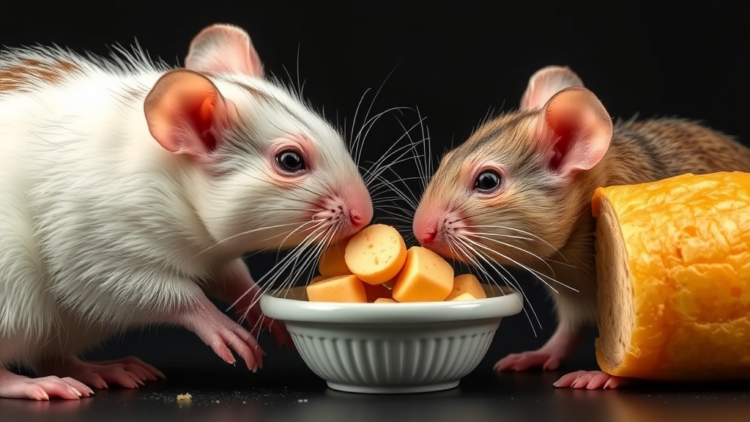
To measure hedonic feeding with real precision, the researchers turned to an approach borrowed from economics rather than simple food-intake counts. Male and female Sprague-Dawley rats were trained in a de-escalating fixed ratio operant task built on behavioral economics principles. In this paradigm, animals work—pressing a lever—to earn high-fat, palatable reward pellets, and the price of those pellets, measured in effort, steadily increases. The design allows researchers to estimate two key parameters. The first is demand elasticity, denoted alpha, which captures how quickly an animal’s demand for the reward falls as the price of obtaining it rises. The second is demand at null cost, or Q0, an extrapolated prediction of how much the animal would consume if the reward required no effort at all. Together, these values describe not just how much an animal eats, but how much it values the food—an economic signature of hedonic drive.
The baseline results were clear and consistent with the team’s earlier work: female rats showed a significantly higher demand at null cost for the high-fat palatable pellets than male rats. In plain terms, when effort was stripped away, females valued and would consume more of the palatable reward than males. Because hedonic feeding is a well-recognized contributor to chronic overconsumption in environments saturated with calorie-dense foods, this kind of sex-linked difference in reward valuation is exactly the sort of biological signal that could help explain why severe obesity disproportionately affects women.
The next question was what might be driving that difference. Emerging evidence suggests the gut microbiome influences feeding behavior through several channels, including the production of short chain fatty acids, metabolites generated when gut bacteria ferment dietary fiber, and through effects on bile acids, molecules synthesized from cholesterol that aid fat digestion and also act as signaling agents in the gut and beyond. The researchers therefore administered an antibiotic cocktail in the rats’ drinking water to disrupt the gut microbiome, then re-ran the behavioral economics task to see whether wiping out the microbial community would change hedonic feeding in either sex.
The outcome was striking in its restraint. Female rats given antibiotics continued to show a higher demand at null cost compared with untreated male control rats, and—critically—the researchers found no statistically significant difference between antibiotic-treated males and females. In other words, disrupting the microbiome did not erase or meaningfully reshape the sex difference in hedonic reward valuation. The antibiotic treatment did do its biological job: when the team characterized the fecal microbiome at the genus level before and after antibiotic administration, they documented clear disruption to the bacterial community, alongside measured changes in fecal short chain fatty acid levels. They also profiled serum short chain fatty acid and bile acid levels at the end of the study, providing a metabolomic snapshot of the systemic consequences of microbial disruption.
What makes the finding conceptually important is what it rules out, or at least renders less likely as a simple explanation. If baseline differences in gut bacterial composition between males and females were the primary engine of the female rats’ stronger hedonic drive, collapsing that composition with antibiotics should have narrowed the gap. It did not. The authors also report that they did not observe striking baseline sex differences in fecal microbiome diversity and composition in the first place, which further weakens the notion that straightforward differences in which bacterial genera dominate the gut could account for the behavioral divergence. The study’s own conclusion is deliberately measured: these results bring into question whether the gut microbiome contributes to sex differences in hedonic feeding at all.
That said, the researchers are careful not to close the book on microbial influence. The gut microbiome is not a single variable but a network of interacting communities and metabolites, and antibiotics are a blunt instrument. The team points to network factors—such as the interplay between the microbiome and bile acids, which themselves show sex differences and can modulate feeding—as avenues requiring further investigation. Serum bile acid profiles measured at the study’s endpoint suggest that downstream signaling pathways, rather than raw bacterial composition, may be where sex-specific microbial effects on appetite ultimately reside, if they exist.
The work also carries a methodological lesson for the field. Behavioral economics approaches like the de-escalating fixed ratio task distinguish between consumption and motivation, two things that simple access-feeding experiments conflate. An animal that eats more of a tasty food at zero cost but gives up quickly when effort increases is economically different from one that persists at high prices, and only the second pattern reflects a genuine shift in reward valuation. By anchoring sex comparisons in demand curve parameters rather than grams consumed, studies of this kind can pinpoint whether the sexes differ in how much they value palatable food, in how sensitive they are to its cost, or both. In this case, the female-male difference lived specifically in the null-cost demand estimate.
For human health, the implications are cautious but meaningful. The finding that female rats place a higher intrinsic value on high-fat palatable food parallels epidemiological patterns in which women face higher rates of severe obesity, and it reinforces the idea that any intervention aimed at curbing pleasure-driven eating may need to account for sex as a fundamental biological variable rather than an afterthought. At the same time, the negative result on the microbiome tempers enthusiasm for microbial therapies—probiotics, targeted antibiotics, or fecal transplants—as quick fixes for hedonic overeating, at least until the relevant mechanisms are better mapped. Obesity, the authors note, remains a pressing public health issue, and hedonic feeding, while not its sole culprit, is one of its major contributing forces. Untangling which biological threads—hormonal, neural, microbial, or metabolic—woven together produce the sex difference in reward valuation will demand the kind of systematic, multi-dimensional profiling this study models: behavior, bacterial census, and metabolites measured in the same animals, before and after perturbation. The microbiome may yet play a role in appetite, but this careful experiment suggests that if it does, it operates through subtler, networked pathways than the simple presence or absence of particular gut bacteria.
Subject of Research: Sex differences in hedonic feeding and the effects of antibiotic-induced gut microbiome disruption in rats
Article Title: Sex differences in hedonic feeding and characterizing the effects of antibiotic-induced microbiome disruption
Article References: Sex differences in hedonic feeding and characterizing the effects of antibiotic-induced microbiome disruption. (n.d.). https://doi.org/10.1186/s13293-026-00970-1
Image Credits: AI Generated
DOI: 10.1186/s13293-026-00970-1
Keywords: hedonic feeding, gut microbiome, sex differences, behavioral economics, obesity, antibiotics, short chain fatty acids, bile acids, operant conditioning, Sprague-Dawley rats, microbiome disruption, food reward
Cite Scienmag News
APA MLA Chicago
Daisy Hatcher. (September 12, 2026). Female Rats Work Harder for Fatty Treats, but Gut Microbes May Not Be the Reason. Scienmag. https://scienmag.com/female-rats-work-harder-for-fatty-treats-but-gut-microbes-may-not-be-the-reason/
Daisy Hatcher. “Female Rats Work Harder for Fatty Treats, but Gut Microbes May Not Be the Reason.” Scienmag, 12 September 2026, https://scienmag.com/female-rats-work-harder-for-fatty-treats-but-gut-microbes-may-not-be-the-reason/. Accessed 12 September 2026.
Daisy Hatcher. “Female Rats Work Harder for Fatty Treats, but Gut Microbes May Not Be the Reason.” Scienmag. September 12, 2026. https://scienmag.com/female-rats-work-harder-for-fatty-treats-but-gut-microbes-may-not-be-the-reason/
Copy citation Download RIS
Tags: animal models of binge eatingantibioticsbehavioral economicsbile acidsfood rewardgender differences in eating behaviorgender-specific study on dietary pleasuregut microbes and eating regulationGut microbiomegut microbiota and metabolic healthhedonic feedingHedonic feeding in female ratsimpact of palatable food consumptioninfluence of pleasure-driven eating on obesitymicrobiome disruptionmicrobiome’s contribution to feeding behaviorobesityobesity and sex disparitiesoperant conditioningrole of gut microbiome in overeatingsex differencessexually dimorphic responses to high-fat treatsshort-chain fatty acidsSprague-Dawley rats