


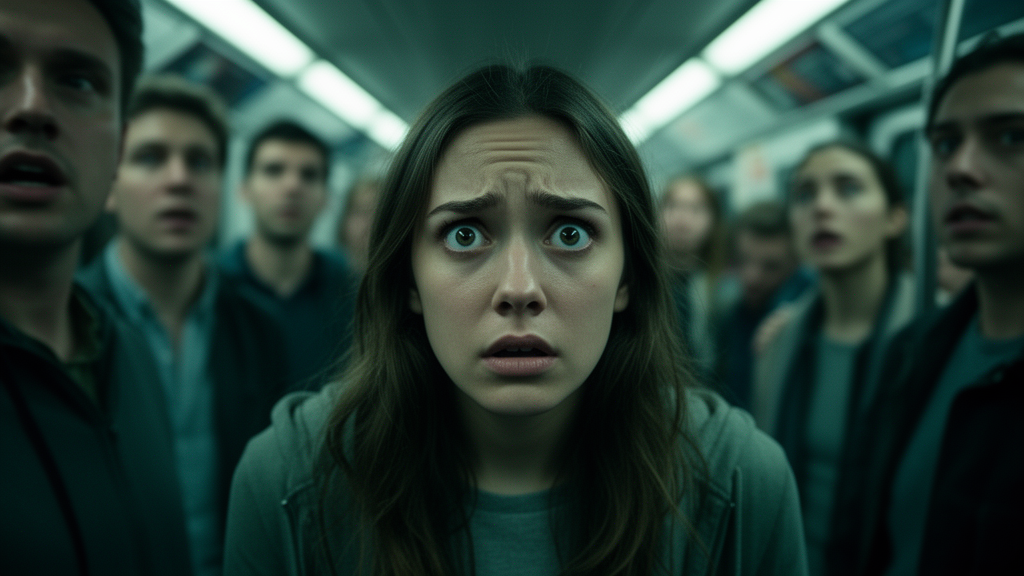
A fleeting sense that someone is watching may be the spark that sets off the full cascade of social anxiety, according to a new ecological momentary assessment study published in BioPsychoSocial Medicine. The model in which noticing a gaze comes first, triggering a sense of being evaluated, which then heightens self-focused attention and anxiety symptoms, fit the data slightly better than the reverse sequence. Yet the margin was small, and the authors are careful to note that the alternative ordering remains plausible.
The study addressed a gap that one-time questionnaires cannot fill. Cognitive-behavioral models of social anxiety disorder, including the influential account of Clark and Wells and the model of Heimberg and colleagues, propose that entering a social situation activates anxiety-related assumptions, shifting attention toward the self, particularly an observer-perspective view of how one appears to others, and thereby producing anxiety symptoms and avoidance. But whether these cognitive processes actually unfold in that order in real life had not been fully established. Momentary self-reports collected in natural settings can capture intra-individual fluctuations in cognition and emotion with minimal recall bias, making them well suited to testing temporal sequences.
Participants were recruited from a Japanese university in a rural region through a campus-wide advertisement and screened with the Japanese version of the Liebowitz Social Anxiety Scale, with a boundary score of 30 indicating a high tendency toward social anxiety. Screening also excluded anyone with current illness or injury, current medication use, extreme sleep deprivation or fatigue, any current or past psychotherapy, or recent involvement in a distressing major accident. Data came from two groups: 22 participants recruited between September and November 2022 who had taken part in the team’s previous study, and 17 new participants recruited between October and November 2024, with male participation specifically encouraged to correct a gender imbalance in the earlier sample. One participant with an extremely low compliance rate of 40 percent was excluded as a statistical outlier.
The final sample comprised 38 participants, 17 male and 21 female, with a mean age of 20.79 years and a mean Liebowitz score of 64.74, indicating marked social anxiety. For 10 consecutive days, participants received reminder emails at 12:00, 17:00, and 22:00 and were asked to complete a smartphone questionnaire within one hour of each prompt. They reflected on the most recent social situation from the past five hours, excluding interactions with family, and rated whether they had perceived being evaluated or perceived a gaze, using two-point items. They then rated self-focused attention from the observer perspective and self-focus on bodily sensations, each with four items adapted from validated scales, and rated their social anxiety immediately after the situation on a six-point scale. Of 1,140 distributed surveys, 991 responses came back, and after removing reports with no social situation, family interactions, or events older than five hours, 569 valid responses remained, an average compliance rate of 86.9 percent.
The most frequently reported situation was being in a crowded place, with 162 reports, followed by one-on-one conversations at 138 and small groups or meetings at 117; giving a report to a group was rarest at just five reports. The researchers computed intraclass correlations to see how much variance in each measure sat between individuals rather than within them. These were low for perceived evaluation at 0.06 and gaze perception at 0.11, moderate for social anxiety at 0.30, and around 0.50 for the two self-focused attention measures, indicating that the two perceptions varied mostly moment to moment within individuals. Consequently, gaze perception and perceived evaluation were excluded from between-individual analyses because their minimal between-person variance could yield unstable estimates.
The core analysis used multilevel structural equation modeling with a latent self-focused attention factor indicated by observer-perspective attention and body-sensation focus, and a latent symptom factor indicated by social anxiety. Model (a) proposed that perceived evaluation precedes gaze perception; Model (b) reversed the order. The authors had hypothesized the evaluation-first sequence, reasoning that fear of negative evaluation is a heritable predisposing factor, and that in their previous study controlling for fear of being evaluated eliminated the effect of perceived evaluation on self-focused attention while controlling for fear of gaze did not eliminate the gaze effect.
The data pointed the other way, though only narrowly. Model (a), after removing a nonsignificant path from gaze perception to symptoms, yielded a mediocre fit with a comparative fit index of 0.90, RMSEA of 0.09, within-level SRMR of 0.07, between-level SRMR of 0.13, AIC of 90.00, and BIC of 181.22. Model (b) fit slightly better on every index: CFI of 0.92, RMSEA of 0.09, within-level SRMR of 0.06, between-level SRMR of 0.12, AIC of 85.20, and BIC of 180.77. In the adopted gaze-first model, all hypothesized paths were significant, and perceived being evaluated showed a direct positive effect on social anxiety symptoms of standardized beta 0.15 in addition to its indirect effect through self-focused attention. This suggests that once a gaze is noticed, the resulting sense of being evaluated can amplify anxiety both by turning attention inward and through a separate, more direct route.
The authors interpret the gaze-first sequence through the lens of gaze hypersensitivity. Prior work reviewed in the paper indicates that the more socially anxious a person is, the more they feel looked at, especially when confronted with negative or neutral facial expressions, and that the perceived extent of gaze can exceed actual eye contact. Related experimental findings show that maintaining eye contact before a task heightens subsequent fear of evaluation and self-focused attention on bodily sensations among people high in fear of negative evaluation. On this account, noticing a gaze is a fast external cue, whereas perceiving oneself as evaluated requires additional cognitive and emotional processing that integrates the external cue with an internal affective response, placing evaluation downstream of gaze.
Important caveats temper the headline finding. The authors themselves stress that the difference in fit indices was marginal and that the evaluation-first model, which also showed acceptable fit, cannot be rejected; in daily life the two perceptions may occur in either order or reinforce each other. All variables were measured concurrently within each report, so causal direction could not be determined, and the five-hour recall window may have introduced recall bias despite the momentary design. The sample consisted solely of Japanese university students with high social anxiety, limiting generalizability to other ages, cultures, and clinical populations, and the partial reuse of data from the team’s previous study may have inflated statistical significance. Individual difference factors such as fear of negative evaluation were not fully modeled, and the small sample precluded analyses by situation type. Within these limits, the study offers a fine-grained picture of daily cognitive dynamics in social anxiety and points to gaze perception, and sensitivity to evaluation, as potential targets for therapeutic intervention, a suggestion the authors frame as a direction for future research rather than a treatment recommendation.
Subject of Research: Temporal sequence of gaze perception, perceived evaluation, self-focused attention, and social anxiety symptoms in daily life
Article Title: Gaze perception fuels social anxiety in everyday life: a comparison of two ecological momentary assessment models
Article References: Nanamori, M., Tomita, N., Yanagida, A., & Kumano, H. (2026). Gaze perception fuels social anxiety in everyday life: a comparison of two ecological momentary assessment models. BioPsychoSocial Medicine, 20(1), Article 14. https://doi.org/10.1186/s13030-026-00360-4
Image Credits: AI Generated
DOI: 10.1186/s13030-026-00360-4
Keywords: social anxiety, gaze perception, ecological momentary assessment, self-focused attention, perceived evaluation, multilevel structural equation modeling, fear of negative evaluation, cognitive model, Japanese university students, daily life, Gaze, perception
News Source: Glenn Wilkins. (October 29, 2026). Feeling Watched First: Gaze Perception May Trigger the Chain Behind Social Anxiety. Scienmag.



