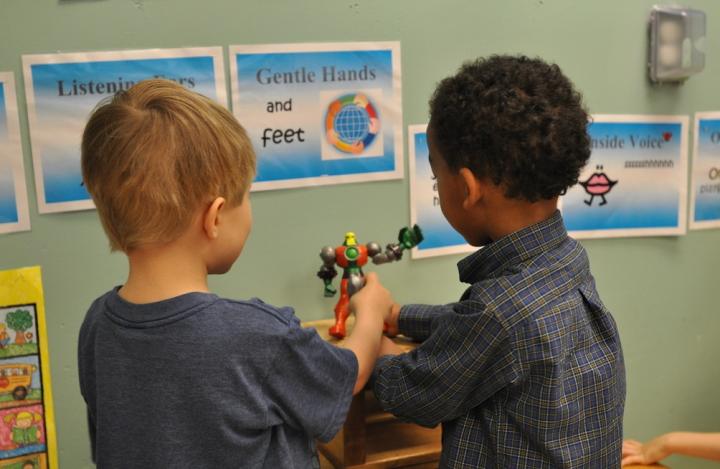
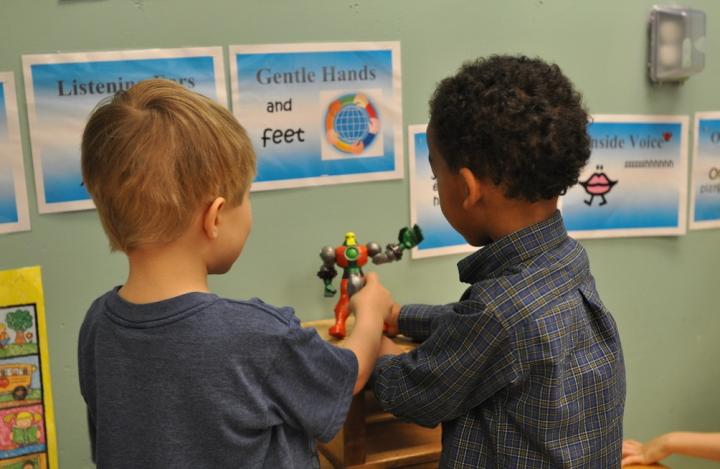
Credit: Frank Porter Graham Child Development Institute.
A new federal report recommends that schools emphasize building children's "self-regulation" skills in order to increase opportunities for student success in a number of areas. The recommendation is one of several in the report, the fourth in a series on self-regulation research and practice from the Administration for Children and Families at the U.S. Department of Health and Human Services (DHHS).
Researchers have zeroed in on the importance of self-regulation skills, which allow children to manage their thoughts and feelings, control impulses, and problem-solve.
"Self-regulation affects wellbeing across the lifespan, from mental health and emotional wellbeing to academic achievement, physical health, and socioeconomic success," said Desiree Murray, associate director of research at the Frank Porter Graham Child Development Institute and lead author of the report. "Unfortunately, prolonged or pronounced stress and adversity, including poverty and trauma, can delay children's self-regulation development."
Murray said the good news is research shows that interventions can improve outcomes for children from backgrounds of risk and adversity. Her research team, which includes Duke Center for Child and Family Policy's Katie Rosanbalm and Christina Christopoulos, recommend embedding a focus on self-regulation in schools and other settings.
"For optimal self-regulation, a child or adolescent needs to have a full bucket of skills and supports on which to draw," Murray said. "There are two crucial periods when children are developing their self-regulation skills the most–in early childhood and early adolescence–when teachers and parents can help them build the skills they need for the rest of their lives."
Murray said many self-regulation interventions are designed for use in schools.
"Schools are an ideal place for interventions because there is opportunity to build skills in a cohesive approach from preschool through secondary school and because of the potential power of shared learning with peers," she said. "Interventions in schools can impact the culture and climate in a way that benefits all students."
According to the report, strengthening self-regulation can be thought of like teaching literacy. Similar to literacy, self-regulation develops with simpler skills first, which build upon one another.
Murray and her team outline a comprehensive approach to the development of self-regulation, which includes teaching skills through repeated practice and frequent feedback in a supportive context. They suggest providing universal interventions across childhood and into early adulthood, with a strong emphasis on teaching caregivers (including teachers and other school staff) how to support children. She said the keys to this support are warm and responsive relationships, paired with positive discipline and consistency.
The report also recommends providing more intensive intervention to children who are experiencing self-regulation difficulties. In 12 elementary schools, Murray's team is currently delivering and studying a small-group pull-out program teaching socio-emotional skills from "The Incredible Years."
"Some children and youth may need additional supports, such as those provided by 'Incredible Years' programs," Murray said. "These and other interventions may be particularly beneficial for youth who live in adversity, increasing children's resilience to the negative effects of stress."
Murray's team based their report's recommendations on two comprehensive reviews of research. "We capitalized on important recent findings from developmental neuroscience, and looked at a wide range of interventions that have been evaluated in the last 25 years," she said.
###
The Office of Planning, Research & Evaluation in the DHHS's Administration for Children and Families commissioned the report. Murray and Rosanbalm currently are developing a series of briefs to support use of their recommendations for different age groups, including new professional development for practitioners in the field.
Media Contact
Desiree Murray
[email protected]
919-843-8085
@FPGInstitute
http://www.fpg.unc.edu/