Research publishing October 5 in the journal Current Biology finds that mammals living in South Africa’s Greater Kruger National Park, home to one of the world’s largest remaining lion populations, are far more afraid of hearing human voices than lion vocalizations or hunting sounds such as dogs barking or gunshots.
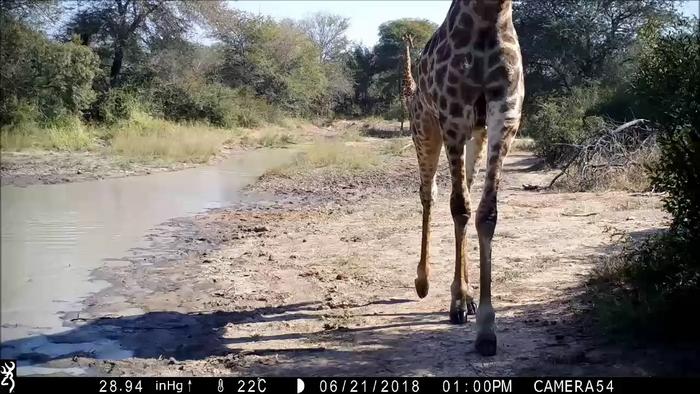
Credit: Current Biology, Zanette et al.
Research publishing October 5 in the journal Current Biology finds that mammals living in South Africa’s Greater Kruger National Park, home to one of the world’s largest remaining lion populations, are far more afraid of hearing human voices than lion vocalizations or hunting sounds such as dogs barking or gunshots.
Recent global surveys show that humans kill prey at much higher rates than other predators. “We usually think about the top of the food chain being large carnivore predators,” says first author Liana Y. Zanette (@ZanetteLab), a conservation biologist at Western University in Canada. “But what we’re interested in is the unique ecology of humans as predators in the system, because humans are super lethal.”
“Normally, if you’re a mammal, you’re not going to die of disease or hunger. The thing that actually ends your life is going to be a predator, and the bigger you are the bigger the predator that finishes you off,” says co-author Michael Clinchy, also a conservation biologist at Western University. “Lions are the biggest group-hunting land predator on the planet, and thus ought to be the scariest, and so we’re comparing the fear of humans versus lions to find out if humans are scarier than the scariest non-human predator.”
As part of their South African mega-experiment, Zanette, Clinchy, and colleagues observed how 19 different mammal species reacted to a series of recordings, including human voices, lion vocalizations, barking dogs, and gunshots. The human-voice clips, which were at conversational volume levels, came from radio or television recordings of people speaking the four most used languages in the region, including Tsonga, Northern Sotho, English, and Afrikaans. The dogs and gunshots were meant to represent sounds associated with human hunting, and the lion vocalizations, curated with the help of lion expert and co-author Craig Packer of the University of Minnesota, were meant to signal the presence of the top predator in the region.
“The key thing is that the lion vocalizations are of them snarling and growling, in ‘conversation’ as it were, not roaring at each other,” says Clinchy. “That way the lion vocalizations are directly comparable to those of the humans speaking conversationally.”
To observe and record the animals’ behaviors in response to the recordings, the authors used custom waterproof systems that combine a camera trap and a speaker—and have enough battery life to record all day and night for many months. The study was conducted in the dry season, and the systems were placed at waterholes to capture recordings of all the animals coming to drink. By the end of the experiment, the team had 15,000 videos to sift through.
“We put the camera in a bear box, not because there are bears out in South Africa, but because of the hyenas and leopards that like to chew on them,” says Zanette. “One night, the lion recording made this elephant so angry that it charged and just smashed the whole thing.”
The researchers found that animals were twice as likely to run and abandon waterholes in response to hearing humans compared to hearing lions or hunting sounds. Fully 95% of species, including giraffes, leopards, hyenas, zebras, kudu, warthog, impala, elephants, and rhinoceroses, ran more often or abandoned waterholes faster in response to humans than in response to lions.
“There’s this idea that the animals are going to habituate to humans if they’re not hunted. But we’ve shown that this isn’t the case.,” says Clinchy. “The fear of humans is ingrained and pervasive, so this is something that we need to start thinking about seriously for conservation purposes.”
The team is now investigating whether their custom sound systems can be used to deliberately steer endangered species such as the Southern white rhino away from known poaching areas in South Africa. So far, efforts to keep rhinos away from certain areas through the use of human voices have been successful.
“I think the pervasiveness of the fear throughout the savannah mammal community is a real testament to the environmental impact that humans have,” says Zanette. “Not just through habitat loss and climate change and species extinction, which is all important stuff. But just having us out there on that landscape is enough of a danger signal that they respond really strongly. They are scared to death of humans, way more than any other predator.”
###
This research was supported by funding from the Natural Sciences and Engineering Research Council of Canada and the South African Agency for Science and Technology Advancement National Research Foundation.
Current Biology, Zanette et al. “Fear of the human ‘super predator’ pervades the South African savanna.” https://www.cell.com/current-biology/fulltext/S0960-9822(23)01169-7
Current Biology (@CurrentBiology), published by Cell Press, is a bimonthly journal that features papers across all areas of biology. Current Biology strives to foster communication across fields of biology, both by publishing important findings of general interest and through highly accessible front matter for non-specialists. Visit: http://www.cell.com/current-biology. To receive Cell Press media alerts, contact [email protected].
Journal
Current Biology
DOI
10.1016/j.cub.2023.08.089
Method of Research
Observational study
Subject of Research
Animals
Article Title
Fear of the human ‘‘super predator’’ pervades the South African savanna
Article Publication Date
5-Oct-2023