• HOME
  • NEWS
  • EXPLORE
    • CAREER
      • Companies
      • Jobs
    • EVENTS
    • iGEM
      • News
      • Team
    • PHOTOS
    • VIDEO
    • WIKI
  • BLOG
  • COMMUNITY
    • FACEBOOK
    • INSTAGRAM
    • TWITTER
Saturday, July 11, 2026
BIOENGINEER.ORG
No Result
View All Result
  • Login
  • HOME
  • NEWS
  • EXPLORE
    • CAREER
      • Companies
      • Jobs
        • Lecturer
        • PhD Studentship
        • Postdoc
        • Research Assistant
    • EVENTS
    • iGEM
      • News
      • Team
    • PHOTOS
    • VIDEO
    • WIKI
  • BLOG
  • COMMUNITY
    • FACEBOOK
    • INSTAGRAM
    • TWITTER
  • HOME
  • NEWS
  • EXPLORE
    • CAREER
      • Companies
      • Jobs
        • Lecturer
        • PhD Studentship
        • Postdoc
        • Research Assistant
    • EVENTS
    • iGEM
      • News
      • Team
    • PHOTOS
    • VIDEO
    • WIKI
  • BLOG
  • COMMUNITY
    • FACEBOOK
    • INSTAGRAM
    • TWITTER
No Result
View All Result
Bioengineer.org
No Result
View All Result
Home NEWS Science News Health

Faster way to catch SARS-CoV-2 virus? Smaller magnetic beads with superior magnetic moment help

Bioengineer by Bioengineer
July 28, 2023
in Health
Reading Time: 2 mins read
0
Faster Way to Catch SARS-CoV-2 Virus? Smaller Magnetic Beads with Superior Magnetic Moment Help
Share on FacebookShare on TwitterShare on LinkedinShare on RedditShare on Telegram

A more efficient way to test SARS-CoV-2 Virus was developed recently by a research team led by Professor WANG Junfeng from Hefei Institutes of Physical Science (HFIPS), Chinese Academy of Science (CAS). The novel nano-immune magnetic bead (Mal-IMB) they developed in this research can efficiently be bound to SARS-CoV-2 pseudovirus in the study of protein biomimetic mineralization and synthesized into magnetic nanoparticles.
Faster Way to Catch SARS-CoV-2 Virus? Smaller Magnetic Beads with Superior Magnetic Moment Help

Credit: MA Kun

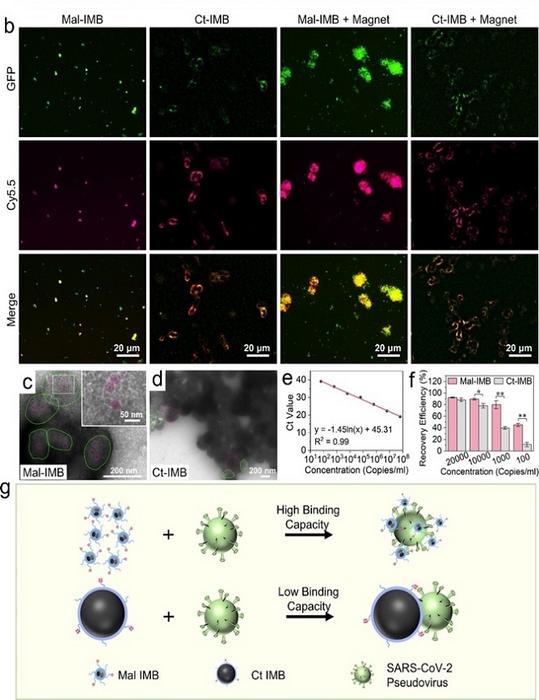
A more efficient way to test SARS-CoV-2 Virus was developed recently by a research team led by Professor WANG Junfeng from Hefei Institutes of Physical Science (HFIPS), Chinese Academy of Science (CAS). The novel nano-immune magnetic bead (Mal-IMB) they developed in this research can efficiently be bound to SARS-CoV-2 pseudovirus in the study of protein biomimetic mineralization and synthesized into magnetic nanoparticles.

The relevant findings were published in Analytical Chemistry.

The novel coronavirus pneumonia caused by the highly contagious SARS-CoV-2 virus has had a significant impact on public health. A convenient and rapid virus separation method is needed. Immune magnetic beads (IMBs),which use magnetic microspheres with specific probes to bind to target substances, have shown significant advantages. However, applying IMBs in biological separations presents challenges that need to be addressed, such as low target substance concentration and complex biological environments. Small-sized magnetic beads, which can penetrate impurities and reduce nonspecific binding, has been suggested.

In this research, based on previous work on biomimetic mineralization synthesis, the research team modified the surface of ultra-small cluster magnetic nanobeads and combined them with ultra-small single-chain antibody fragments (RBD-scFv) targeting the RBD region of the S protein. In this way, they successfully obtained highly efficient ultra-small immune magnetic beads for identifying RBD antigens and attached them to SARS-CoV-2 pseudovirus.

“This innovative bead is designed to address the challenges of enrichment and detection of the novel coronavirus in complex biological environments,” said MA Kun, member of the team.

Cluster magnetic beads exhibited excellent magnetic properties, high homogeneity, and chemical stability. Furthermore, due to their small size, they demonstrated stable capture capacity and superior binding efficiency, making them a potential solution for the rapid and effective enrichment and separation of COVID-19.

When compared to commercial beads, Mal-IMB exhibited a maximum virus loading capacity of 83 μg/mg in complex biological environments and could effectively enrich pseudoviruses as low as 70 copies/mL.

Additionally, through immunofluorescence and transmission electron microscopy experiments, the mechanism of ultra-small magnetic bead enrichment in complex biological environments was further elucidated, demonstrating not only the effectiveness of the novel immune magnetic beads but also providing valuable insights for their performance improvement in complex biological environments.


Journal

Analytical Chemistry
Share12Tweet8Share2ShareShareShare2

Related Posts

Study Finds Dopamine System Damage in Long COVID Patients’ Brains

July 11, 2026

HMGA Proteins Linked to Brain Tumors and Neurodegenerative Diseases

July 11, 2026

Physical Activity Lowers Frailty Risk in Older Adults: Review and Analysis

July 11, 2026

FMR1 Gene Therapy Rescues Fragile X Syndrome Traits in Mice

July 11, 2026

POPULAR NEWS

  • Detection of EDCs in Breast Milk and Infant Urine Up to Six Months Highlights Early Exposure Risks

    77 shares
    Share 31 Tweet 19
  • New Drug Candidate Developed at McMaster Shows Potential for Treating Brain Cancer

    58 shares
    Share 23 Tweet 15
  • KTU Researchers Explore Ultrasound’s Role in Enhancing Blood Flow Beyond Diagnostics

    53 shares
    Share 21 Tweet 13
  • 高齢者の骨粗鬆症治療の持続性比較

    51 shares
    Share 20 Tweet 13

About

BIOENGINEER.ORG

We bring you the latest biotechnology news from best research centers and universities around the world. Check our website.

Follow us

Recent News

Study Finds Dopamine System Damage in Long COVID Patients’ Brains

HMGA Proteins Linked to Brain Tumors and Neurodegenerative Diseases

Physical Activity Lowers Frailty Risk in Older Adults: Review and Analysis

Subscribe to Blog via Email

Success! An email was just sent to confirm your subscription. Please find the email now and click 'Confirm' to start subscribing.

Join 84 other subscribers
  • Contact Us

Bioengineer.org © Copyright 2023 All Rights Reserved.

Welcome Back!

Login to your account below

Forgotten Password?

Retrieve your password

Please enter your username or email address to reset your password.

Log In
No Result
View All Result
  • Homepages
    • Home Page 1
    • Home Page 2
  • News
  • National
  • Business
  • Health
  • Lifestyle
  • Science

Bioengineer.org © Copyright 2023 All Rights Reserved.