


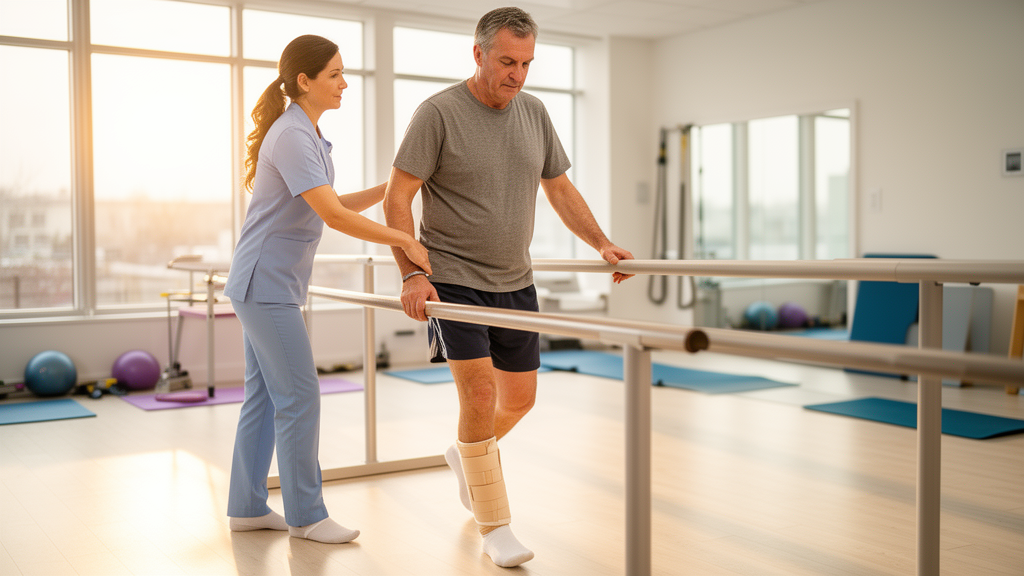
Patients who undergo total ankle replacement may not need the long stretches of immobilisation that have traditionally followed the operation, according to a prospective study published in Archives of Orthopaedic and Trauma Surgery. In a single-arm study of 22 consecutive patients operated on between January 2023 and June 2024, a structured fast-track protocol built around early mobilisation, multimodal pain control and standardised discharge criteria allowed active ankle movement within a median of two days after surgery, assisted walking with crutches within three days, and discharge from hospital after a median stay of 4.5 days. Ankle function, measured with the American Orthopaedic Foot and Ankle Society’s Ankle Hindfoot Scale, rose from a median of 29.0 points before surgery to 68.0 points at discharge, a statistically significant median gain of 39 points.
The study, led by Luca Maria Vena, Lucrezia Moggio, Erminia Cofano, Umile Giuseppe Longo, Pim van Dijk, C. Niek van Dijk, Giorgio Gasparini and Michele Mercurio, was designed to test whether an accelerated recovery pathway could be applied safely to an operation where such protocols have rarely been studied. Total ankle replacement is increasingly used for end-stage ankle osteoarthritis, including post-traumatic disease and rheumatoid arthritis, and preserves joint motion in contrast to ankle arthrodesis, which fuses the joint. While implant design and surgical technique have improved considerably over the past two decades, with contemporary fourth-generation implants reporting short- to medium-term survivorship of 92 to 98 percent at one to two years, the period immediately after surgery has remained conservative, with prolonged immobilisation traditionally recommended to protect soft-tissue healing and the osseous integration of the implant.
The authors argue that this conservatism deserves scrutiny. Prolonged immobilisation and delayed mobilisation may increase the risk of nosocomial complications, delay the return to daily activities and contribute to higher healthcare costs. Fast-track or enhanced recovery protocols have become standard practice in hip and knee arthroplasty, where they consistently deliver earlier mobilisation, shorter hospital stays, fewer perioperative complications and better patient satisfaction. Those protocols typically combine multimodal pain management, early physiotherapy, structured discharge criteria and patient education. Translating them to the ankle, however, is not straightforward. The ankle has a relatively thin soft-tissue envelope with limited coverage, particularly over the front of the joint, and the commonly used anterior surgical approach places the incision at particular risk of wound-healing problems. Those anatomical realities have historically justified postoperative protection and raised legitimate concerns about whether accelerated recovery could compromise the surgical wound.
To address that question, the researchers enrolled consecutive adults undergoing primary total ankle replacement through an anterior approach, performed by a single experienced surgeon using the same implant, the Vantage Total Ankle System. All operations were carried out under spinal anaesthesia with the patient supine and a pneumatic tourniquet at the thigh. A 10 to 14 centimetre anterior longitudinal incision was made between the anterior tibial and extensor hallucis longus tendons, with careful identification and protection of the superficial peroneal nerve and the anterior tibial neurovascular bundle. Tibial and talar bone cuts were made under fluoroscopic guidance, trial components were inserted to assess stability and soft-tissue tension, and the wound was closed with an intradermal suture sealed with cyanoacrylate skin adhesive. Of 28 patients screened, five were excluded for not meeting the inclusion criteria and one declined participation, leaving 22 patients who completed the study, of whom 13 were women and nine were men, with a median age of 54.5 years and a median body mass index of 27.7.
The fast-track protocol itself was detailed and prescriptive. Cryotherapy and early mobilisation began approximately three hours after surgery, with active ankle mobilisation targeted at around six hours. Walker-assisted partial weight-bearing was planned from roughly twelve hours after surgery, provided the patient was clinically stable. From the second postoperative day, patients progressed to crutches with weight-bearing as tolerated, alongside supervised passive and active range-of-motion exercises. By the third day, they continued crutch ambulation and began stair climbing, ascending leading with the operated limb and descending leading with the non-operated limb. Pain control was multimodal: acetaminophen at one gram every twelve hours for five days, an elastomeric pump infusing tramadol at 0.1 milligrams per kilogram per hour for 48 hours, and intravenous dexamethasone at 16 milligrams given 30 minutes before surgery and again 24 hours after. Bleeding control followed a standardised regimen of two grams of intravenous tranexamic acid 20 minutes before surgery, one gram intra-articularly when the capsule was closed, and one gram intravenously at three and six hours after surgery. Pharmacological thromboprophylaxis with once-daily subcutaneous enoxaparin continued until full weight-bearing was regained or for a maximum of 35 days.
The results showed that patients achieved the recovery milestones close to the protocol targets, though the reported times reflect actual achievement rather than the planned schedule. Active ankle mobilisation began at a median of two days, assisted ambulation with crutches at a median of three days, and the median hospital stay was 4.5 days. Wound healing, the outcome many surgeons would consider the key safety question for early mobilisation after an anterior ankle approach, was favourable. The median ASEPSIS wound score at discharge was 4, well below the threshold of 10 that the scoring system defines as satisfactory healing. Eighteen patients scored 4, three scored 3 and one scored 7, and every patient fell below the satisfactory-healing threshold. Only one minor wound complication occurred, and it was managed conservatively. No major wound complications, early infections or prosthesis-related adverse events were observed during the short-term period or across a follow-up of at least 12 months, which the researchers used primarily for safety surveillance.
Beyond the headline outcomes, the study explored whether preoperative function predicted the speed of recovery. Higher preoperative Ankle Hindfoot Scale scores were significantly associated with shorter times to active mobilisation, with each additional point linked to a 3.5 percent reduction in days to mobilisation, and with shorter times to assisted ambulation, a 2.8 percent reduction per point, as well as a shorter hospital stay, a 2.4 percent reduction per point. Higher preoperative scores also showed a trend toward lower ASEPSIS wound scores, roughly two percent per point, though this did not reach statistical significance. The authors fitted generalised linear models with heteroskedasticity-consistent robust standard errors to account for the small sample and explicitly treated these associations as exploratory, stressing that they were not interpreted as causal. Spearman rank correlations confirmed the same pattern for the recovery and stay endpoints.
The authors are careful about what these numbers can and cannot show. Because the study had no control group receiving conventional postoperative care, the findings are descriptive and do not demonstrate superiority of the fast-track protocol. The observed improvements cannot be attributed exclusively to the accelerated pathway, since recovery after any joint replacement is also shaped by the surgical procedure itself, patient characteristics, perioperative management and the natural course of healing. The functional assessment adds a further caveat: the Ankle Hindfoot Scale was measured at discharge, corresponding to a median of roughly five days after surgery, and the authors note that some functional items of the scale may not yet be applicable at that stage and that the recall period overlaps the immediate perioperative phase. They therefore treat the discharge score as an exploratory measure of early postoperative status rather than a definitive assessment of functional recovery. Standardised functional and radiological outcomes were not collected at the 12-month time point, although all patients were followed for at least a year for safety.
Other limitations follow from the design. The sample of 22 patients is small, patients with neurological disorders of the lower limbs were excluded, and clinical scores were not used to evaluate bone quality or mental status, factors that could influence both treatment decisions and rehabilitation in other patient groups. No formal cost-effectiveness analysis was performed, so despite the median hospital stay of 4.5 days, which the authors describe as a preliminary descriptive finding, no conclusions about cost reduction can be drawn. Nevertheless, the study situates itself within a growing body of work on enhanced recovery in foot and ankle surgery, citing previous demonstrations of fast-track feasibility after ankle replacement and large observational evidence from hip and knee arthroplasty, where enhanced recovery protocols have been associated with reductions in length of stay of 30 to 50 percent without increases in readmission or complication rates. The authors also point to physiological rationales for early movement, including reduced stiffness, improved synovial fluid circulation, reduced muscle atrophy and lower rates of thromboembolic and pulmonary complications reported in lower limb arthroplasty more broadly.
Looking forward, the researchers argue that early postoperative gains do not always predict long-term outcomes, and they call for multicentre randomised controlled trials comparing fast-track and standard rehabilitation pathways with both clinical and cost-effectiveness endpoints. They also suggest that individualised rehabilitation strategies, including adaptive physiotherapy programmes and digital tele-rehabilitation platforms, which have shown promising results in hip and knee arthroplasty through continuous monitoring, better adherence and reduced travel burden, could be integrated into ankle replacement recovery protocols. For now, the study’s contribution is a proof of concept: in a carefully selected, consecutively enrolled cohort operated on by a single experienced surgeon with one implant, a structured fast-track pathway after total ankle replacement was feasible, produced early functional recovery, and was accompanied by favourable short-term wound healing and safety outcomes over at least 12 months. Whether it outperforms conventional postoperative care remains a question that only controlled comparative studies with larger cohorts and longer follow-up can answer.
Subject of Research: Feasibility and short-term outcomes of a fast-track recovery protocol after total ankle replacement
Article Title: Clinical outcomes and feasibility of a fast-track protocol after total ankle replacement: a prospective study
Article References: Vena, L. M., Moggio, L., Cofano, E., Longo, U. G., van Dijk, P., van Dijk, C. N., Gasparini, G., & Mercurio, M. (2026). Clinical outcomes and feasibility of a fast-track protocol after total ankle replacement: a prospective study. Archives of Orthopaedic and Trauma Surgery, 146(1), Article 372. https://doi.org/10.1007/s00402-026-06532-9
Image Credits: AI Generated
DOI: 10.1007/s00402-026-06532-9
Keywords: total ankle replacement, fast-track protocol, enhanced recovery, ankle osteoarthritis, early mobilisation, AOFAS Ankle Hindfoot Scale, ASEPSIS wound score, length of hospital stay, wound healing, orthopaedic surgery, prospective study, multimodal pain management
News Source: Ophelia Keating. (October 28, 2026). Fast-track recovery protocol shows early promise after total ankle replacement. Scienmag.



