• HOME
  • NEWS
  • EXPLORE
    • CAREER
      • Companies
      • Jobs
    • EVENTS
    • iGEM
      • News
      • Team
    • PHOTOS
    • VIDEO
    • WIKI
  • BLOG
  • COMMUNITY
    • FACEBOOK
    • INSTAGRAM
    • TWITTER
Thursday, June 25, 2026
BIOENGINEER.ORG
No Result
View All Result
  • Login
  • HOME
  • NEWS
  • EXPLORE
    • CAREER
      • Companies
      • Jobs
        • Lecturer
        • PhD Studentship
        • Postdoc
        • Research Assistant
    • EVENTS
    • iGEM
      • News
      • Team
    • PHOTOS
    • VIDEO
    • WIKI
  • BLOG
  • COMMUNITY
    • FACEBOOK
    • INSTAGRAM
    • TWITTER
  • HOME
  • NEWS
  • EXPLORE
    • CAREER
      • Companies
      • Jobs
        • Lecturer
        • PhD Studentship
        • Postdoc
        • Research Assistant
    • EVENTS
    • iGEM
      • News
      • Team
    • PHOTOS
    • VIDEO
    • WIKI
  • BLOG
  • COMMUNITY
    • FACEBOOK
    • INSTAGRAM
    • TWITTER
No Result
View All Result
Bioengineer.org
No Result
View All Result
Home NEWS Science News

Fast decisions of flying insects

Bioengineer by Bioengineer
January 14, 2021
in Science News
Reading Time: 2 mins read
0
IMAGE
Share on FacebookShare on TwitterShare on LinkedinShare on RedditShare on Telegram

Ten times more skilled at ‘life or death’ reactions
IMAGE

Credit: Flinders Foundation, Jonathan Barge photographer

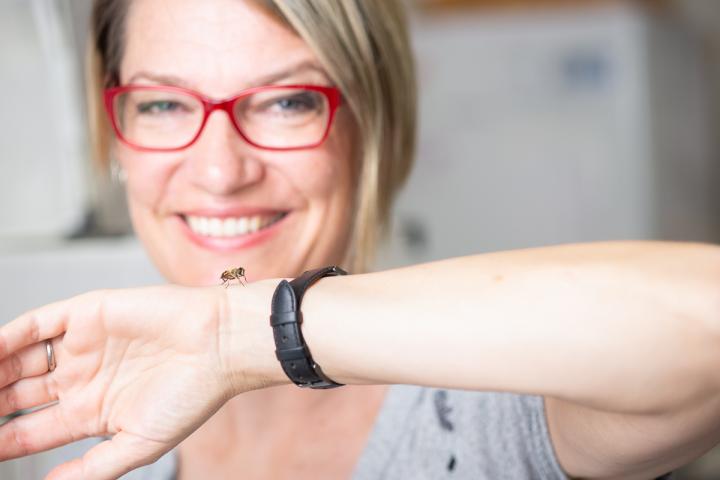
Scientists are homing in on the amazing flying skills of insects. How flying insects are able to respond rapidly and appropriately in a fast-changing surroundings is a serious ambition of new Australian Research Council study.

Led by Flinders University Professor Karin Nordström, and Macquarie University Professor Andrew Barron who will ‘train’ European honeybees, the new ARC project will help unravel how the insects’ movements through the world helps them make rapid decisions.

‘Life or death decisions: making fast, accurate choices in a complex world’ is a $533,000 Discovery Project (DP210100740) that will combine brain recordings with flight analyses and computational modelling to generate new knowledge on how animals may utilise movements to simplify information sampling.

“If you’ve ever tried to swat a fly, you’ll know their response to movement is extremely rapid – about 10 times faster than us,” says ARC Future Fellow Professor Nordström, who leads the hoverfly motion vision research group at Flinders.

“Some insects are so small, but high-performing, we can learn a lot by understanding the neural and behavioural mechanisms that allow them to be very efficient foragers and experts at attacking and evading other insects.”

Findings from this ARC research will inform aspects of autonomous robotics and systems, computational neuroscience, aviation, defence, technologies required for challenging situations such as disaster relief, mining and remote exploration, and even pollination and agricultural applications.

The Flinders University lab has already been surprised by hoverfly responses to target motion, which opens even more questions about how these animals are able to perform optimally, despite carrying small brains and low-resolution compound eyes.

“We know that hoverflies are highly sensitive to movement, so understand how they visualise the world by the way they fly and position their bodies to capitalise on their decision-making will help us understand why they are so efficient at what they do,” says Professor Nordström.

While the Flinders hoverfly lab will investigate the insects’ responses to stimuli on a screen in a confined space, the Macquarie University team led by chief investigator Professor Barron will compare free-flying honeybee flight patterns with a separate group of bees trained to fly to a specific target.

“The ability to train bees, then determining how they fly to a pre-determined target, will allow us to understand whether they adjust their flight path when, for example, a flower is harder to see,” says Professor Baron, ARC Future Fellow at the Macquarie University’s Department of Biological Sciences.

###

References:

Nicholas, S and Nordström, K (2020) Persistent firing and adaptation in optic-flow-sensitive descending neurons Curr Biol 30(14): P2739-2742.E2

Nicholas, S, Leibbrandt, R and Nordström, K (2020) Visual motion sensitivity in descending neurons in the hoverfly J Comp Physiol A 206(2):149-163

Media Contact
Professor Karin Nordström
[email protected]

Tags: BiologyBiomechanics/BiophysicsMechanical EngineeringTechnology/Engineering/Computer ScienceVehicles
Share12Tweet8Share2ShareShareShare2

Related Posts

Tracking Lanthanide-Labeled Microplastics in Plants

June 25, 2026

POSTECH Researchers Slash Cost of Reconstituted Cell-Free Systems by 95%

June 25, 2026

AI and Physics Collaborate to Design Advanced Hydrogen Storage Materials

June 25, 2026

Natural Hallucinogens: Evolution’s Ecological Tools, Not Mere Chemical Byproducts

June 25, 2026
Please login to join discussion

POPULAR NEWS

  • Saying Goodbye to PGY-6: Pediatric Fellowship Realities

    103 shares
    Share 41 Tweet 26
  • Multi-Hospital Study Reveals Long Covid Burden Is Twice as High as Current Estimates

    92 shares
    Share 36 Tweet 23
  • Detection of EDCs in Breast Milk and Infant Urine Up to Six Months Highlights Early Exposure Risks

    77 shares
    Share 31 Tweet 19
  • New Drug Candidate Developed at McMaster Shows Potential for Treating Brain Cancer

    58 shares
    Share 23 Tweet 15

About

We bring you the latest biotechnology news from best research centers and universities around the world. Check our website.

Follow us

Recent News

Tracking Lanthanide-Labeled Microplastics in Plants

POSTECH Researchers Slash Cost of Reconstituted Cell-Free Systems by 95%

AI and Physics Collaborate to Design Advanced Hydrogen Storage Materials

Subscribe to Blog via Email

Enter your email address to subscribe to this blog and receive notifications of new posts by email.

Join 82 other subscribers
  • Contact Us

Bioengineer.org © Copyright 2023 All Rights Reserved.

Welcome Back!

Login to your account below

Forgotten Password?

Retrieve your password

Please enter your username or email address to reset your password.

Log In
No Result
View All Result
  • Homepages
    • Home Page 1
    • Home Page 2
  • News
  • National
  • Business
  • Health
  • Lifestyle
  • Science

Bioengineer.org © Copyright 2023 All Rights Reserved.