• HOME
  • NEWS
  • EXPLORE
    • CAREER
      • Companies
      • Jobs
    • EVENTS
    • iGEM
      • News
      • Team
    • PHOTOS
    • VIDEO
    • WIKI
  • BLOG
  • COMMUNITY
    • FACEBOOK
    • INSTAGRAM
    • TWITTER
Saturday, July 11, 2026
BIOENGINEER.ORG
No Result
View All Result
  • Login
  • HOME
  • NEWS
  • EXPLORE
    • CAREER
      • Companies
      • Jobs
        • Lecturer
        • PhD Studentship
        • Postdoc
        • Research Assistant
    • EVENTS
    • iGEM
      • News
      • Team
    • PHOTOS
    • VIDEO
    • WIKI
  • BLOG
  • COMMUNITY
    • FACEBOOK
    • INSTAGRAM
    • TWITTER
  • HOME
  • NEWS
  • EXPLORE
    • CAREER
      • Companies
      • Jobs
        • Lecturer
        • PhD Studentship
        • Postdoc
        • Research Assistant
    • EVENTS
    • iGEM
      • News
      • Team
    • PHOTOS
    • VIDEO
    • WIKI
  • BLOG
  • COMMUNITY
    • FACEBOOK
    • INSTAGRAM
    • TWITTER
No Result
View All Result
Bioengineer.org
No Result
View All Result
Home NEWS Science News Biology

Fast, cheap and colorful 3D printing

Bioengineer by Bioengineer
August 1, 2018
in Biology
Reading Time: 2 mins read
0
Share on FacebookShare on TwitterShare on LinkedinShare on RedditShare on Telegram
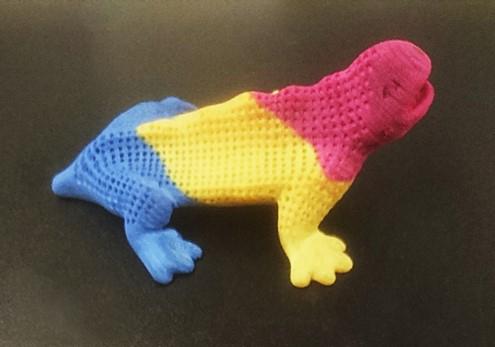
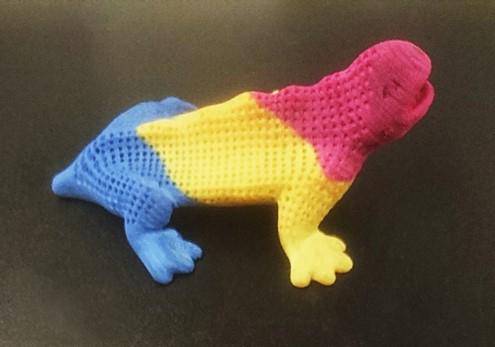
IMAGE

Credit: American Chemical Society

People are exploring the use of 3D printing for wide-ranging applications, including manufacturing, medical devices, fashion and even food. But one of the most efficient forms of 3D printing suffers from a major drawback: It can only print objects that are gray or black in color. Now, researchers have tweaked the method so it can print in all of the colors of the rainbow. They report their results in the ACS journal Nano Letters.

Selective laser sintering (SLS) printers use a laser to heat specific regions of a powdered material, typically nylon or polyamide, so that the powder melts or sinters to form a solid mass. The printer adds then selectively sinters new powdered material layer by layer until the desired 3D structure is obtained. To reduce the energy requirements of the process, researchers have added compounds called photosensitizers to the polymer powders. These materials, such as carbon nanotubes, carbon black and graphene, absorb light much more strongly than the polymers and transfer heat to them, enabling the use of cheaper, lower-power lasers. However, the carbon-based photosensitizers can only produce printed objects that are gray or black. Gerasimos Konstantatos, Romain Quidant and their coworkers at The Institute of Photonic Sciences (IFCO) wanted to find a photosensitizer that would enable color printing by the SLS method.

The researchers designed gold nanorods to strongly absorb in the near-infrared region of the spectrum while being almost transparent to visible light. They coated them with silica and then mixed them with polyamide powders to print 3D objects. They found that the gold nanorods were much better at converting light from the laser to heat than carbon black, the industry standard. Also, the new photosensitizers could produce much whiter and — when mixed with dyes — brightly colored 3D objects. Importantly, the materials are cost-effective for large-scale production. The researchers have filed several patent applications related to the new technology.

###

The authors acknowledge funding from the European Research Council, Fundació Privada Cellex, the Research Centers of Catalonia (CERCA) and the Severo Ochoa program of the Spanish Ministry of Economy and Business.

The abstract that accompanies this study is available here.

The American Chemical Society, the world's largest scientific society, is a not-for-profit organization chartered by the U.S. Congress. ACS is a global leader in providing access to chemistry-related information and research through its multiple databases, peer-reviewed journals and scientific conferences. ACS does not conduct research, but publishes and publicizes peer-reviewed scientific studies. Its main offices are in Washington, D.C., and Columbus, Ohio.

To automatically receive news releases from the American Chemical Society, contact [email protected].

Follow us on Twitter | Facebook

Media Contact

Katie Cottingham
[email protected]
301-775-8455
@ACSpressroom

http://www.acs.org

Related Journal Article

http://dx.doi.org/10.1021/acs.nanolett.8b01164

Share12Tweet8Share2ShareShareShare2

Related Posts

Han directs new $15M NIH center for organ-on-chip technology

Han directs new $15M NIH center for organ-on-chip technology

July 11, 2026
Bacteriophages Enable Next-Gen Smart Pathogen Detection Sensors

Bacteriophages Enable Next-Gen Smart Pathogen Detection Sensors

July 10, 2026

Temperature Fluctuations Have Greater Impact Than Previously Believed

July 10, 2026

New Study Uncovers Biology Behind Glioma Cancer Progression

July 10, 2026
Please login to join discussion

POPULAR NEWS

  • Detection of EDCs in Breast Milk and Infant Urine Up to Six Months Highlights Early Exposure Risks

    77 shares
    Share 31 Tweet 19
  • New Drug Candidate Developed at McMaster Shows Potential for Treating Brain Cancer

    58 shares
    Share 23 Tweet 15
  • KTU Researchers Explore Ultrasound’s Role in Enhancing Blood Flow Beyond Diagnostics

    53 shares
    Share 21 Tweet 13
  • é«˜é½¢č€…ć®éŖØē²—é¬†ē—‡ę²»ē™‚ć®ęŒē¶šę€§ęÆ”č¼ƒ

    51 shares
    Share 20 Tweet 13

About

We bring you the latest biotechnology news from best research centers and universities around the world. Check our website.

Follow us

Recent News

Ultra-fine bubbles revolutionize future of inkjet printing technology

Polyunsaturated Fatty Acid Synthesis Influences Ferroptosis Sensitivity with Low Arachidonic Acid

Real-Time Pain and Activity Patterns in Older Adults with Chronic Pain

Subscribe to Blog via Email

Success! An email was just sent to confirm your subscription. Please find the email now and click 'Confirm' to start subscribing.

Join 84 other subscribers
  • Contact Us

Bioengineer.org Ā© Copyright 2023 All Rights Reserved.

Welcome Back!

Login to your account below

Forgotten Password?

Retrieve your password

Please enter your username or email address to reset your password.

Log In
No Result
View All Result
  • Homepages
    • Home Page 1
    • Home Page 2
  • News
  • National
  • Business
  • Health
  • Lifestyle
  • Science

Bioengineer.org Ā© Copyright 2023 All Rights Reserved.