As the global population continues to age and grow, the demand for protein-rich food is also expected to increase concurrently. This has also caused concerns on increasing greenhouse gases, land and water consumption associated with the conventional rearing of animals for food.
Credit: Credit to SUTD
As the global population continues to age and grow, the demand for protein-rich food is also expected to increase concurrently. This has also caused concerns on increasing greenhouse gases, land and water consumption associated with the conventional rearing of animals for food.
In some parts of Africa, Asia and South America, people have already been turning to alternative sources of proteins from insects, plants and algae for sustainable, nutrient-rich food. However, the idea of consuming insects might be an uncomfortable concept to digest for the rest of the world.
“The appearance and taste of such alternative proteins can be disconcerting for many. This is where the versatility of 3D food printing rises to the challenge as it can transform the way in which food is presented and overcome the inertia of consumer inhibitions,” explained Prof Chua Chee Kai, co-author from the Singapore University of Technology and Design (SUTD).
For instance, commonly known foods like carrots can be mixed with alternative proteins such as crickets to produce a more familiar taste to consumers. This mixture of carrots and crickets can then be extruded by a 3D food printer to create a visually appealing dish that would appeal to the senses.
However, the combining of different food inks and optimising it for 3D food printing is known to be a laborious task as it is usually done using a trial and error-based approach.
Prof Chua and team from SUTD collaborated with researchers from Khoo Teck Puat Hospital (KTPH) and University of Electronic Science and Technology of China (UESTC) to devise a systematic engineering approach to efficiently incorporate alternative proteins into food inks. Using this approach for the optimisation of protein inks, the research team minimised time and resources by reducing experimental runs.
In their study, ‘Systematic Engineering approach for optimization of multi-component alternative protein-fortified 3D printing food Ink’ which was published in Food Hydrocolloids, the team used the established engineering technique, Response Surface Methodology, and applied it for use in 3D food printing.
Prof Yi Zhang, the principal investigator from UESTC explained: “Alternative proteins may become our main source of protein intake in the future. This study proposes a systematic engineering approach of optimising food inks, thereby enabling easy creations and customisations of visually pleasing, flavourful and nutritionally adequate food enhanced with alternative proteins. We hope our work would encourage consumers to eat more of these unfamiliar, but sustainable food items”.
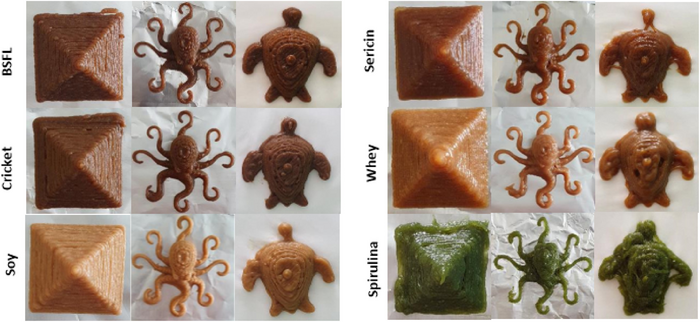
The research team used the central composite design approach to optimise the protein ink formulations having three variables – carrot powder, proteins and xanthan gum. Carrot powder helped provide mechanical strength as well as taste, nutrients and colour to the formulated inks.
Meanwhile, they experimented with alternative proteins such as soy, spirulina, cricket, black soldier fly larvae and sericin. Formulated inks were tested experimentally for 3D printability and syneresis with optimised inks achieving maximum printability and minimal syneresis.
Aakanksha Pant, corresponding author of the paper and Research Associate from SUTD added: “This research study can also be generalised for other food ingredients and response of the food inks like texture, printability, water seepage may be included for optimisation. The response surface method approach may lead researchers to adopt similar method for optimising 3DFP food inks constituting complex multicomponent food ingredients.”
Journal
Food Hydrocolloids
DOI
10.1016/j.foodhyd.2022.107803
Article Title
Systematic Engineering approach for optimization of multi-component alternative protein-fortified 3D printing food Ink
Article Publication Date
1-Oct-2022