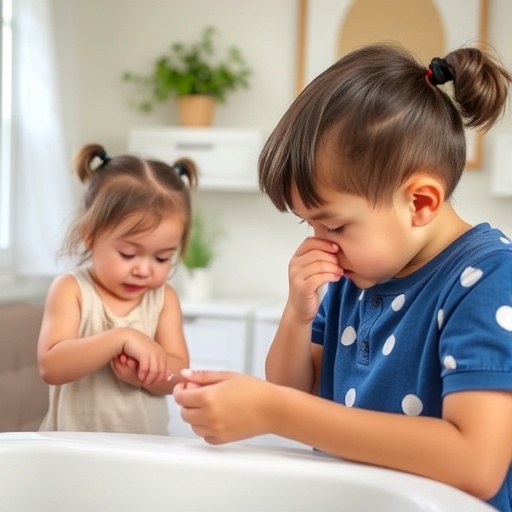
The intricate relationship between indoor environmental conditions and the health of children has long been a subject of public health inquiry, particularly in the context of allergic diseases. While extensive research has elucidated the connection between indoor environmental factors such as the use of solid fuels, structural materials, and home renovations with the development and exacerbation of allergic conditions, a vital piece of the puzzle has remained elusive. The behavioral dynamics of occupants themselves—the nuanced hygiene practices, patterns of indoor ventilation, and usage of household devices—are emerging as significant, yet understudied, contributors to childhood allergies. A pioneering study conducted in Wuhan, China, authored by Zhou, Ren, Tang, and colleagues, addresses this gap by meticulously analyzing how combined exposure to these behavioral factors influences allergic disease prevalence in children, thereby opening new avenues for preventive strategies.
Indoor environmental health research has traditionally focused on tangible elements: pollutants emitted from cooking fuels, volatile organic compounds leaching from building materials, and exposure to renovation-related dust and chemicals. These studies have laid a solid foundation, enabling better architectural and policy measures to mitigate indoor air pollution. However, the behavior of individuals inhabiting these spaces often modulates exposure levels in subtle but profound ways. For instance, the frequency and quality of ventilation can either exacerbate or alleviate pollutant concentrations, and hygiene practices can influence microbial environments which are known to affect the immune responses implicated in allergies. This new research underscores that it is not enough to consider static environmental factors alone; dynamic human behaviors within the indoor microenvironment must also be integrated into risk assessment models.
The Wuhan study deployed a cross-sectional design encompassing a representative cohort of families, carefully capturing a composite profile of indoor behaviors along with environmental and health data. This approach enabled the researchers to parse out the intertwined effects of hygiene practices, ventilation habits, and device usage—such as air conditioners, heaters, and humidifiers—on the incidence of allergic diseases like asthma, eczema, and allergic rhinitis among children. The rigor of their data collection, including validated questionnaires and environmental assessments, provides a robust framework to discern associations beyond mere correlations, thus advancing our mechanistic understanding of how lifestyle choices within the household shape health outcomes.
A central finding of the investigation reveals that mixed exposure to suboptimal hygiene behaviors and inadequate ventilation correlates strongly with increased rates of childhood allergic diseases. Poor ventilation can lead to a build-up of indoor allergens, including dust mites, pet dander, and mold spores, which are potent triggers of allergic reactions. Moreover, the research highlights that habitual use of certain indoor devices without appropriate ventilation exacerbates this risk by contributing to indoor air pollution. These results suggest a complex interaction where the cumulative burden of various behavioral factors creates an environment conducive to the initiation and aggravation of allergic pathology.
Of particular note is the nuanced role of hygiene practices. Conventional wisdom often promotes rigorous hygiene as a preventive measure against illness; however, this study echoes emerging discourse on the “hygiene hypothesis” by indicating that overly stringent cleaning can disrupt the natural microbial diversity beneficial for immune development. In Wuhan’s urban domestic settings, families exhibiting extremely high hygiene standards, characterized by frequent use of disinfectants and avoidance of outdoor microbial exposure, had children with a higher incidence of allergies. This paradox introduces compelling evidence that balancing hygiene to maintain microbial diversity is crucial in allergy prevention.
Ventilation, often an underappreciated factor in indoor environmental quality, emerged as a pivotal determinant of allergic disease risk. The research delineates two critical dimensions: the frequency with which families ventilate their homes and the methods they employ. Traditional cross-ventilation using windows and doors was found significantly more effective in mitigating allergen accumulation than sole reliance on mechanical ventilation devices, which may recirculate potentially contaminated air if filters are not properly maintained. Thus, the study advocates for public health messaging that encourages natural ventilation practices supplemented by responsible device usage.
Indoor devices such as humidifiers, air conditioners, and heaters are ubiquitous in many households, especially in climates like Wuhan’s, which experiences distinct seasons. The study meticulously evaluated how the usage patterns of these devices interact with ventilation and hygiene practices to influence allergic outcomes. Humidifiers, for example, when used improperly, can foster mold growth and increase allergen load, whereas air conditioners without regular filter cleaning can harbor dust mites and bacteria. These findings bring to the fore the importance of maintenance, not just ownership, in leveraging technology to promote healthy indoor environments.
A noteworthy contribution of this research is its adoption of a mixed-exposure model, recognizing that children are rarely subjected to a single risk factor in isolation. By examining combinations of hygiene, ventilation, and device use, the study elucidates the synergistic effects that amplify allergic disease risk, a perspective that single-factor analyses may miss. This holistic approach aligns well with contemporary environmental epidemiology, which increasingly appreciates the complexity of multifactorial exposures and their cumulative impact on disease etiology.
From a technical perspective, the study employed advanced statistical modeling techniques to control for confounders such as socioeconomic status, parental history of allergies, and urban versus suburban dwelling. This allowed the researchers to isolate the effect of indoor behavioral factors on childhood allergic diseases with higher confidence. The inclusion of objective measures, such as air quality indices and microbial assessments in select households, further enriched the data, bridging subjective behavior reports with measurable environmental conditions.
The implications of these findings extend beyond the scientific community into public policy and urban planning. Addressing childhood allergic diseases requires integration of behavioral guidelines within housing standards and health education programs. For example, policies incentivizing the design of homes with optimal natural ventilation or subsidizing maintenance services for indoor air devices could substantially reduce allergen exposure. Furthermore, awareness campaigns aimed at educating parents about balanced hygiene and effective ventilation practices can empower families to create healthier living environments.
This research also intersects with the burgeoning field of exposomics, which aims to characterize the totality of environmental exposures across the lifespan. By incorporating behavioral elements into exposomic assessments, studies such as this Wuhan investigation enrich exposure profiles, enabling precision public health initiatives tailored to individual household dynamics. The study thus serves as a model for transdisciplinary research integrating behavioral science, environmental health, and epidemiology.
Critically, while providing novel insights, the cross-sectional nature of the Wuhan study does limit causal inference; longitudinal studies will be necessary to confirm temporality and causality. Additionally, cultural and regional specificities in behavior and housing configurations suggest the need for similar investigations in diverse global settings to validate and generalize these findings. Nonetheless, the rigor and scope of this research represent a significant advance in understanding the behavioral ecology of childhood allergic diseases.
In conclusion, the intricate interplay between family hygiene practices, indoor ventilation habits, and device usage significantly shapes the landscape of childhood allergic disease risk. This paradigm shift from focusing solely on environmental materials and pollutants toward encompassing occupant behavior offers a more comprehensive framework for disease prevention. As urbanization and indoor living continue to intensify worldwide, insights from the Wuhan study provide an invaluable blueprint for mitigating allergic diseases through informed, behaviorally attuned environmental interventions.
The study by Zhou, Ren, Tang, and colleagues invites policymakers, healthcare providers, and families to reconsider indoor living strategies and embrace a balanced, evidence-based approach to hygiene and ventilation. Such measures hold promise not only for alleviating the growing burden of childhood allergic diseases but also for enhancing overall respiratory health and quality of life. Ultimately, this research highlights that in the quest for healthy homes, human behavior is as critical a factor as the physical environment itself.
Subject of Research: The study investigates the combined impact of family hygiene practices, indoor ventilation, and household device usage on the prevalence of childhood allergic diseases.
Article Title: Associations of mixed exposure to family hygiene practices, indoor ventilation, and device use with childhood allergic diseases: A cross-sectional study in Wuhan, China.
Article References:
Zhou, Z., Ren, Q., Tang, H. et al. Associations of mixed exposure to family hygiene practices, indoor ventilation, and device use with childhood allergic diseases: A cross-sectional study in Wuhan, China. J Expo Sci Environ Epidemiol (2026). https://doi.org/10.1038/s41370-026-00912-4
Image Credits: AI Generated
DOI: 10.1038/s41370-026-00912-4
Keywords: childhood allergic diseases, indoor environmental exposure, family hygiene, indoor ventilation, air quality, household devices, cross-sectional study, epidemiology
Tags: behavioral factors in indoor air qualitychildhood allergy prevention strategiescombined exposure to indoor allergensfamily hygiene and childhood allergieshome renovations and allergic reactionshousehold devices linked to allergic diseaseshygiene practices affecting children’s allergiesindoor environmental health researchindoor pollutant exposure in childrenindoor ventilation impact on kids’ healthsolid fuels and child allergiesventilation patterns and allergy prevalence