For decades, the pursuit of effective pharmacological treatments for autism spectrum disorder (ASD) has been marked by persistent failure, particularly in the critical transition from experimental models to human patients. A recently published peer-reviewed Perspective in the journal Genomic Psychiatry proposes a transformative paradigm shift that could break this impasse: leveraging gene-edited canine models, specifically Shank3 mutant dogs, that exhibit profoundly human-like social behaviors. This synthesis of a decade’s worth of disparate findings highlights the unique evolutionary co-adaptation between dogs and humans, suggesting dogs as a vital new lens through which to explore the genetic and neurobiological underpinnings of autism.
The fundamental challenge in autism drug development arises from the limitations inherent in traditional animal models. Over ninety percent of candidate therapeutics falter before reaching clinical efficacy, primarily because the social deficits hallmarking ASD cannot be fully recapitulated in species that lack comparable social cognition. Rodents, though genetically tractable, do not engage in the same nuanced eye contact and social reciprocity that define human interaction. Primate models, while closer in social complexity, present prohibitive issues involving metabolism, cost, ethics, and crucially, interpretive disparities—macaques interpret direct gaze as threatening rather than affiliative, skewing behavioral readouts. This conceptual bottleneck has stymied progress, leaving a critical translational void between in vitro findings and human outcomes.
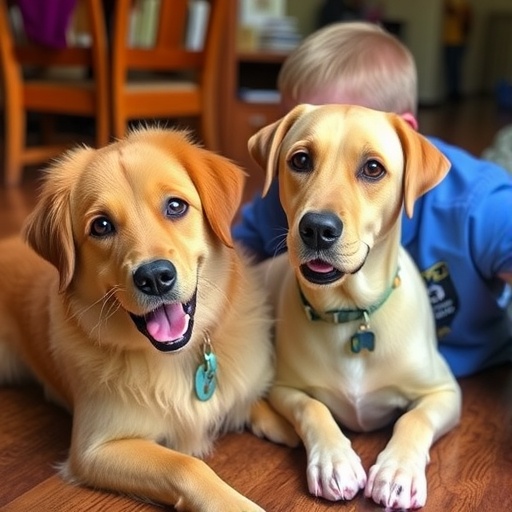
Enter the dog, a species whose evolutionary history is intimately intertwined with humans over approximately thirty thousand years, leading to a unique social attunement. Dr. Siqi Yuan, lead author of the Perspective, emphasizes that dogs did not merely coexist with humans but co-evolved complex social cognition and communication strategies tailored to human interaction. This co-evolution renders them exquisitely sensitive to human social cues, including eye contact, facial expressions, and communicative gestures, attributes starkly absent in other laboratory species. This shared social wiring positions dogs as an optimal candidate model to bridge the current translational gap in autism research.
At the heart of this new modeling approach lies the gene Shank3, a critical scaffold protein involved in synaptic structure and function. Mutations in its human ortholog consistently represent one of the strongest genetic risk factors for ASD. Intriguingly, gene-edited dogs harboring human-relevant Shank3 mutations exhibit a constellation of phenotypes remarkably parallel to human autism. These mutant dogs manifest social withdrawal, altered sensory processing including atypical responses to sound and touch, and a pronounced aversion to sustained human eye contact—the same social gaze avoidance observed clinically in autistic individuals. By compiling these phenotypes into an integrated framework, the authors illuminate a translationally rich behavioral and neurobiological congruence that sets the stage for robust mechanistic investigations.
This emerging canine model offers an unprecedented platform for probing the synaptic and circuit-level disruptions that underlie social impairments in ASD. Moreover, it opens new avenues for testing therapeutic interventions in a biological context that authentically replicates human social cognition. Preliminary findings hint at the potential to ameliorate specific autism-related phenotypes pharmacologically. For example, intranasal administration of oxytocin—a neuropeptide implicated in social bonding—temporarily enhanced social engagement by increasing time spent by mutant mothers licking their pups and prolonged dog gaze on human eyes. Additionally, sub-psychedelic doses of certain compounds restored impaired brain-to-brain synchrony between dogs and their human handlers, an enigmatic signature of effective social interaction disrupted by the mutation. Other agents aimed at rebalancing neural excitation and inhibition showed promise in normalizing tactile sensitivity and fostering social behaviors. While these therapeutic effects are preliminary, derived from limited sample sizes and controlled experimental settings, they underscore the translational potential embedded in this novel model.
The introduction of dogs into genetic neuropsychiatric research inevitably surfaces profound ethical considerations. Dogs occupy a revered and intimate space in human society as companions and family members, engendering heightened moral scrutiny over their use in experimental contexts. The authors confront this ethical tension transparently, grounding their approach in the principles of the three Rs—replacement, reduction, and refinement—and emphasizing rigorous ethical oversight at every experimental step. They recognize the delicate balance between acquiring scientifically meaningful data and minimizing potential distress, thereby ensuring the welfare of animal subjects remains paramount. This ethical rigor is not ancillary but foundational to legitimizing the dog as a research model with translational promise.
Technical hurdles remain substantial but are not insurmountable. Gene editing success rates in canines currently linger at approximately 25%, with certain mutations proving embryonically lethal, limiting available cohorts. Behavioral training to facilitate advanced neuroimaging modalities such as fMRI or electrophysiological recordings demands extensive time investments—often exceeding two years—to habituate dogs to the rigors of stillness and compliance during scans. Consequently, the toolkit for canine neuroscience is embryonic compared to the sophisticated methods established in murine models. Addressing these challenges will necessitate cross-disciplinary collaborations incorporating molecular genetics, veterinary science, ethology, and neuroimaging technology development, alongside innovations in gene-editing precision and minimally invasive behavioral protocols.
Despite these complexities, the authors advocate a cautious but optimistic roadmap. They envision a research ecosystem that integrates dogs not as mere experimental tools but as biological translators—living entities that embody a thirty-millennia evolutionary dialogue with humans and now offer novel insight into the social brain’s genetic architectures. This perspective reframes dogs as partners in deciphering human neurodevelopmental disorders rather than passive subjects, a conceptual shift with profound scientific and ethical implications.
The ramifications for autism research are potentially transformative. By bridging the semantic and behavioral gap between rodent models and human clinical phenotypes, gene-edited dog models may catalyze the identification of drug targets more likely to succeed in human trials. This approach also enables granular studies of dynamic social behaviors inherently inaccessible to in vitro or simpler organism models. Integrating canine genetics, detailed behavioral phenotyping, and emerging neurotechnologies promises a high-fidelity model system that captures the complexity of ASD’s social deficits with unprecedented precision.
Moreover, this perspective aligns with a broader trend emphasizing species-specific behavioral ecology in neuropsychiatric research, underscoring the limits of one-size-fits-all animal models. It champions the principle that the evolutionary context shaping a species’ social brain critically influences its validity as a model for human disorders. This nuanced stance urges the field to adopt more refined, species-appropriate approaches that respect both biological complexity and ethical imperatives.
In conclusion, the convergence of gene editing, behavioral neuroscience, and canine social cognition heralds a compelling new chapter in autism research. While challenges in methodology, ethics, and translational validation remain, the evidence synthesized by Dr. Yuan and colleagues underscores the dog’s unique position to illuminate the genetics of social dysfunction. As we seek to unravel and ultimately treat the biological roots of autism, the humble laboratory Beagle—long a silent companion to scientific progress—may finally help us see ourselves more clearly.
Subject of Research: Animals
Article Title: Emerging gene-edited dog models for autism spectrum disorder
News Publication Date: 24 June 2026
Web References: https://doi.org/10.61373/gp026p.0036
References: Yuan S, Shi Q, Zhao H, Guo K, Jiang Y-H, Zhang YQ. Emerging gene-edited dog models for autism spectrum disorder. Genomic Psychiatry 2026. DOI: https://doi.org/10.61373/gp026p.0036. Epub 2026 Jun 24.
Image Credits: Yong Q. Zhang
Keywords: Autism, Developmental disabilities, Social cognition, Gene editing, Shank3, Dog models, Neuroscience, Neuropsychiatry, Genetic risk factors, Animal models, Behavioral neuroscience, Translational research
Tags: autism spectrum disorder gene-edited canine modelsdogs as models for human social behaviorevolutionary co-adaptation dogs humansgenomic psychiatry autism studieslimitations of rodent models autismneurobiological underpinnings of autismpharmacological treatments autism failureprimate models challenges autism researchShank3 mutant dogs in autism researchsocial behavior deficits in ASDsocial cognition in animal models autismtranslational challenges in autism drug development