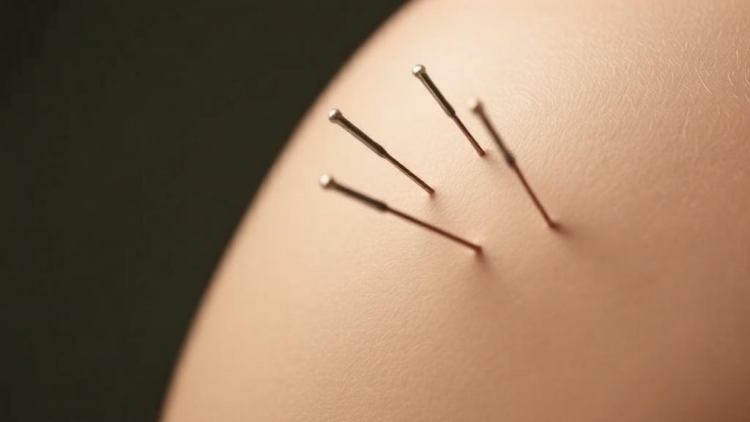
Fake needles can make a real difference in how patients with irritable bowel syndrome feel, according to a sweeping new analysis that quantifies just how powerful the placebo response to acupuncture can be. A team of researchers at Hebei University of Chinese Medicine, working with collaborators in Zhejiang, pooled data from twelve randomized controlled trials covering 977 patients and found that sham acupuncture — needling procedures deliberately designed to have no specific therapeutic effect — produced measurable improvements in symptom severity, quality of life, and abdominal pain. The study, published as a systematic review and meta-analysis in BMC Complementary Medicine and Therapies, offers one of the most detailed portraits yet of how much of acupuncture’s apparent benefit in IBS might be attributable to expectation, ritual, and the therapeutic encounter itself rather than to needle placement at traditional acupoints.
The findings arrive at a moment when irritable bowel syndrome has become one of the most common and frustrating diagnoses in gastroenterology. Classified among disorders of gut-brain interaction, IBS produces abdominal pain, bloating, and disturbed bowel habits in the absence of visible structural damage, and it resists most pharmacological treatments. That therapeutic vacuum has made acupuncture an increasingly popular option, and clinical trials have repeatedly reported that patients improve after a course of needling. But those trials also routinely show that patients receiving sham acupuncture improve nearly as much, raising a question that has shadowed complementary medicine research for decades: how much of the benefit is the needle, and how much is the mind?
To answer it, the researchers searched eight databases — PubMed, Embase, the Cochrane Library, Web of Science Core Collection, and four major Chinese databases including CNKI, Wanfang, VIP, and CBM — from their inception through July 4, 2026. They included only randomized controlled trials in which sham acupuncture served as a comparator in IBS patients, and they registered the protocol prospectively with PROSPERO under the identifier CRD420251035956. The primary outcome was the response rate, the proportion of patients who reported meaningful improvement, while secondary outcomes tracked changes in the IBS Symptom Severity Scale, the IBS Quality of Life scale, and abdominal pain intensity scores. Effect sizes were expressed as risk differences and pooled pre-to-post changes with 95 percent confidence intervals.
The headline numbers are striking. In patients who received sham acupuncture, the combined response rate was 0.38, meaning roughly 38 of every 100 patients treated with a placebo procedure reported feeling meaningfully better. On the IBS Symptom Severity Scale, scores fell by a pooled 60.08 points, with a confidence interval running from 70.62 down to 49.54 points of improvement. Quality of life scores rose by 8.23 points on average, and abdominal pain intensity dropped by 1.39 points on standard rating scales. None of these changes came from needles that penetrated classical acupoints in the way traditional theory prescribes; they emerged entirely from procedures intended to mimic acupuncture without its specific effects.
What does a 60-point drop on the symptom severity scale actually mean in clinical terms? The IBS-SSS is a 500-point instrument that captures pain intensity, pain frequency, bloating, satisfaction with bowel habits, and overall interference with daily life, and clinicians generally regard shifts of 50 points or more as clinically meaningful. By that yardstick, the placebo response documented in this analysis is not a statistical curiosity but a genuine therapeutic effect — one large enough that patients experience it as relief. Similarly, the 1.39-point reduction in pain intensity, measured on visual analog or numerical rating scales, represents a noticeable easing of the cramping and discomfort that define the condition.
Perhaps the most consequential part of the study, however, is not the headline effect size but the heterogeneity hiding beneath it. When the researchers stratified trials by their methodological and diagnostic characteristics, clear patterns emerged. Studies that used the Rome IV diagnostic criteria — the current international standard for defining functional gastrointestinal disorders — tended to report lower placebo responses than those relying on older Rome III or earlier criteria. Trials judged to be at low risk of bias also yielded smaller placebo effects, as did studies that defined treatment response according to the stringent criteria recommended by the U.S. Food and Drug Administration for IBS clinical trials. In other words, the more rigorous and modern the trial, the smaller the apparent power of the sham needle.
That pattern carries a lesson that extends well beyond acupuncture. Placebo responses are not fixed properties of a treatment; they are shaped by how trials are designed, how patients are selected, how outcomes are defined, and how much room subjective judgment has to wander. Older diagnostic criteria that swept in more heterogeneous patient populations, and looser definitions of what counts as a response, both inflate the apparent benefit of an inert procedure. The FDA’s patient-reported outcome requirements, which demand sustained improvement in abdominal pain and stool pattern rather than a fleeting global impression, are specifically engineered to filter out noise — and the analysis suggests they do exactly that, compressing the placebo response toward more conservative estimates.
The mechanisms behind a placebo response of this magnitude are likely multiple and overlapping. Ritualized, hands-on treatment delivers a dense bundle of contextual cues: a practitioner’s attention, the sensory experience of needling, the expectation of relief, and repeated clinical contact over weeks. IBS is, by definition, a disorder of gut-brain interaction, in which visceral sensitivity, stress physiology, and central pain processing are tightly entangled — making it precisely the kind of condition in which expectation and conditioning can plausibly modulate symptoms through real neurophysiological pathways. The gut’s enteric nervous system, its bidirectional communication with the brain via the vagus nerve and hypothalamic-pituitary-adrenal axis, and the endogenous opioid and cannabinoid systems all provide biological conduits through which psychological context can translate into altered gut sensation and motility.
For acupuncture researchers, the implications cut in two directions. On one hand, the substantial placebo response documented here means that any future trial of real acupuncture in IBS must be powered and designed to detect benefits that exceed this baseline — a demanding threshold, given that the sham arm already delivers clinically meaningful improvement to more than a third of patients. On the other hand, the finding does not automatically invalidate acupuncture as a therapy; it reframes the question. If part of acupuncture’s effect in IBS is a potent, ritual-mediated placebo response, some researchers argue that harnessing that response deliberately and ethically could itself be a legitimate clinical strategy, particularly for a condition with few effective drugs. The authors of the analysis note that several factors — diagnostic criteria, risk of bias, and response definitions — can notably influence the size of the placebo component, and that understanding these moderators is essential for interpreting both past and future trials.
For patients and clinicians, the study is a reminder that improvement after treatment is real even when the mechanism is expectation rather than needle stimulation — and that honest science can quantify that effect without dismissing the suffering it relieves. The 977 patients in these twelve trials who felt better after sham acupuncture were not imagining their symptoms fading; their brains and guts were genuinely recalibrating in response to context, ritual, and care. Disentangling how much of acupuncture’s benefit in IBS comes from specific needling effects and how much from this powerful contextual machinery will require trials that meet the highest methodological standards — Rome IV criteria, low risk of bias, and FDA-grade outcome definitions — and the new analysis provides the benchmark against which those trials can now be judged. In the meantime, it stands as one of the clearest quantitative demonstrations that in the contested territory of mind-body medicine, the placebo needle is anything but inert.
Subject of Research: Placebo response to sham acupuncture in patients with irritable bowel syndrome
Article Title: Placebo response of sham acupuncture in patients with irritable bowel syndrome: a systematic review and meta-analysis
Article References: Xiang, P., Wang, X., Li, B., Li, H., Zheng, W., Fan, X., Jiao, J., Wang, Y., Li, J., & She, Y. (2026). Placebo response of sham acupuncture in patients with irritable bowel syndrome: a systematic review and meta-analysis. BMC Complementary Medicine and Therapies. https://doi.org/10.1186/s12906-026-05513-0
Image Credits: AI Generated
DOI: 10.1186/s12906-026-05513-0
Keywords: irritable bowel syndrome, sham acupuncture, placebo response, meta-analysis, systematic review, randomized controlled trials, IBS-SSS, gut-brain interaction, Rome IV criteria, abdominal pain, complementary medicine, clinical trial methodology
Cite Scienmag News
APA MLA Chicago
Ophelia Keating. (October 4, 2026). Fake Needles, Real Relief: Sham Acupuncture Triggers Strong Placebo Response in IBS Patients. Scienmag. https://scienmag.com/fake-needles-real-relief-sham-acupuncture-triggers-strong-placebo-response-in-ibs-patients/
Ophelia Keating. “Fake Needles, Real Relief: Sham Acupuncture Triggers Strong Placebo Response in IBS Patients.” Scienmag, 4 October 2026, https://scienmag.com/fake-needles-real-relief-sham-acupuncture-triggers-strong-placebo-response-in-ibs-patients/. Accessed 4 October 2026.
Ophelia Keating. “Fake Needles, Real Relief: Sham Acupuncture Triggers Strong Placebo Response in IBS Patients.” Scienmag. October 4, 2026. https://scienmag.com/fake-needles-real-relief-sham-acupuncture-triggers-strong-placebo-response-in-ibs-patients/
Copy citation Download RIS
Tags: abdominal painabdominal pain managementacupuncture and quality of lifeclinical trial methodologycomplementary medicinegut-brain interactiongut-brain interaction disordersIBS symptom reliefIBS treatment challengesIBS-SSSirritable bowel syndromemeta-analysismeta-analysis of acupuncture trialsnon-specific effects in alternative medicineplacebo effect in acupunctureplacebo responserandomized controlled trialsrandomized controlled trials in IBSRome IV criteriasham acupuncturesham acupuncture effectivenesssystematic reviewtherapeutic encounter and expectation