• HOME
  • NEWS
  • EXPLORE
    • CAREER
      • Companies
      • Jobs
    • EVENTS
    • iGEM
      • News
      • Team
    • PHOTOS
    • VIDEO
    • WIKI
  • BLOG
  • COMMUNITY
    • FACEBOOK
    • INSTAGRAM
    • TWITTER
Tuesday, September 1, 2026
BIOENGINEER.ORG
No Result
View All Result
  • Login
  • HOME
  • NEWS
  • EXPLORE
    • CAREER
      • Companies
      • Jobs
        • Lecturer
        • PhD Studentship
        • Postdoc
        • Research Assistant
    • EVENTS
    • iGEM
      • News
      • Team
    • PHOTOS
    • VIDEO
    • WIKI
  • BLOG
  • COMMUNITY
    • FACEBOOK
    • INSTAGRAM
    • TWITTER
  • HOME
  • NEWS
  • EXPLORE
    • CAREER
      • Companies
      • Jobs
        • Lecturer
        • PhD Studentship
        • Postdoc
        • Research Assistant
    • EVENTS
    • iGEM
      • News
      • Team
    • PHOTOS
    • VIDEO
    • WIKI
  • BLOG
  • COMMUNITY
    • FACEBOOK
    • INSTAGRAM
    • TWITTER
No Result
View All Result
Bioengineer.org
No Result
View All Result
Home NEWS Science News Biology

‘Fake fin’ discovery reveals new ichthyosaur species

Bioengineer by Bioengineer
October 10, 2017
in Biology
Reading Time: 2 mins read
0
Share on FacebookShare on TwitterShare on LinkedinShare on RedditShare on Telegram
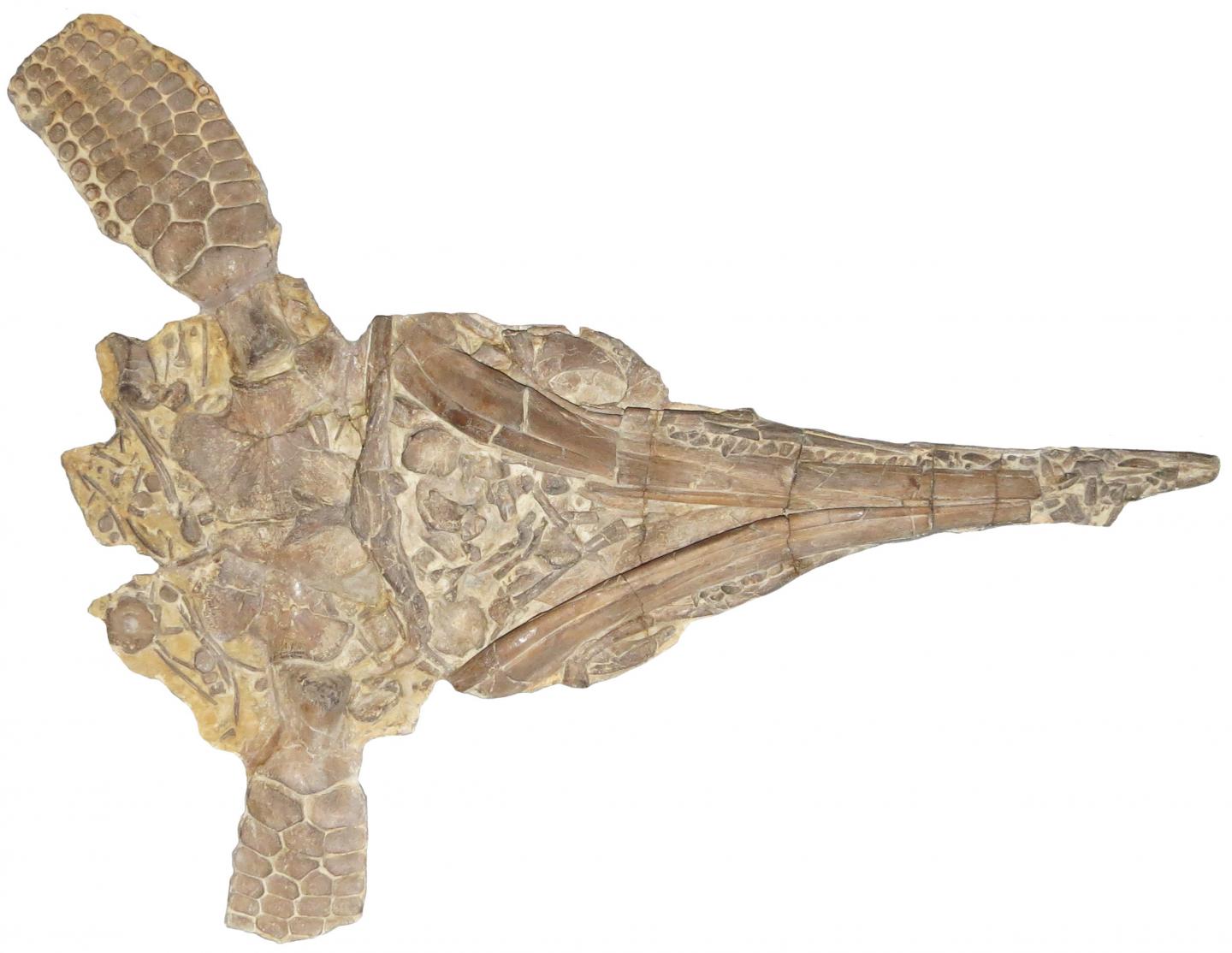
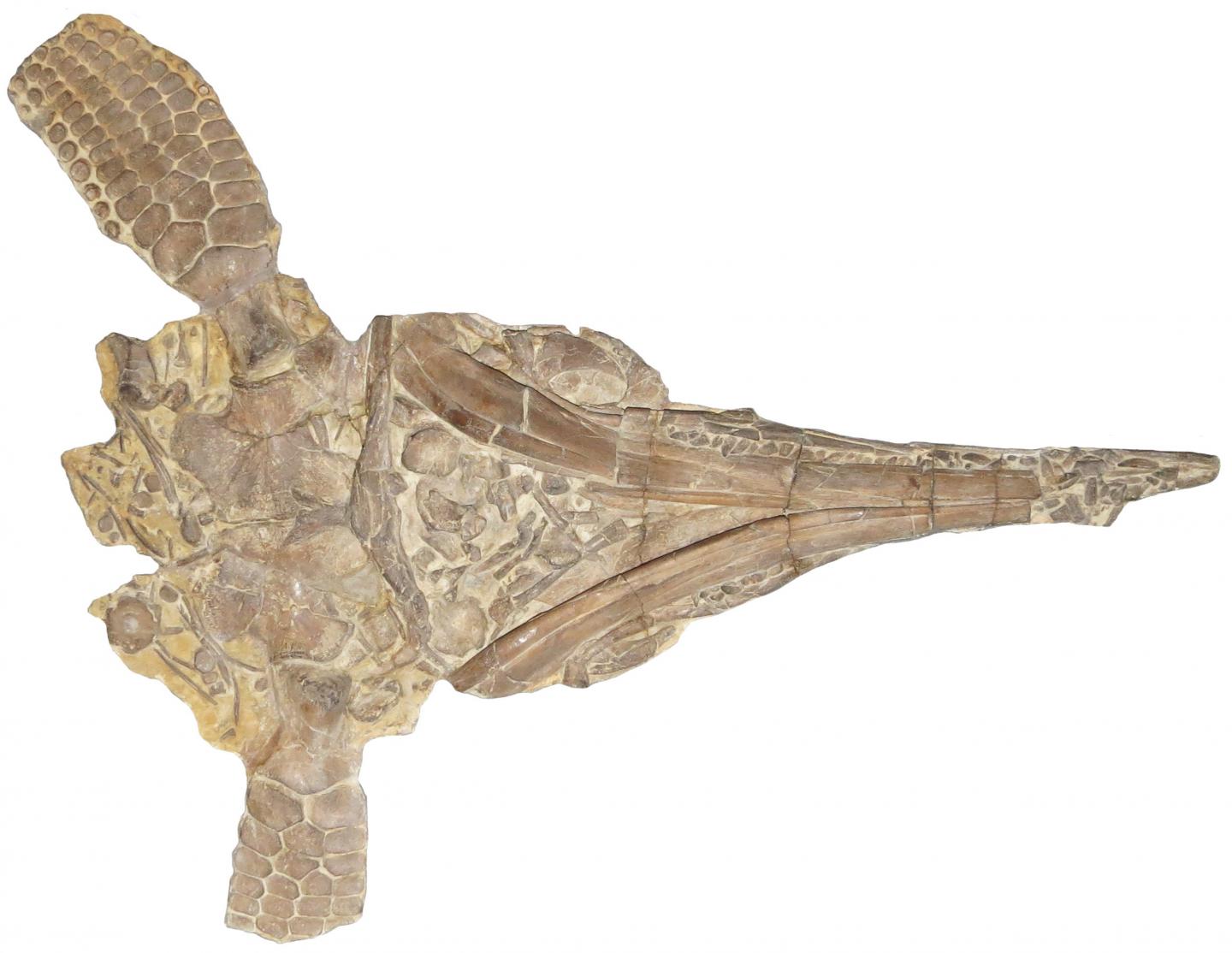
IMAGE

Credit: (c) National Museum of Wales – Dean R. Lomax.jpg

An ichthyosaur first discovered in the 1970s but then dismissed and consigned to museum storerooms across the country has been re-examined and found to be a new species.

In 1979, after inspecting several ichthyosaurs from the UK, palaeontologist Dr Robert Appleby announced a new type of ichthyosaur called Protoichthyosaurus. He also named two species, P. prostaxalis and P. prosostealis. Other scientists, however, dismissed the discovery of Protoichthyosaurus and suggested that it was identical with Ichthyosaurus, a very common UK ichthyosaur.

Now a detailed study led by palaeontologists Dean Lomax (The University of Manchester) and Professor Judy Massare (State University of New York), has re-examined and compared Protoichthyosaurus and Ichthyosaurus. It found major differences in the number of bones in the front fin, or forefin, of both species. This fundamental difference probably reflects the way both species used them to manoeuvre whilst swimming. Differences were also found in the skulls. But it was another discovery about the fins that also got the team's attention.

Lomax explains: "This unusual forefin structure was originally identified by Robert Appleby in 1979, but some of the historic specimens he examined had been 'faked', and this fakery had been missed until now. In some instances, an isolated fin of an Ichthyosaurus had been added to a Protoichthyosaurus skeleton to make it appear more complete, which led to the genuine differences being missed. This has been a major problem because it stopped science from progressing. We also found some pathological fins, including Ichthyosaurus fins with pathologies that mimic the Protoichthyosaurus forefin structure".

Lomax and Massare also teamed up with former undergraduate student Rashmi Mistry (University of Reading), who had been studying an unusual ichthyosaur in the collections of the Cole Museum of Zoology, University of Reading, for her undergraduate dissertation.

"Whilst doing my dissertation in 2016, I studied several ichthyosaurs in the collections, including a very small skeleton. It had an unusual forefin that matched Protoichthyosaurus, which I understood to be a widely unrecognised genus. However, when I contacted Dean, he was very excited. He told me that this little skeleton is the only known small juvenile Protoichthyosaurus", added Rashmi.

Over 20 specimens of Protoichthyosaurus were identified as part of this study. This is significant as each specimen (with a forefin) has the same structure. The specimens are from the Jurassic Period, between 200 – 190 million years old, and come from Somerset, Dorset, Leicestershire, Warwickshire, Nottinghamshire, England, and Glamorgan, Wales.

Whilst searching through collections, Dean also came across a skeleton at The University of Nottingham. This specimen is different to all other known examples of Protoichthyosaurus in the skull and humerus and it has been identified as a new species, which the team have called Protoichthyosaurus applebyi, in honour of Robert Appleby. It is currently on display as part of the 'Dinosaurs of China' exhibition at Lakeside Arts, University of Nottingham.

###

The new study has been published today in the scientific journal, Journal of Vertebrate Paleontology.

Media Contact

Jordan kenny
[email protected]
44-016-127-58257
@UoMNews

http://www.manchester.ac.uk

Related Journal Article

http://dx.doi.org/10.1080/02724634.2017.1361433

Share12Tweet8Share2ShareShareShare2

Related Posts

Methylation puts parasites in motion

Methylation puts parasites in motion

August 31, 2026
Desiccation promotes DNA damage and rifampin resistance in Mycobacterium tuberculosis

Desiccation promotes DNA damage and rifampin resistance in Mycobacterium tuberculosis

August 31, 2026

Gastrointestinal Parasitism in Cattle and Water Buffaloes in Pakistan: Prevalence and Associated Risk Factors

August 31, 2026

Development of HPLC–PDA method for steviol glycosides analysis in food matrices

August 31, 2026
Please login to join discussion

POPULAR NEWS

  • β-Sitosterol from Ipomoea carnea Jacq. As a promising anti-inflammatory agent: Evidence from in silico modeling and in vitro validation

    29 shares
    Share 12 Tweet 7
  • Design, fabrication and characterization of a wearable Fiber Bragg grating sensor for cardiorespiratory monitoring using finger plethysmography

    29 shares
    Share 12 Tweet 7
  • KAIST opens the era of industrial-scale microbial foods, proposing growth strategies for the next-generation protein market

    29 shares
    Share 12 Tweet 7
  • Virologist awarded $2 million NIH grant to investigate how virus-infected cells live and die

    29 shares
    Share 12 Tweet 7

About

We bring you the latest biotechnology news from best research centers and universities around the world. Check our website.

Follow us

Recent News

β-Sitosterol from Ipomoea carnea Jacq. As a promising anti-inflammatory agent: Evidence from in silico modeling and in vitro validation

Design, fabrication and characterization of a wearable Fiber Bragg grating sensor for cardiorespiratory monitoring using finger plethysmography

KAIST opens the era of industrial-scale microbial foods, proposing growth strategies for the next-generation protein market

Subscribe to Blog via Email

Enter your email address to subscribe to this blog and receive notifications of new posts by email.

Join 85 other subscribers
  • Contact Us

Bioengineer.org © Copyright 2023 All Rights Reserved.

Welcome Back!

Login to your account below

Forgotten Password?

Retrieve your password

Please enter your username or email address to reset your password.

Log In
No Result
View All Result
  • Homepages
    • Home Page 1
    • Home Page 2
  • News
  • National
  • Business
  • Health
  • Lifestyle
  • Science

Bioengineer.org © Copyright 2023 All Rights Reserved.