• HOME
  • NEWS
  • EXPLORE
    • CAREER
      • Companies
      • Jobs
    • EVENTS
    • iGEM
      • News
      • Team
    • PHOTOS
    • VIDEO
    • WIKI
  • BLOG
  • COMMUNITY
    • FACEBOOK
    • INSTAGRAM
    • TWITTER
Wednesday, July 22, 2026
BIOENGINEER.ORG
No Result
View All Result
  • Login
  • HOME
  • NEWS
  • EXPLORE
    • CAREER
      • Companies
      • Jobs
        • Lecturer
        • PhD Studentship
        • Postdoc
        • Research Assistant
    • EVENTS
    • iGEM
      • News
      • Team
    • PHOTOS
    • VIDEO
    • WIKI
  • BLOG
  • COMMUNITY
    • FACEBOOK
    • INSTAGRAM
    • TWITTER
  • HOME
  • NEWS
  • EXPLORE
    • CAREER
      • Companies
      • Jobs
        • Lecturer
        • PhD Studentship
        • Postdoc
        • Research Assistant
    • EVENTS
    • iGEM
      • News
      • Team
    • PHOTOS
    • VIDEO
    • WIKI
  • BLOG
  • COMMUNITY
    • FACEBOOK
    • INSTAGRAM
    • TWITTER
No Result
View All Result
Bioengineer.org
No Result
View All Result
Home NEWS Science News Chemistry

Extremely low thermal conductivity in 1D soft chain structure BiSeX (X = Br, I)

Bioengineer by Bioengineer
June 19, 2020
in Chemistry
Reading Time: 2 mins read
0
IMAGE
Share on FacebookShare on TwitterShare on LinkedinShare on RedditShare on Telegram

IMAGE

Credit: ©Science China Press

The low thermal transport properties are important for applications in thermoelectrics and thermal barrier coatings. Nowadays, the strategies to acquire low thermal conductivity in bulk materials include multi-scale defect (atomic, nano- and meso-scale), heavy molecular weight, complex crystal structure, larger unit cell and strong anharmonicity.

In a recent article in Science China Materials, Prof. Li-Dong Zhao from Beihang University and co-workers proposed a new strategy to search intrinsically low thermal conductivity in one-dimensional crystal structure. By using the first-principles calculations and experimental synthesis, they found a sort of material with extremely low thermal conductivity, namely BiSeX (X= Br, I) with one-dimensional chain structure. The mechanisms behind the low thermal conductivity were revealed from the aspect of crystal structure, by neutron powder-diffraction measurements and temperature tunable aberration-corrected scanning transmission electron microscopy (STEM).

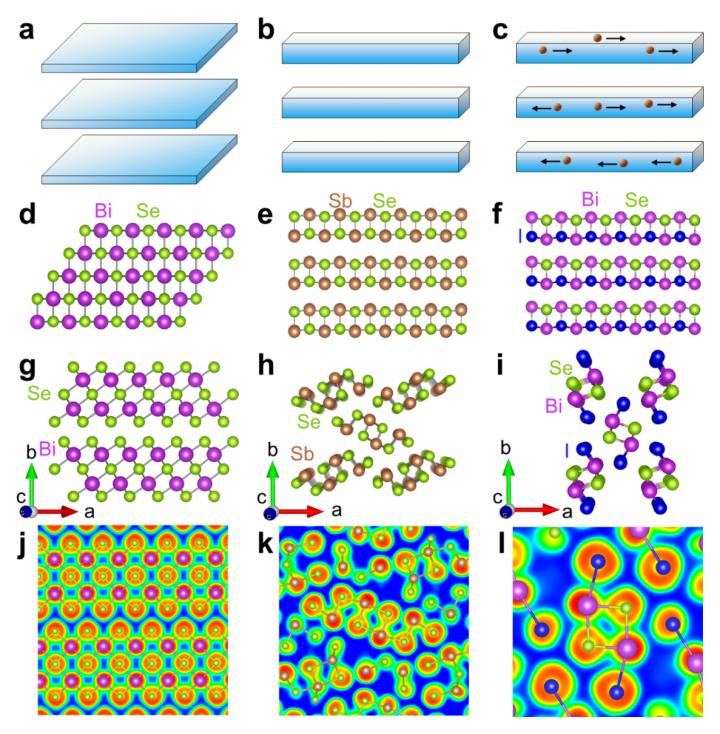
To elucidate the origins of ultralow thermal conductivity, the authors make comparisons with several analogues that exhibit cubic- (3D), layer- (2D) and chain-like (1D) crystal structures and find that the thermal conductivity shows a decreasing trend from 3D, 2D to 1D (Fig. 1), which is due to the chemical bonding strength between the low-dimensional structure becoming progressively weaker and weaker.

“Based on these guidelines, we found that the chemical bonding along the chain further weakened with added halogen atom”, said Prof. Zhao. Therefore, the chemical bondings of BiSeX along all three crystallographic directions are weaker than in other compounds (Fig. 2), showing a quasi-0D crystal structure.

Different from the ultrahigh thermal conductivity diamond (> 2000 W m-1 K-1) with strong covalent bond between carbon atoms, the phonon transport in bismuth selenohalides was significantly suppressed. As a result, they exhibit extremely low thermal conductivity. “The thermal conductivity of BiSeI at 573 K reaches ~0.27 W m-1 K-1, which is close to the theoretical minimum value”, emphasized by Prof. Zhao.

These findings open up a prospect of achieving low thermal conductivity materials in one-dimensional chain-containing bulk structure with potential applications in the fields of thermal barrier coatings, thermoelectric materials, etc.

###

This work was published online in Science China Materials and highlighted by Science (Science, 368 (2020) 1325.) (Fig. 3).

This work was supported by the National Key Research and Development Program of China (2018YFA0702100, 2018YFB0703600), the National Natural Science Foundation of China (51772012, 51632005), the National Science Foundation for Distinguished Young Scholars (51925101), Shenzhen Peacock Plan team (KQTD2016022619565991), Beijing Natural Science Foundation (JQ18004), China Postdoctoral Science Foundation Grant (2019M650429) and 111 Project (B17002).

See the article: D. Wang, et al. “Extremely low thermal conductivity from bismuth selenohalides with 1D soft crystal structure”. Science China Materials (2020) (https://doi.org/10.1007/s40843-020-1407-x)

Media Contact
Li-Dong Zhao
[email protected]

Related Journal Article

http://dx.doi.org/10.1007/s40843-020-1407-x

Tags: Chemistry/Physics/Materials Sciences
Share13Tweet8Share2ShareShareShare2

Related Posts

Researchers Enhance Hydrogen Production with Single-Element Dual-Site Substitution

Researchers Enhance Hydrogen Production with Single-Element Dual-Site Substitution

July 17, 2026
Satellite Observations Improve Global Mapping of Soil Moisture

Satellite Observations Improve Global Mapping of Soil Moisture

July 17, 2026

Noble Metal-Modified Zinc Oxide Nanoflakes Show Enhanced Gas Sensing Properties

July 17, 2026

Y-Added FeCoNiSiB Amorphous Multi-Principal Alloys Demonstrate Enhanced Performance

July 17, 2026
Please login to join discussion

POPULAR NEWS

  • Groundbreaking Discovery: New Shark Species Identified for the First Time — Technology and Engineering

    Groundbreaking Discovery: New Shark Species Identified for the First Time

    34 shares
    Share 14 Tweet 9
  • Controlled Study Defines Pediatric Long COVID Features

    32 shares
    Share 13 Tweet 8
  • Behavioral Nudge Boosts Medication Prescriptions for Alcohol Reduction

    35 shares
    Share 14 Tweet 9
  • Clean Cooking and Remittances Slash Somalia’s Ecological Footprints

    31 shares
    Share 12 Tweet 8

About

We bring you the latest biotechnology news from best research centers and universities around the world. Check our website.

Follow us

Recent News

Sleep Quality Links Synergistically with Frailty to Increase Cardiometabolic Multimorbidity in Elderly Chinese

Cognitive reserve helps older adults resist frailty and recover better

Physical Activity and Health Inequality in China’s Older Adults

Subscribe to Blog via Email

Success! An email was just sent to confirm your subscription. Please find the email now and click 'Confirm' to start subscribing.

Join 85 other subscribers
  • Contact Us

Bioengineer.org © Copyright 2023 All Rights Reserved.

Welcome Back!

Login to your account below

Forgotten Password?

Retrieve your password

Please enter your username or email address to reset your password.

Log In
No Result
View All Result
  • Homepages
    • Home Page 1
    • Home Page 2
  • News
  • National
  • Business
  • Health
  • Lifestyle
  • Science

Bioengineer.org © Copyright 2023 All Rights Reserved.