


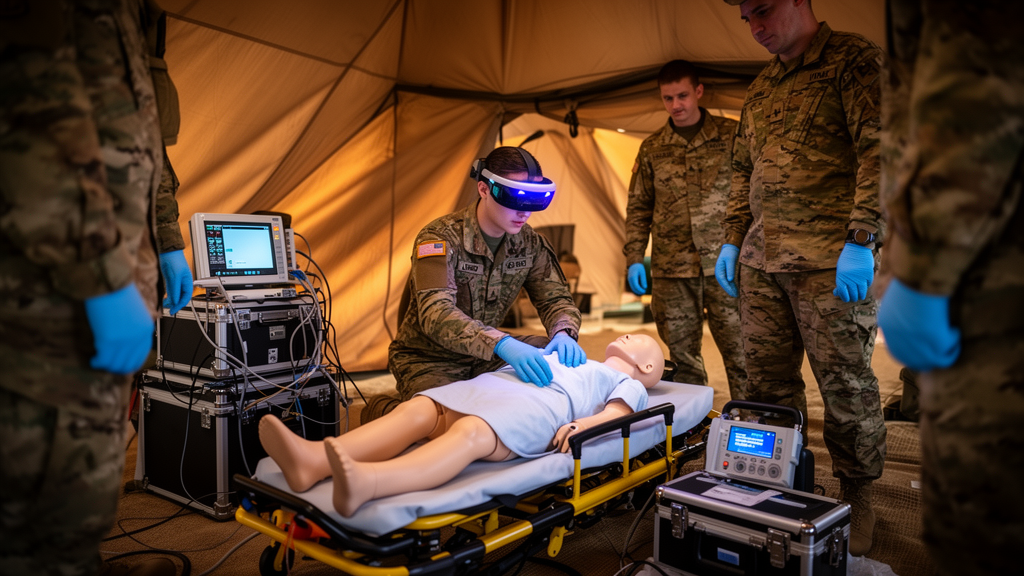
Extended reality trauma simulation proved feasible and educationally valuable when embedded within a large-scale multinational military medical exercise, according to a study conducted during Vigorous Warrior 2024 in Hungary. Twenty-five members of Emergency Medical Teams from three countries, including physicians, anaesthesiologists, nurses and radiographers, took part in an XR-based penetrating chest trauma scenario using the MilExTS XR platform on a Meta Quest 3 headset. The findings, published in Advances in Simulation, suggest that immersive virtual training could complement resource-intensive live simulation exercises, although significant limitations in realism and interface design remain.
The research team evaluated feasibility across recruitment, implementation, usability, acceptability and perceived educational value. Recruitment and completion thresholds were fully achieved, with 100 percent participation and 100 percent survey completion. Acceptability was high: 88 percent of participants rated XR as good or excellent for trauma training and indicated willingness to use it in future education. Two-thirds of participants, 66 percent, endorsed XR for enhancing teamwork, while 68 percent valued the opportunities for individual decision-making practice in a safe environment.
Usability results were more mixed. Fifty-six percent of participants rated scenario realism as average or below, citing limited physiological fidelity, lack of tactile feedback, headset navigation challenges and insufficient role differentiation. Qualitative feedback supported XR’s perceived educational value while identifying areas requiring further technological and pedagogical development. The authors conclude that XR trauma simulation demonstrated educational feasibility, high acceptability and perceived learning value when embedded within a complex multinational large-scale live simulation exercise, but that further research should progress to efficacy testing, cost-effectiveness analysis and curricular integration before wider adoption.
The study was conducted as an educational feasibility study during Vigorous Warrior 2024, embedded within NATO MILMED COE’s multinational large-scale medical live simulation. Session logs, post-simulation surveys using Likert scales from 1 to 5, and open-ended qualitative feedback were collected. Data were analysed descriptively and thematically, in line with published feasibility frameworks for medical education. The authors note that large-scale civil-military medical live simulation exercises such as the Vigorous Warrior series provide authentic environments to test interoperability and clinical performance of Emergency Medical Teams, but that such exercises are resource intensive, logistically demanding and infrequent, raising challenges for sustained workforce readiness.
Extended reality has emerged as a complementary modality with potential to extend access to trauma training, reduce costs and support distributed learning. The study aimed to examine the educational feasibility of XR trauma simulation when embedded in multinational large-scale live simulation. The authors state that XR shows promise as a complementary modality for interprofessional trauma training, while limitations in realism and interface design remain. The study was published as an open access article on 18 August 2026.
Subject of Research: Feasibility and perceived educational value of extended reality trauma simulation for emergency medical teams in a multinational training context
Article Title: Feasibility and perceived educational value of extended reality trauma simulation for emergency medical teams in a multinational training context
Article References: Sonesson, L., Boffard, K. D., & Reedy, G. (2026). Feasibility and perceived educational value of extended reality trauma simulation for emergency medical teams in a multinational training context. Advances in Simulation. https://doi.org/10.1186/s41077-026-00418-x
Image Credits: AI Generated
DOI: 10.1186/s41077-026-00418-x
Keywords: extended reality, trauma simulation, emergency medical teams, military medicine, NATO, feasibility study, medical education, virtual reality, interprofessional training, Vigorous Warrior 2024, Feasibility, perceived
News Source: Courtney Benton. (October 30, 2026). Extended Reality Trauma Simulation Proves Feasible for Emergency Medical Teams in Multinational NATO Exercise. Scienmag.



