• HOME
  • NEWS
  • EXPLORE
    • CAREER
      • Companies
      • Jobs
    • EVENTS
    • iGEM
      • News
      • Team
    • PHOTOS
    • VIDEO
    • WIKI
  • BLOG
  • COMMUNITY
    • FACEBOOK
    • INSTAGRAM
    • TWITTER
Tuesday, June 30, 2026
BIOENGINEER.ORG
No Result
View All Result
  • Login
  • HOME
  • NEWS
  • EXPLORE
    • CAREER
      • Companies
      • Jobs
        • Lecturer
        • PhD Studentship
        • Postdoc
        • Research Assistant
    • EVENTS
    • iGEM
      • News
      • Team
    • PHOTOS
    • VIDEO
    • WIKI
  • BLOG
  • COMMUNITY
    • FACEBOOK
    • INSTAGRAM
    • TWITTER
  • HOME
  • NEWS
  • EXPLORE
    • CAREER
      • Companies
      • Jobs
        • Lecturer
        • PhD Studentship
        • Postdoc
        • Research Assistant
    • EVENTS
    • iGEM
      • News
      • Team
    • PHOTOS
    • VIDEO
    • WIKI
  • BLOG
  • COMMUNITY
    • FACEBOOK
    • INSTAGRAM
    • TWITTER
No Result
View All Result
Bioengineer.org
No Result
View All Result
Home NEWS Science News

Exposing office distractions and effects on worker productivity

Bioengineer by Bioengineer
November 21, 2019
in Science News
Reading Time: 3 mins read
0
IMAGE
Share on FacebookShare on TwitterShare on LinkedinShare on RedditShare on Telegram

Dataset links stress, interruptions and performance
IMAGE

Credit: Computational Physiology Lab at University of Houston


With seemingly endless emails, phone calls and meetings, it’s no secret that working in an office environment can be quite stressful. Understanding how stress manifests by exposing the effects of distractions can help unlock an office workers’ full potential, according to new data collected by researchers from three university laboratories.

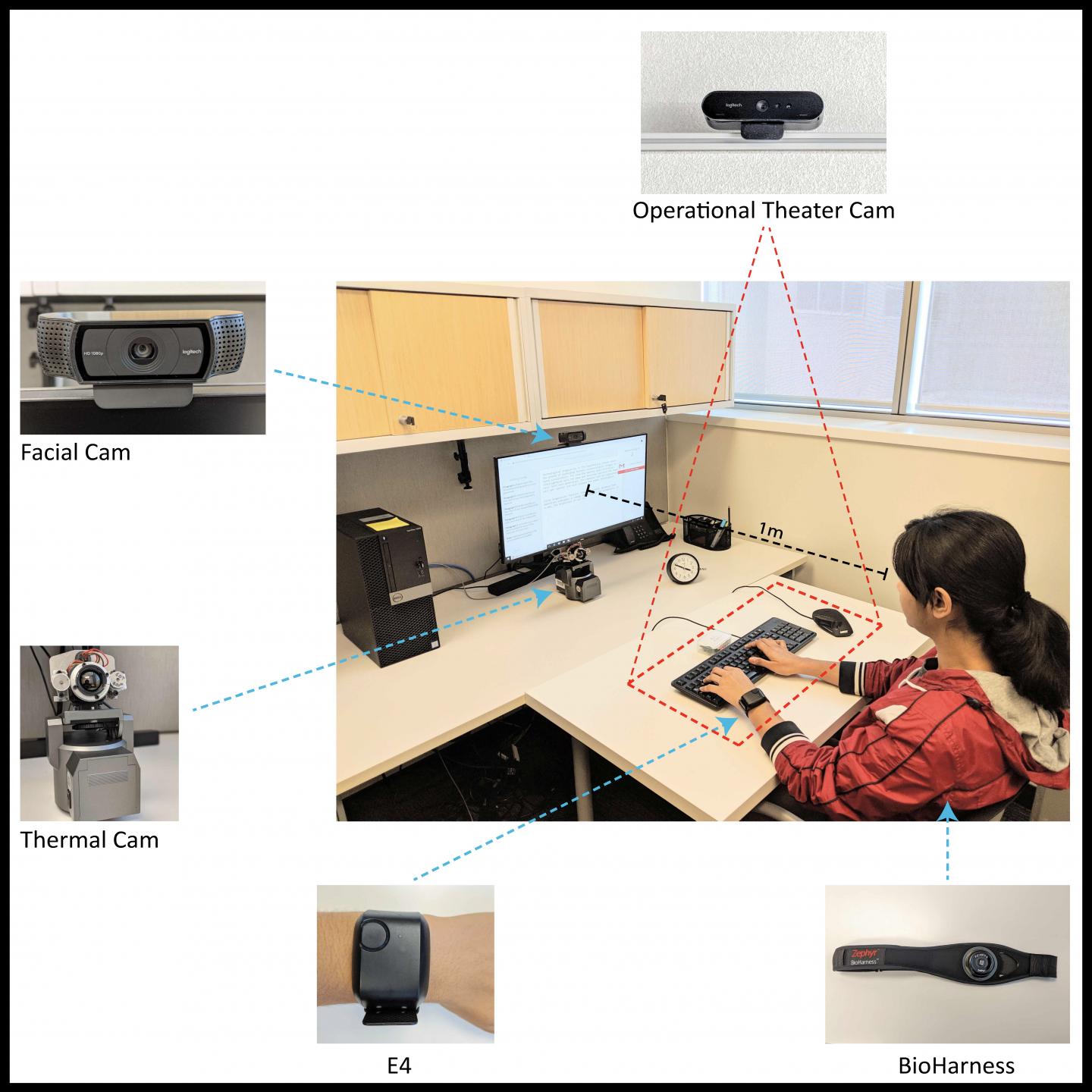
Ioannis Pavlidis, director of the Computational Physiology Laboratory at the University of Houston, along with Ricardo Gutierrez-Osuna from Texas A&M University and Gloria Mark from the University of California Irvine, conducted an experiment using thermal imaging and wearable sensors to better understand the stress and performance patterns of so-called knowledge workers – scientists, engineers, designers and academics. The findings are published in the journal Scientific Data.

Preliminary observations include:

  • Minute fluctuation of facial sweating emerges as the best way to measure stress during knowledge production and handling.
  • Presenting views and findings to management is far more stressful than producing them.
  • Given more relaxed deadlines, many office workers do not write longer reports but spend all the extra time to style them better.
  • Spell checkers – despite their bad rap in the context of texting – save the day in long writings, which would be riddled with mechanics errors in their absence.

“When you are stressed, you don’t realize this, but you perspire small amounts of from your nose. The more you are stressed, the more you sweat,” said Pavlidis, Eckhard-Pfeiffer Professor of Computer Science in the UH College of Natural Science and Mathematics, whose focus is human-computer interaction. “We also found people who have neurotic tendencies work better when they are regularly distracted by emails and the highly-educated worker relies too much on computerized tools such as spellcheck.”

Sixty-three study participants carried out a series of typical tasks and office activities including writing essays, taking breaks and presenting their findings before their managers. Half of the participants wrote their essays while being regularly distracted by emails while the other half received their emails in batches. This study is the first of a series of studies on knowledge work funded by a $1.2 million grant from the National Science Foundation.

A thermal facial camera tracked perspiration levels around the nose and upper mouth while wearable devices on the chest and wrist monitored heart and breathing rates. Two cameras one on the computer screen and the other tucked in the ceiling – recorded participants’ facial expressions and hand activities.

“This study was a comprehensive microcosm of all things happening in a 21st century office,” Pavlidis explained. “Crowdsourced data analysis is expected to lead to personalized recommendations for handling email interruptions and a deeper understanding of how people cope with different office activities. If the initial analysis we did is an indicator, the conclusion is that people who work at the office in knowledge professions have far more diverse responses than people in other professions we studied in the past.”

###

Media Contact
Sara Tubbs
[email protected]
713-743-4248

Original Source

http://uh.edu/news-events/stories/2019/november-2019/11212019-exposing-office-distractions-effects-on-worker-productivity.php

Related Journal Article

http://dx.doi.org/10.1038/s41597-019-0249-5

Tags: Computer ScienceMultimedia/Networking/Interface DesignResearch/DevelopmentRobotry/Artificial IntelligenceSoftware EngineeringTechnology/Engineering/Computer Science
Share12Tweet8Share2ShareShareShare2

Related Posts

Brain Signals Body After Injury: Review Suggests Discarded Vesicles May Drive Repair — Technology and Engineering

Brain Signals Body After Injury: Review Suggests Discarded Vesicles May Drive Repair

June 30, 2026
How a Common Probiotic Ingredient Transforms Immune Cells into Tumor-Fighting Warriors — Cancer

How a Common Probiotic Ingredient Transforms Immune Cells into Tumor-Fighting Warriors

June 30, 2026

Why the Same Alzheimer’s Blood Marker Might Indicate a More Serious Condition in Men: Examining the Evidence

June 30, 2026

From Cells to Boundaries: Unveiling the Origins of Biological Order

June 30, 2026
Please login to join discussion

POPULAR NEWS

  • Saying Goodbye to PGY-6: Pediatric Fellowship Realities

    103 shares
    Share 41 Tweet 26
  • Detection of EDCs in Breast Milk and Infant Urine Up to Six Months Highlights Early Exposure Risks

    77 shares
    Share 31 Tweet 19
  • New Drug Candidate Developed at McMaster Shows Potential for Treating Brain Cancer

    58 shares
    Share 23 Tweet 15
  • KTU Researchers Explore Ultrasound’s Role in Enhancing Blood Flow Beyond Diagnostics

    53 shares
    Share 21 Tweet 13

About

We bring you the latest biotechnology news from best research centers and universities around the world. Check our website.

Follow us

Recent News

Brain Signals Body After Injury: Review Suggests Discarded Vesicles May Drive Repair

How a Common Probiotic Ingredient Transforms Immune Cells into Tumor-Fighting Warriors

Why the Same Alzheimer’s Blood Marker Might Indicate a More Serious Condition in Men: Examining the Evidence

Subscribe to Blog via Email

Enter your email address to subscribe to this blog and receive notifications of new posts by email.

Join 82 other subscribers
  • Contact Us

Bioengineer.org © Copyright 2023 All Rights Reserved.

Welcome Back!

Login to your account below

Forgotten Password?

Retrieve your password

Please enter your username or email address to reset your password.

Log In
No Result
View All Result
  • Homepages
    • Home Page 1
    • Home Page 2
  • News
  • National
  • Business
  • Health
  • Lifestyle
  • Science

Bioengineer.org © Copyright 2023 All Rights Reserved.