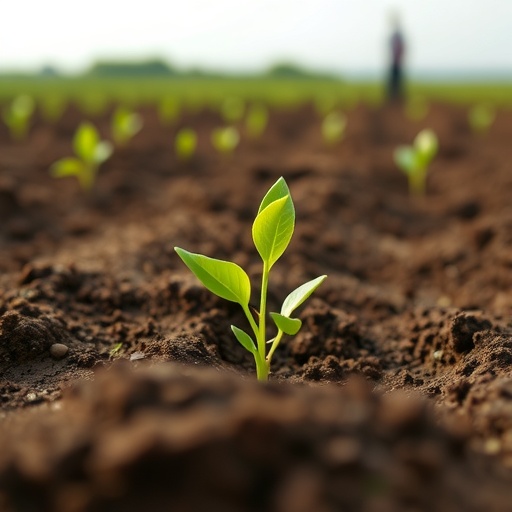
In a pioneering leap for soil science, artificial intelligence (AI) is poised to transform how researchers understand and manage complex terrestrial ecosystems. Scientists are now harnessing AI to create “digital soil twins” – high-fidelity virtual replicas of soil environments constructed from an extensive array of sensor-derived data. This innovative melding of AI with soil science promises to accelerate the depth and precision of soil ecosystem analysis, enabling revolutionary insights into soil behavior, microbiomes, and climatic responses.
Digital soil twins represent a convergence of data acquisition, machine learning, and computer modeling, capturing the dynamic interactions within soil matrices at unprecedented resolution. By integrating sensor inputs on moisture levels, nutrient composition, microbial populations, and physical parameters, these digital counterparts simulate real-world soil conditions. This capability allows researchers to monitor soil health continuously, observe microbial community shifts in near real-time, and predict outcomes under varying environmental stressors, providing a quantum leap beyond traditional sporadic field sampling.
Beyond monitoring, AI-powered digital twins facilitate advanced experimentation through virtual trials of climate adaptation strategies. Researchers can simulate how soils would respond to variables such as temperature fluctuations, moisture stress, and land management interventions before conducting costly and time-consuming field experiments. These predictive models enable rapid hypothesis testing and optimization of strategies aimed at maintaining soil fertility and ecosystem resilience under changing climate conditions.
The work is spearheaded by a team of internationally recognized experts including Professor Alex McBratney, Professor Budiman Minasny, and Dr. Mercedes Dobarco. Their landmark article in Frontiers in Science intricately explores how human-guided AI systems, equipped with perceptual processing and scientific reasoning capabilities, can revolutionize soil research. These multi-agent AI architectures mimic aspects of human cognition, orchestrating complex processes such as autonomous hypothesis generation, experimental design, and intricate data analysis, thus expanding the horizons of scientific inquiry.
Multi-agent AI systems, in particular, hold promise for decentralizing research workflows within soil science. By delegating routine but intricate tasks such as dataset curation, quality control, and preliminary interpretation, scientists gain the freedom to focus on conceptual thinking and nuanced judgment calls. This paradigm shift enhances innovation while ensuring adherence to rigorous scientific standards and environmental stewardship.
The prospective benefits of AI in soil science extend well beyond laboratory walls. By enabling real-time, high-resolution ecological monitoring and predictive modeling, these systems equip policymakers and land managers with actionable intelligence. This empowers evidence-based decision-making in agriculture, conservation, and climate resilience programs, ultimately fostering sustainable land management practices globally.
Key to this transformative vision is the integration of various computational approaches including generative AI, machine learning algorithms, and adaptive systems theory. These advanced computational frameworks underpin the simulation of soil ecosystem complexity, capturing interactions across biological, chemical, and physical domains with remarkable fidelity. The result is a dynamic, evolving representation that can anticipate emergent behaviors and feedback loops intrinsic to soil environments.
The researchers emphasize that the fusion of AI with soil science transcends traditional disciplinary boundaries. It invites a new era of transdisciplinary collaboration, weaving together earth science, computer science, environmental chemistry, and agricultural technology. This holistic approach ensures that AI tools are grounded in both scientific rigor and practical relevance, fostering solutions with global scalability.
Moreover, the adoption of AI-driven methodologies aligns with evolving expectations for scientific transparency and reproducibility. Automated hypothesis testing and experimental validation protocols embedded within multi-agent systems promise to reduce human bias and error. This enhances the credibility and replicability of soil research outcomes, critical for addressing pressing environmental challenges.
Recognizing the profound implications, Frontiers in Science is convening a Deep Dive webinar on July 2, 2026, from 16:00 to 17:30 CEST. This event will feature the authors discussing the frontier applications of multi-agent AI systems in soil research. Attendees will gain insights into how autonomous computational agents can identify novel research questions, design experiments, and parse complex datasets to untangle soil ecosystem intricacies.
The Deep Dive series itself exemplifies the journal’s commitment to fostering global dialogue among researchers, policymakers, and innovators on transformational scientific advances. This particular session invites stakeholders across earth sciences, computer science, and environmental policy to explore next steps in leveraging AI for sustainable soil management and climate adaptation.
As the dialogue around AI’s role in science continues to evolve, the intersection with soil research emphasizes the technology’s potential to address the foundational challenges of food security, environmental health, and climate resilience. Digital soil twins and autonomous AI agents stand at the vanguard of a paradigm shift, promising faster discoveries and more nuanced understanding of Earth’s critical interior.
For those interested in the full scientific discourse, the article is accessible via DOI 10.3389/fsci.2026.1721295. The ongoing collaboration between human expertise and AI not only augurs a future where soil science is faster and more accurate but also paves the way for responsible, innovative stewardship of the planet’s most vital natural resource.
Subject of Research: Soil science enhanced by multi-agent AI systems, digital soil twins, soil microbiome monitoring, and climate adaptation strategies.
Article Title: Enhancing soil science research with multi-agent artificial intelligence systems.
News Publication Date: Not explicitly stated, emerging around 2026 with reference to the July 2, 2026 webinar.
Web References:
Original Article DOI: 10.3389/fsci.2026.1721295
Webinar Registration: Frontiers in Science Deep Dive
Keywords: soil science, digital soil twins, soil microbiome, climate adaptation, multi-agent AI systems, scientific reasoning, autonomous hypothesis generation, experimental design, machine learning, generative AI, computer modeling, environmental chemistry, earth sciences, soil fertility, scientific collaboration.
Tags: AI for soil ecosystem analysisAI-driven climate adaptation for soilsAI-enhanced terrestrial ecosystem managementartificial intelligence in soil sciencedigital soil twins technologymachine learning in soil health assessmentpredictive soil behavior modelingreal-time soil health monitoringsensor data integration in soil studiessoil microbiome monitoring with AIsoil nutrient composition analysisvirtual soil environment modeling