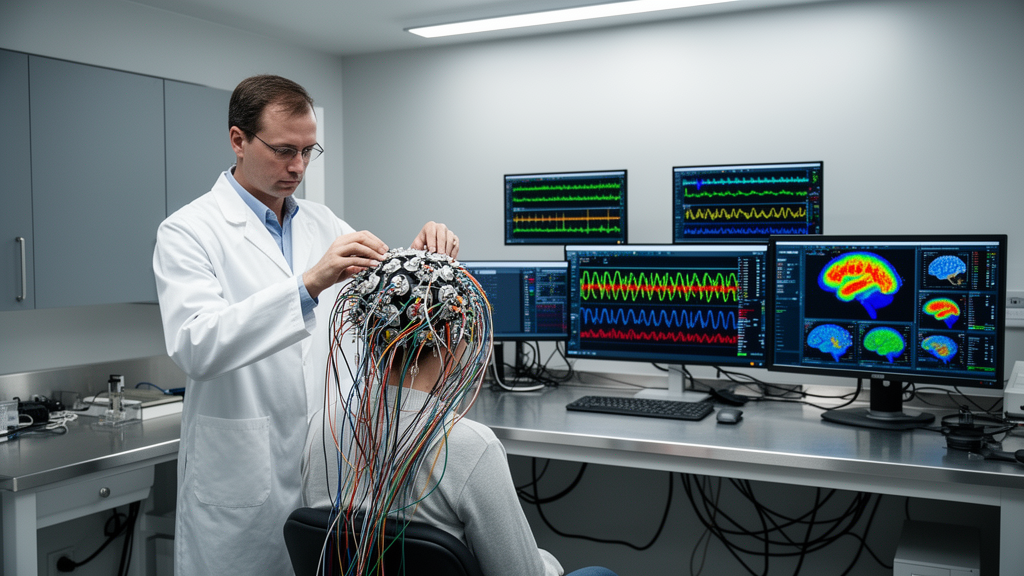
A comprehensive systematic review synthesizing forty-six peer-reviewed investigations has revealed critical methodological vulnerabilities in artificial intelligence systems designed to detect psychological stress from brainwave signals. Although recent machine learning architectures routinely report laboratory classification accuracies approaching or exceeding ninety percent, rigorous scrutiny indicates that these figures are systematically inflated by lenient evaluation protocols, unaddressed data leakage, and an absence of formal explanation testing. The investigation, published in Discover Artificial Intelligence by researchers Danish M. Khan, Li Yang Chan, and Ahmed A. Moustafa, appraises the rapidly expanding literature at the intersection of electroencephalography and explainable artificial intelligence. Across dozens of published predictive frameworks, the authors identified an absence of empirical verification confirming whether the explanations generated by these systems accurately reflect genuine neural processes or merely approximate black-box models. These findings challenge the prevailing assumption that high classification metrics in laboratory environments demonstrate algorithmic readiness for safety-critical clinical monitoring, occupational health surveillance, or human-robot collaboration.
The urgency surrounding robust neurotechnological diagnostics stems directly from the escalating worldwide prevalence and economic impact of psychological stress and associated affective conditions. Chronic stress disrupts emotional regulation, degrades cognitive performance, and significantly increases human vulnerability to major depressive disorders, generalized anxiety, and post-traumatic stress disorder. Empirical data highlighted within the investigation document that workplace stress alone generates annual expenditures exceeding three hundred billion dollars in the United States through healthcare claims, workplace absenteeism, and lost operational productivity. Across the globe, prolonged exposure to debilitating stress mechanisms accounts for approximately twelve billion lost working days annually, causing global productivity losses estimated at one trillion dollars. Scalable, non-invasive neurotechnologies that leverage scalp-recorded electrical potentials offer a promising physiological window into these mental states, primarily because electroencephalography provides millisecond-level temporal resolution capable of tracking rapid transitions in neural oscillatory dynamics across diverse cognitive demands.
To rigorously map the current state of explainable neurotechnology, the investigative team deployed a standardized literature search adhering to the Preferred Reporting Items for Systematic Reviews and Meta-Analyses guidelines. Operating across primary academic databases including Scopus, ScienceDirect, and IEEE Xplore through July 2026, the systematic screening filtered two hundred and thirty-one candidate records down to forty-six core empirical studies published between 2019 and 2026. The authors systematically categorized these works by evidence type to prevent inappropriate methodological conflation: thirty-six Type I studies deploying predictive machine learning or deep learning pipelines, eight Type II experimental investigations analyzing electrical signals via traditional inferential statistics, and two Type III operational studies evaluating system acceptance within naturalistic settings. The research cohort incorporated empirical studies exploring primary stress alongside mechanistically linked constructs such as emotional valence, acute anxiety, clinical depression, cognitive fatigue, and mental workload.
Across the thirty-six predictive modeling publications, traditional machine learning models and modern deep neural networks demonstrated ostensibly stellar benchmark results when tested on standard laboratory data. Algorithms such as support vector machines, random forests, extreme gradient boosting, and complex hybrid convolutional-recurrent networks achieved classification accuracies generally ranging between eighty-three percent and ninety-six percent, with specialized architectures such as EEGNet even reporting accuracy rates as high as 99.45 percent. However, the systematic synthesis uncovered an immediate, severe performance collapse whenever models faced rigorous subject-independent validation protocols. In studies implementing explainable feature engineering, including ChMinMaxPat, QuadTPat, and TriPat-XFE, model accuracy plummeted dramatically from subject-dependent ten-fold cross-validation scores between 92.86 percent and one hundred percent down to a modest ceiling of roughly seventy-three to seventy-six percent under leave-one-subject-out validation. This recurring double-digit accuracy drop demonstrates that models frequently overfit to participant-specific idiosyncratic signal traits rather than learning generalized neural markers of stress.
A primary driver of these artificially elevated performance metrics is the pervasive presence of methodological data leakage across the reviewed literature. Methodological appraisal using a standardized quality framework revealed that fourteen out of the thirty-six predictive modeling studies presented a high risk of subject-dependent data leakage, while twelve exhibited moderate risk and only ten achieved a low-concern rating by enforcing strict participant-disjoint partitioning. High-risk practices frequently involved slicing continuous recording epochs into overlapping sliding windows and randomly allocating segments from identical participants into both training and testing folds, or partitioning benchmark datasets at the segment level rather than the subject level. Furthermore, the synthesis highlighted widespread dataset reuse as a confounding factor: eight separate studies derived their primary findings exclusively from identical public benchmark archives, including the DEAP, SEED, and DREAMER repositories. This heavy reliance on a small cluster of public datasets undermines statistical independence across the broader literature, disguising shared benchmark quirks as reproducible scientific validation.
The review also presents a detailed taxonomy categorizing how explainability mechanisms are implemented across electroencephalography-based stress models, classifying them along axes of local versus global scope, post-hoc versus intrinsic integration, and underlying algorithmic mechanics. Post-hoc perturbation techniques, predominantly SHapley Additive exPlanations and Local Interpretable Model-Agnostic Explanations, appeared across seven predictive investigations. These tools attempt to explain black-box models by perturbing input features and measuring the resulting shifts in model predictions. However, the synthesis emphasizes that these generic explainability algorithms violate the physical and physiological properties of electroencephalography data. Scalable scalp recording is fundamentally governed by volume conduction, wherein a single underlying cortical generator projects electrical potentials simultaneously across multiple scalp electrodes, creating substantial spatial collinearity. Standard game-theoretic attribution methods assume input features are independently manipulable, which inadvertently distributes attribution arbitrarily across correlated adjacent sensors. Similarly, localized surrogate models frequently evaluate synthetic feature combinations that no living human brain could physically generate, fitting explanations on impossible neurophysiological states.
Beyond structural algorithmic violations, the systematic review uncovered a notable evaluation gap: not one of the forty-six reviewed studies conducted a formal quantitative verification of explanation fidelity or numerical stability. While twenty-eight studies attempted to rationalize their explanatory outputs by referencing established neurophysiological literature—such as linking frontal delta modulation or alpha asymmetry to emotional reactivity—none empirically tested whether these explanations remained stable under slight retraining perturbations, varying random seeds, or realistic sensor noise. Furthermore, none of the included investigations implemented systematic neurophysiological ablation or occlusion experiments to determine whether masked frequency bands or specific electrode channels were causally necessary for model predictions rather than merely correlated artifacts. The author team noted that intrinsic attention mechanisms embedded within modern deep learning networks, while avoiding post-hoc approximations by computing saliency during the forward pass, similarly failed to validate their attention maps against objective independent criteria such as concurrent eye-tracking or expert neurological annotation.
The interpretation of traditional brainwave frequency bands as definitive biomarkers of psychological stress represents another major source of empirical vulnerability highlighted in the review. Numerous reviewed works attributed elevated stress to modest shifts in normalized alpha, beta, and theta band power without implementing adequate methodological controls for critical confounding variables. Chief among these confounds is construct overlap: neurophysiological metrics such as theta-to-beta or beta-to-alpha engagement ratios are frequently shared interchangeably between models of stress, general mental workload, cognitive fatigue, and emotional arousal. Furthermore, none of the newly reviewed laboratory studies formally quantified or eliminated residual electromyographic, ocular, or head-movement artifacts using dedicated correction pipelines, despite several papers explicitly noting physical twitching or crying among stressed participants. Inconsistencies in the selection of electrical recording montages—such as mastoid reference, average reference, or surface Laplacian schemes—and ambiguous baseline rest periods further undermine the reproducibility of reported band-power shifts, while unmodeled time-on-task vigilance drift easily masquerades as genuine acute stress reactivity.
A critical translational bottleneck identified in the synthesis is the severe deficit in ecological validity, which prevents laboratory demonstrations from transitioning into reliable real-world applications. Of the forty-six reviewed publications, thirty-four were conducted entirely within tightly constrained laboratory testing environments, while seven utilized semi-naturalistic paradigms such as driving simulators, competitive video games, or virtual reality tasks. Only two studies deployed functional wearable systems in the field, and merely two papers evaluated system performance on authentic real-world data or within operational environments, including an investigation examining air-traffic control trainees. Operational field environments introduce severe practical challenges that laboratory protocols completely bypass, including label instability arising from reliance on subjective self-reports, persistent electrode impedance drift over time, variations in daily sensor montage placement, and substantial calibration burdens. Additionally, continuous wearable neuroimaging introduces privacy risks that remain virtually unaddressed, as fine-grained saliency maps and raw brainwave recordings can inadvertently expose sensitive biometric identities and private mental health markers.
To transition explainable neurotechnologies from fragile laboratory exercises into trustworthy, clinically viable systems, the systematic review establishes clear methodological reporting standards and outlines prospective research frontiers. Foremost among these mandates is the requirement that subject-independent cross-validation become the universal evaluation baseline, reported alongside any subject-dependent metrics to expose latent overfitting risks. The authors advocate for standardizing quantitative explanation audits, including perturbation-based fidelity checks and physiologically constrained ablation across channels, frequency bands, and temporal windows. Concurrently, emerging foundation models pre-trained on diverse, multi-subject electroencephalography archives present an untested opportunity to bridge the generalization gap. Recent interpretability benchmarks demonstrate that foundation architectures can extract decodable, mechanistically interpretable neural representations across general neurological tasks. Applying these large-scale pretrained models and mechanistic interpretability tools directly to stress and affective computing represents the most promising pathway toward establishing robust, transparent, and clinically deployable neurotechnological diagnostics.
Subject of Research: Explainable artificial intelligence in electroencephalography-based stress and mental state classification
Article Title: A systematic review of explainable artificial intelligence for EEG based stress and mental state analysis
Article References: Khan, D. M., Chan, L. Y., & Moustafa, A. A. (2026). A systematic review of explainable artificial intelligence for EEG based stress and mental state analysis. Discover Artificial Intelligence, 6(1), Article 1870. https://doi.org/10.1007/s44163-026-02393-8
Image Credits: AI Generated
DOI: 10.1007/s44163-026-02393-8
Keywords: Electroencephalography, Explainable Artificial Intelligence, Stress Detection, Subject-Independent Validation, Data Leakage, SHAP, LIME, Leave-One-Subject-Out, Explainable Feature Engineering, Neurophysiological Plausibility, Ecological Validity, EEG Foundation Models, Frequency Band Analysis, Model Interpretability, Affective Computing, Algorithmic Bias
News Source: Denise Maddox. (November 20, 2026). Explainable AI Models for EEG Stress Analysis Fail Rigorous Reliability Tests. Scienmag.