


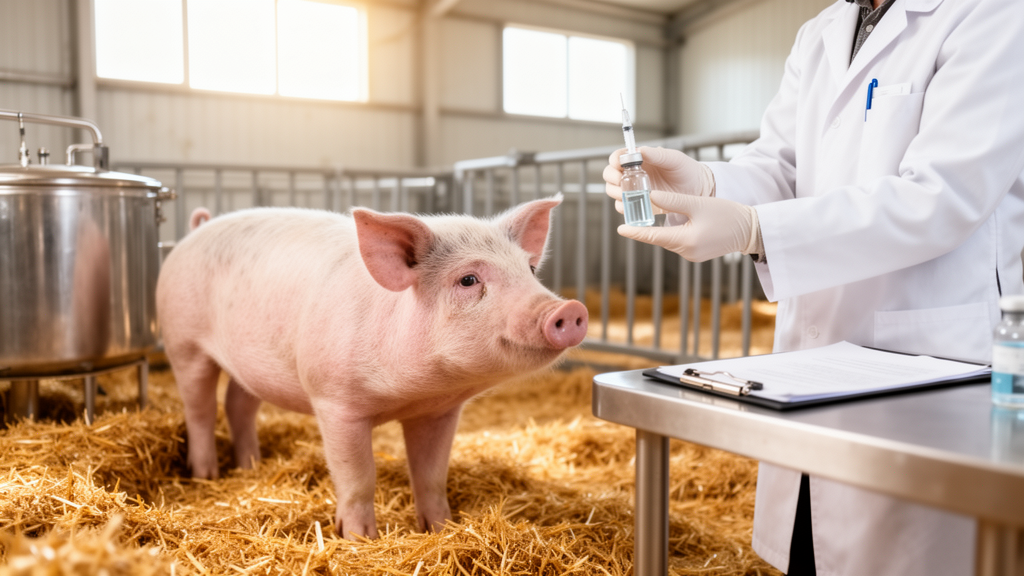
An experimental inactivated vaccine developed from a Chinese isolate of Lawsonia intracellularis, the bacterium behind porcine proliferative enteropathy, induced strong antibody responses and reduced the damage that the pathogen inflicts on pigs in a controlled challenge study, according to a paper published in Animal Diseases on 10 September 2026.
Porcine proliferative enteropathy is an important enteric disease of pigs caused by the obligate intracellular bacterium Lawsonia intracellularis, often abbreviated LI. The bacterium targets intestinal crypt epithelial cells, driving crypt hyperplasia, goblet cell depletion and mucosal thickening. These lesions impair absorptive function and feed efficiency, and in severe cases can progress to diarrhea, intestinal hemorrhage and death, resulting in substantial economic losses to the swine industry. Vaccination is considered the most effective measure for preventing and controlling the disease, but isolating and propagating LI strains in the laboratory is notoriously difficult, which has constrained vaccine development.
Only two commercial PPE vaccines exist worldwide: an attenuated live Enterisol Ileitis vaccine made by Boehringer Ingelheim and an inactivated Porcilis Ileitis vaccine made by MSD Animal Health. Enterisol Ileitis is the only one of the two commercially available in China, which is why the authors argue that isolating local LI strains and building vaccines from them is a priority for the Chinese swine industry. In 2023, the research group isolated a strain designated LI-HuB23 from an intestinal sample collected from slaughtered pigs in Hubei, China, and showed that it could be continuously and stably passaged in vitro beyond the 50th generation.
To make the vaccine, the 12th passage of LI-HuB23 was propagated in IEC-18 cells, inactivated with 0.3% formaldehyde at 37 degrees Celsius for 36 hours, and emulsified with Montanide ISA 201 VG adjuvant at a 1:1 volume ratio. Complete inactivation was verified by inoculating the treated suspension onto IEC-18 cell monolayers and performing three consecutive blind passages, during which no LI-specific fluorescence was detected. The final formulation contained 1 × 10⁹ LI organisms per pig dose.
The trial involved 35 healthy 28-day-old pigs confirmed negative for LI by fecal qPCR and serum indirect immunofluorescence assay. Ten pigs received the LI-HuB23-inactivated vaccine intramuscularly on day 0 with a booster at day 21, ten pigs received a single oral dose of Enterisol Ileitis following the manufacturer’s instructions, and fifteen pigs received oral sucrose-phosphate-glutamate buffer as a negative control. At day 35, five pigs from each group were orally challenged with a pure culture of LI-HuB23, five from each group received the JX703 intestinal homogenate derived from a clinical field strain, and the remaining five buffer-treated pigs served as unchallenged blank controls. All pigs were monitored for 27 days after challenge.
Immunization with the inactivated vaccine produced rapid and sustained antibody responses. By 21 days after primary vaccination, all ten vaccinated pigs were seropositive, with a mean log2-transformed reciprocal endpoint antibody titer of 5.81 ± 1.66, rising to 8.11 ± 1.55 at 35 days. By contrast, the Enterisol Ileitis group showed no detectable antibodies at 21 days and only three of ten pigs seropositive at 35 days, with a group mean titer of 1.17 ± 1.89. Serum from the inactivated-vaccine pigs also inhibited LI invasion of IEC-18 cells in vitro. Serum concentrations of IFN-γ, TNF-α and IL-6 were significantly higher in the inactivated-vaccine group than in the buffer controls at 35 days post-immunization, and were statistically similar to those induced by the commercial live vaccine. The authors note that they lacked an intramuscular adjuvant-only control, so the effects of the inactivated antigen could not be fully separated from those of the adjuvant, particularly for cytokine responses.
Growth performance told a consistent story. Unchallenged blank controls gained 428.15 ± 27.42 grams per day with a feed conversion ratio of 2.34 ± 0.15, while buffer-treated pigs challenged with LI-HuB23 gained 322.22 ± 34.82 grams per day with a feed conversion ratio of 3.13 ± 0.31, and those challenged with JX703 gained 279.26 ± 98.01 grams per day with a ratio of 4.01 ± 1.64. Pigs immunized with the inactivated vaccine and then challenged with LI-HuB23 gained 370.74 ± 58.84 grams per day with a feed conversion ratio of 2.75 ± 0.43; after JX703 challenge the corresponding values were 338.15 ± 79.29 grams per day and 2.87 ± 0.71. Enterisol Ileitis-vaccinated pigs performed comparably, reaching 385.93 ± 44.42 and 336.30 ± 65.92 grams per day after LI-HuB23 and JX703 challenge respectively.
Fecal shedding of LI, measured by qPCR as log10 LI copies per gram of feces, was also reduced. Buffer-treated pigs challenged with LI-HuB23 began shedding at 4 days post-challenge and peaked at 7.17 ± 0.98 and 7.32 ± 1.14 log10 copies per gram at 14 and 27 days post-challenge. Inactivated-vaccine pigs shed 1.36 ± 3.04 log10 copies per gram at 14 days, a reduction of 5.81 log10 copies relative to the buffer group, and 5.68 ± 1.07 at 27 days, a reduction of 1.64. After JX703 challenge, the inactivated-vaccine group shed 6.61 ± 1.03 log10 copies per gram at 14 days and 6.87 ± 1.08 at 17 days, reductions of 0.66 and 0.90 respectively. Enterisol Ileitis pigs showed no detectable shedding at 14 days in either challenge system and significantly lower fecal LI loads than the inactivated-vaccine group at both 14 and 17 days after JX703 challenge, although no significant difference between the two vaccines was observed after LI-HuB23 challenge.
Cumulative fecal scores and ileal pathology improved as well. Buffer-treated pigs challenged with LI-HuB23 or JX703 developed cement-like feces with cumulative scores of 2.00 ± 1.22 and 2.20 ± 1.92, whereas inactivated-vaccine pigs scored 0.40 ± 0.55 and 0.60 ± 1.34, both significantly lower than the buffer group and not significantly different from the Enterisol Ileitis group. At necropsy on day 27 post-challenge, buffer-treated pigs challenged with LI-HuB23 and JX703 showed typical PPE lesions, including ileal mucosal thickening, rugae formation, marked crypt cell hyperplasia and goblet cell depletion, with abundant LI antigen-positive signals in crypt epithelial cells and gross lesion scores of 1.20 ± 0.84 and 1.40 ± 0.55. Inactivated-vaccine pigs had lesion scores of 0.60 ± 0.55 in both challenge systems, matching the Enterisol Ileitis group, with markedly reduced LI antigen signals and alleviated crypt hyperplasia and goblet cell depletion.
The authors conclude that the LI-HuB23-inactivated vaccine induced serum antibody and cytokine responses and reduced the adverse effects of LI challenge on growth performance, fecal shedding and ileal pathology, supporting further development of injectable inactivated LI vaccines. They also report that their group has optimized large-scale antigen production by integrating cell factory and microcarrier culture technologies, moving from laboratory-scale culture toward industrial production. Because live attenuated vaccines carry a risk of vaccine strain shedding after immunization, the team argues that inactivated vaccines may hold greater practical value for future PPE eradication programs in pig herds, though the findings come from a small experimental challenge study with five pigs per challenge group and will require further evaluation before any commercial use.
Subject of Research: Development and evaluation of an inactivated Lawsonia intracellularis vaccine candidate for pigs
Article Title: Immunogenicity and protective efficacy evaluation of an inactivated Lawsonia intracellularis vaccine candidate developed on the basis of a Chinese isolate in pigs
Article References: Xie, R., Gu, Z., Zhu, Z., Chen, Y., Gao, Z., Cui, Y., Hua, L., Song, W., Huang, C., Tang, X., Xu, G., Chen, H., Wu, B., & Peng, Z. (2026). Immunogenicity and protective efficacy evaluation of an inactivated Lawsonia intracellularis vaccine candidate developed on the basis of a Chinese isolate in pigs. Animal Diseases, 6(1), Article 53. https://doi.org/10.1186/s44149-026-00276-0
Image Credits: AI Generated
DOI: 10.1186/s44149-026-00276-0
Keywords: Lawsonia intracellularis, porcine proliferative enteropathy, inactivated vaccine, LI-HuB23, pigs, vaccine efficacy, fecal shedding, ileal lesions, Enterisol Ileitis, swine health, challenge study, China
News Source: Kristina Jarvis. (October 29, 2026). Experimental Inactivated Vaccine Built from Chinese Pig Isolate Curbs Ileitis in Challenge Study. Scienmag.



