• HOME
  • NEWS
  • EXPLORE
    • CAREER
      • Companies
      • Jobs
    • EVENTS
    • iGEM
      • News
      • Team
    • PHOTOS
    • VIDEO
    • WIKI
  • BLOG
  • COMMUNITY
    • FACEBOOK
    • INSTAGRAM
    • TWITTER
Wednesday, June 24, 2026
BIOENGINEER.ORG
No Result
View All Result
  • Login
  • HOME
  • NEWS
  • EXPLORE
    • CAREER
      • Companies
      • Jobs
        • Lecturer
        • PhD Studentship
        • Postdoc
        • Research Assistant
    • EVENTS
    • iGEM
      • News
      • Team
    • PHOTOS
    • VIDEO
    • WIKI
  • BLOG
  • COMMUNITY
    • FACEBOOK
    • INSTAGRAM
    • TWITTER
  • HOME
  • NEWS
  • EXPLORE
    • CAREER
      • Companies
      • Jobs
        • Lecturer
        • PhD Studentship
        • Postdoc
        • Research Assistant
    • EVENTS
    • iGEM
      • News
      • Team
    • PHOTOS
    • VIDEO
    • WIKI
  • BLOG
  • COMMUNITY
    • FACEBOOK
    • INSTAGRAM
    • TWITTER
No Result
View All Result
Bioengineer.org
No Result
View All Result
Home NEWS Science News

Expanding the plasmonic painter’s palette

Bioengineer by Bioengineer
March 4, 2020
in Science News
Reading Time: 3 mins read
0
IMAGE
Share on FacebookShare on TwitterShare on LinkedinShare on RedditShare on Telegram

IMAGE

Credit: Adapted from ACS Nano 2020, DOI: 10.1021/acsnano.9b07523


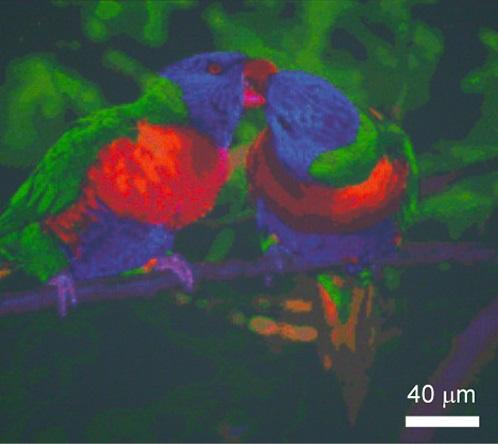
By blending paints in their palette, artists can create a broad spectrum of colors with subtly different hues. However, scientists who wish to create a similar range of structural colors, like those found on butterfly wings, are much more limited. Now, researchers reporting in ACS Nano have developed a new method for mixing plasmonic red, blue and green to yield a virtually unlimited number of colors that could be used for new types of displays. 

Unlike pigments, structural colors get their hues by reflecting light from microscopic textures. Scientists can create some of these colors by putting metal nanoparticles onto surfaces in various patterns. These “plasmonically induced” colors are less susceptible to fading than pigments, and they might be useful for new types of paint, electronic displays and anti-counterfeiting measures. But producing a gamut of structural colors with smooth transitions between hues and tones has been challenging. Therefore, Dimos Poulikakos, Hadi Eghlidi and colleagues wanted to develop a new plasmonic color-mixing approach that would allow countless color variations.

The researchers began with a palette of three primary colors (red, green and blue). They made pixels of each color by arranging silver nanorods in lattice patterns on glass surfaces. The lengths and widths of the nanorods, and the distances between nanorods in the horizontal direction, determined whether the pixel was red, green or blue. The researchers adjusted the brightness of each color by varying the vertical distance between nanorods in the lattice. When the team interwove three of the primary color lattices in a single pixel and varied the vertical distances to adjust brightness, they could generate 2,456 unique colors with a pixel size of 4.26 × 4.26 μm. The researchers demonstrate the method to reproduce an image of two colorful parrots and a black-and-white photograph of Marie Curie.

###

The authors do not acknowledge any funding sources for this study.

The abstract that accompanies this study is available here.

For more research news, journalists and public information officers are encouraged to apply for complimentary press registration for the ACS Spring 2020 National Meeting & Exposition in Philadelphia.

The American Chemical Society (ACS) is a nonprofit organization chartered by the U.S. Congress. ACS’ mission is to advance the broader chemistry enterprise and its practitioners for the benefit of Earth and its people. The Society is a global leader in providing access to chemistry-related information and research through its multiple research solutions, peer-reviewed journals, scientific conferences, eBooks and weekly news periodical Chemical & Engineering News. ACS journals are among the most cited, most trusted and most read within the scientific literature; however, ACS itself does not conduct chemical research. As a specialist in scientific information solutions (including SciFinder® and STN®), its CAS division powers global research, discovery and innovation. ACS’ main offices are in Washington, D.C., and Columbus, Ohio.

To automatically receive news releases from the American Chemical Society, contact [email protected].

Follow us on Twitter | Facebook

Media Contact
Katie Cottingham
[email protected]
301-775-8455

Related Journal Article

http://dx.doi.org/10.1021/acsnano.9b07523

Tags: Audiovisual MediaChemistry/Physics/Materials SciencesElectrical Engineering/ElectronicsMass MediaNanotechnology/Micromachines
Share12Tweet8Share2ShareShareShare2

Related Posts

Water-Activated PVA Film Transforms from Bioplastic to High-Performance Wood Adhesive — Chemistry

Water-Activated PVA Film Transforms from Bioplastic to High-Performance Wood Adhesive

June 24, 2026
Copal Tree Genetics Reveal Tropical Forest Connectivity — Biology

Copal Tree Genetics Reveal Tropical Forest Connectivity

June 24, 2026

Fourier Pixels Enable Bidirectional Light Control

June 24, 2026

Unfinished Care, Burnout, and Managerial Support in Nursing Homes

June 24, 2026
Please login to join discussion

POPULAR NEWS

  • Saying Goodbye to PGY-6: Pediatric Fellowship Realities

    103 shares
    Share 41 Tweet 26
  • Multi-Hospital Study Reveals Long Covid Burden Is Twice as High as Current Estimates

    92 shares
    Share 36 Tweet 23
  • Detection of EDCs in Breast Milk and Infant Urine Up to Six Months Highlights Early Exposure Risks

    77 shares
    Share 31 Tweet 19
  • New Drug Candidate Developed at McMaster Shows Potential for Treating Brain Cancer

    58 shares
    Share 23 Tweet 15

About

We bring you the latest biotechnology news from best research centers and universities around the world. Check our website.

Follow us

Recent News

Water-Activated PVA Film Transforms from Bioplastic to High-Performance Wood Adhesive

Copal Tree Genetics Reveal Tropical Forest Connectivity

Fourier Pixels Enable Bidirectional Light Control

Subscribe to Blog via Email

Enter your email address to subscribe to this blog and receive notifications of new posts by email.

Join 82 other subscribers
  • Contact Us

Bioengineer.org © Copyright 2023 All Rights Reserved.

Welcome Back!

Login to your account below

Forgotten Password?

Retrieve your password

Please enter your username or email address to reset your password.

Log In
No Result
View All Result
  • Homepages
    • Home Page 1
    • Home Page 2
  • News
  • National
  • Business
  • Health
  • Lifestyle
  • Science

Bioengineer.org © Copyright 2023 All Rights Reserved.