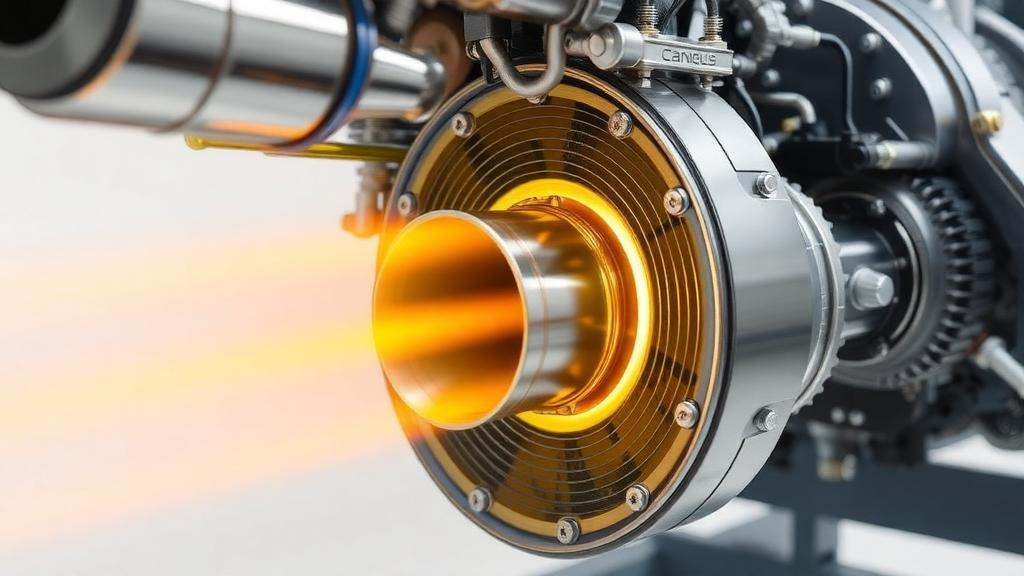
Hydrogen has long been touted as the fuel that could rescue the internal combustion engine from the dustbin of history, and nowhere is that promise more consequential than in the enormous engines that keep power plants and industrial facilities running. A new experimental study from the Technical University of Munich, published in Automotive and Engine Technology, now reveals a surprisingly thorny obstacle on that path: the exhaust backpressure created by the turbochargers meant to make these engines powerful in the first place. The findings, based on systematic single-cylinder testing, quantify exactly how much efficiency is sacrificed when engineers bolt on the breathing hardware needed to push a hydrogen engine to competitive power densities, and they point toward multi-stage and externally assisted charging as the way forward.
The core problem stems from a fundamental property of hydrogen as a gaseous fuel. Unlike diesel or gasoline, which enter the cylinder as liquids or fine sprays, hydrogen is injected into the intake ports as a gas, and that gas physically occupies space. In a port-fuel-injected engine, the hydrogen displaces a substantial fraction of the intake air, starving the cylinder of the oxygen needed to burn the fuel efficiently. To recover that lost oxygen and maintain power output, the engine must be supplied with far higher charging pressures than an equivalent gasoline or diesel unit would need. On top of this, large-bore hydrogen engines are designed to run lean, with an abundance of excess air, which further inflates the air-delivery requirements of the charging system.
Here is where the vicious circle begins. Conventional single-stage turbochargers harvest their drive energy from the exhaust stream, extracting enthalpy from the hot gases leaving the cylinders. A hydrogen engine that runs very lean produces comparatively cool exhaust with low energy content, yet the compressor demands a great deal of work to deliver the required boost pressure. To extract enough energy from a weak exhaust stream, the turbine must work against a high pressure difference, which means the exhaust pressure ahead of the turbine rises well above the intake pressure. That elevated exhaust backpressure acts like a hand pressing down on the engine’s breathing, trapping residual gas in the cylinder and degrading the thermodynamics of every subsequent combustion cycle.
The Munich team, led by Felina Armbruster together with Moritz Lerchner, Andreas Zepf, Martin Härtl and Malte Jaensch, set out to measure precisely what this trade-off costs. Working with a single-cylinder large-bore hydrogen research engine fitted with port fuel injection, they compared three scenarios. The baseline was an unrestricted exhaust, representing an idealized engine free of turbocharger constraints. The second configuration emulated the backpressure signature of a realistic single-stage turbocharger, using an efficiency typical of commercially available hardware. The third and fourth configurations reproduced the backpressure profiles of turbocharging concepts assisted by an electric or mechanical compressor drive, the kind of hybridized charging architectures increasingly discussed for stationary power applications.
The numbers are striking. When the researchers applied a realistic single-stage turbocharger efficiency to the engine, the indicated efficiency dropped by 3.7 percentage points compared with the unrestricted baseline. In the world of large stationary engines, where every fraction of a point translates into significant fuel costs and emissions over thousands of operating hours, a penalty of that magnitude is enormous. It means that roughly a tenth of the engine’s useful work potential can be erased purely by the thermodynamic consequences of pushing exhaust gas through a conventional turbine that is struggling to power a demanding compressor.
The assisted turbocharger configurations told a related but distinct story. Emulating an electrically or mechanically assisted setup restricted the engine’s stable operating map, shrinking the range of conditions under which combustion proceeded smoothly and reliably. The maximum indicated mean effective pressure, the standard yardstick of an engine’s specific load capability, fell from 19.7 bar to 18.7 bar, and the indicated efficiency penalty reached up to 3.1 percentage points. The study thereby crystallizes a fundamental dilemma for hydrogen engine designers: the boost pressure that port fuel injection demands must be paid for either through elevated exhaust backpressure, which taxes the engine thermodynamically, or through additional power fed into the compressor from an external or mechanical source, which taxes the system energetically. There is no free lunch in the charging architecture.
Not every consequence of the higher backpressure turned out to be negative, however. The measurements revealed a nuanced emissions picture that varies strongly with engine load. At medium loads, where the engine runs on less lean mixtures, the elevated backpressure substantially reduced nitrogen oxide emissions compared with the unrestricted baseline. The mechanism is physical rather than chemical: higher exhaust pressure traps more residual gas inside the cylinder, and this inert residual dilutes the fresh charge, lowering peak combustion temperatures and thereby suppressing the thermal formation of nitrogen oxides, which are exquisitely sensitive to flame temperature. At low loads, though, the same residual gas trapping produced a slight increase in nitrogen oxides, a reminder that the interaction between backpressure and in-cylinder chemistry does not follow a single simple rule.
At the high end of the load spectrum, the picture simplified. Both nitrogen oxide emissions and unburned hydrogen emissions, often called hydrogen slip, remained essentially unaffected by the increased backpressure. Hydrogen slip is a particular concern for port-fuel-injected engines, because hydrogen injected into the intake port can escape into the exhaust during valve overlap, wasting fuel and, since hydrogen is an indirect greenhouse gas, potentially offsetting some of the climate benefits of the fuel switch. The finding that slip does not worsen under realistic turbocharging backpressures at high load is therefore genuinely encouraging for engineers sizing these systems for baseload power generation, where engines spend most of their lives near full load.
Methodologically, the study demonstrates the value of emulating backpressure on a single-cylinder research engine rather than building complete multi-cylinder prototypes with every conceivable turbocharger configuration. By controlling the exhaust pressure independently of the actual turbine behavior, the researchers isolated the thermodynamic effect of backpressure from the mechanical and aerodynamic peculiarities of specific turbocharger hardware. This allowed them to attribute efficiency changes and emissions shifts directly to the pressure conditions in the exhaust system, providing clean data with which charging concepts can be evaluated and optimized before expensive hardware is committed. The approach effectively turns the turbocharger design problem into a quantifiable thermodynamic accounting exercise.
The broader significance of the work lies in what it prescribes for the decarbonization of stationary power generation. Large-bore engines currently burn natural gas in countless power plants, combined heat and power installations and industrial cogeneration facilities, and converting them to hydrogen is one of the few ways to keep that installed infrastructure useful in a net-zero energy system. The Munich results demonstrate that simply swapping the fuel is not enough: the charging system must be redesigned from the ground up, with multi-stage turbocharging or externally assisted concepts that can deliver the high boost pressures hydrogen requires without crushing the engine under its own exhaust. Achieving competitive power densities with carbon-free fuel, the study concludes, will depend as much on clever thermodynamic engineering of the air path as on the combustion itself.
Subject of Research: Exhaust backpressure effects in port-fuel-injected large-bore hydrogen engines with different turbocharging configurations
Article Title: Influence of exhaust backpressure on the performance of port-fuel-injected large-bore hydrogen engines with different turbocharger configurations
Article References: Influence of exhaust backpressure on the performance of port-fuel-injected large-bore hydrogen engines with different turbocharger configurations. (n.d.). https://doi.org/10.1007/s41104-026-00181-1
Image Credits: AI Generated
DOI: 10.1007/s41104-026-00181-1
Keywords: hydrogen engine, turbocharging, exhaust backpressure, port fuel injection, large-bore engines, nitrogen oxide emissions, hydrogen slip, stationary power generation, indicated efficiency, multi-stage turbocharger, assisted turbocharging, engine decarbonization
News Source: Denise Maddox. (October 12, 2026). Exhaust Backpressure Emerges as the Hidden Bottleneck for Large Hydrogen Engines. Scienmag.