• HOME
  • NEWS
  • EXPLORE
    • CAREER
      • Companies
      • Jobs
    • EVENTS
    • iGEM
      • News
      • Team
    • PHOTOS
    • VIDEO
    • WIKI
  • BLOG
  • COMMUNITY
    • FACEBOOK
    • INSTAGRAM
    • TWITTER
Saturday, May 9, 2026
BIOENGINEER.ORG
No Result
View All Result
  • Login
  • HOME
  • NEWS
  • EXPLORE
    • CAREER
      • Companies
      • Jobs
        • Lecturer
        • PhD Studentship
        • Postdoc
        • Research Assistant
    • EVENTS
    • iGEM
      • News
      • Team
    • PHOTOS
    • VIDEO
    • WIKI
  • BLOG
  • COMMUNITY
    • FACEBOOK
    • INSTAGRAM
    • TWITTER
  • HOME
  • NEWS
  • EXPLORE
    • CAREER
      • Companies
      • Jobs
        • Lecturer
        • PhD Studentship
        • Postdoc
        • Research Assistant
    • EVENTS
    • iGEM
      • News
      • Team
    • PHOTOS
    • VIDEO
    • WIKI
  • BLOG
  • COMMUNITY
    • FACEBOOK
    • INSTAGRAM
    • TWITTER
No Result
View All Result
Bioengineer.org
No Result
View All Result
Home NEWS Science News Biology

Exercise increases dopamine release in mice

Bioengineer by Bioengineer
May 16, 2022
in Biology
Reading Time: 2 mins read
0
Exercise Increases Dopamine Release in Mice
Share on FacebookShare on TwitterShare on LinkedinShare on RedditShare on Telegram

Exercise increases dopamine signaling in the motor areas of mice, according to research recently published in JNeurosci.
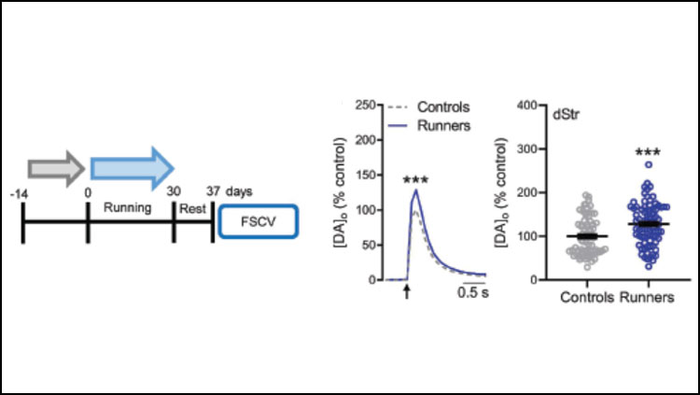
Exercise Increases Dopamine Release in Mice

Credit: Bastioli et al., JNeurosci 2022

Exercise increases dopamine signaling in the motor areas of mice, according to research recently published in JNeurosci.

It’s no secret exercise is good for the brain — working out can improve mood, sharpen memory, and stave off cognitive decline. Exercise even improves motor behavior in people with Parkinson’s disease, but the exact mechanism is not known. One possibility is through an increase in dopamine, a neurotransmitter needed for motor and emotional control that declines as the disease progresses.

Bastioli et al. compared dopamine signaling in mice after 30 days of voluntary wheel running or inactivity. In the runner mice, dopamine release in the striatum (a motor area) increased in response to electrical stimulation, while there was no change in sedentary mice. The increased dopamine release remained even a week after the exercise ended. The researchers also measured increased levels of brain-derived neurotrophic factor (BDNF), a protein involved in neuron health, in the striatum of active mice. When the researchers repeated the experiments in a genetic mouse model lacking BDNF, there was no difference in dopamine release between the active and sedentary mice, suggesting BDNF catalyzes increased dopamine signaling. Future studies will examine if the relationship holds true in a mouse model of Parkinson’s disease, and if exercise can improve motor outcomes. 

###

Paper title: Voluntary Exercise Boosts Striatal Dopamine Release: Evidence for the Necessary and Sufficient Role of BDNF

Please contact [email protected] for the full-text PDF and to join SfN’s journals media list.

About JNeurosci

JNeurosci, the Society for Neuroscience’s first journal, was launched in 1981 as a means to communicate the findings of the highest quality neuroscience research to the growing field. Today, the journal remains committed to publishing cutting-edge neuroscience that will have an immediate and lasting scientific impact, while responding to authors’ changing publishing needs, representing breadth of the field and diversity in authorship.

About The Society for Neuroscience

The Society for Neuroscience is the world’s largest organization of scientists and physicians devoted to understanding the brain and nervous system. The nonprofit organization, founded in 1969, now has nearly 37,000 members in more than 90 countries and over 130 chapters worldwide.


Journal

JNeurosci

DOI

10.1523/JNEUROSCI.2273-21.2022

Method of Research

Experimental study

Subject of Research

Animals

Article Title

Voluntary exercise boosts striatal dopamine release: evidence for the necessary and sufficient role of BDNF

Article Publication Date

16-May-2022

Share12Tweet8Share2ShareShareShare2

Related Posts

Ancient Plant Populations Reveal Fresh Insights into Climate Resilience — Biology

Ancient Plant Populations Reveal Fresh Insights into Climate Resilience

May 8, 2026
Rare Brain Disorders in Children Linked to Mutations in Lesser-Known Protein Complex — Biology

Rare Brain Disorders in Children Linked to Mutations in Lesser-Known Protein Complex

May 8, 2026

From Odd Insect to Underwater Predator: The Remarkable Evolution of a Bloodthirsty Fruit Fly

May 8, 2026

SNU Professor Sangwoo Seo’s Team Develops Next-Generation CRISPR Biocontainment Technology to Control Microbial Survival Without DNA Cleavage

May 8, 2026

POPULAR NEWS

  • Research Indicates Potential Connection Between Prenatal Medication Exposure and Elevated Autism Risk

    839 shares
    Share 336 Tweet 210
  • New Study Reveals Plants Can Detect the Sound of Rain

    726 shares
    Share 290 Tweet 181
  • Scientists Investigate Possible Connection Between COVID-19 and Increased Lung Cancer Risk

    68 shares
    Share 27 Tweet 17
  • Salmonella Haem Blocks Macrophages, Boosts Infection

    61 shares
    Share 24 Tweet 15

About

We bring you the latest biotechnology news from best research centers and universities around the world. Check our website.

Follow us

Recent News

Btg2 Blocks Fmo1 UFMylation, Worsens Liver Injury

Boosted NIR Luminescence via Dark Fe3+ Energy

Nanoparticles Boost Cell Density for Better Tissue Repair

Subscribe to Blog via Email

Enter your email address to subscribe to this blog and receive notifications of new posts by email.

Join 82 other subscribers
  • Contact Us

Bioengineer.org © Copyright 2023 All Rights Reserved.

Welcome Back!

Login to your account below

Forgotten Password?

Retrieve your password

Please enter your username or email address to reset your password.

Log In
No Result
View All Result
  • Homepages
    • Home Page 1
    • Home Page 2
  • News
  • National
  • Business
  • Health
  • Lifestyle
  • Science

Bioengineer.org © Copyright 2023 All Rights Reserved.