• HOME
  • NEWS
  • EXPLORE
    • CAREER
      • Companies
      • Jobs
    • EVENTS
    • iGEM
      • News
      • Team
    • PHOTOS
    • VIDEO
    • WIKI
  • BLOG
  • COMMUNITY
    • FACEBOOK
    • INSTAGRAM
    • TWITTER
Monday, May 11, 2026
BIOENGINEER.ORG
No Result
View All Result
  • Login
  • HOME
  • NEWS
  • EXPLORE
    • CAREER
      • Companies
      • Jobs
        • Lecturer
        • PhD Studentship
        • Postdoc
        • Research Assistant
    • EVENTS
    • iGEM
      • News
      • Team
    • PHOTOS
    • VIDEO
    • WIKI
  • BLOG
  • COMMUNITY
    • FACEBOOK
    • INSTAGRAM
    • TWITTER
  • HOME
  • NEWS
  • EXPLORE
    • CAREER
      • Companies
      • Jobs
        • Lecturer
        • PhD Studentship
        • Postdoc
        • Research Assistant
    • EVENTS
    • iGEM
      • News
      • Team
    • PHOTOS
    • VIDEO
    • WIKI
  • BLOG
  • COMMUNITY
    • FACEBOOK
    • INSTAGRAM
    • TWITTER
No Result
View All Result
Bioengineer.org
No Result
View All Result
Home NEWS Science News Biology

Excessive rainfall as damaging to corn yield as extreme heat, drought

Bioengineer by Bioengineer
April 30, 2019
in Biology
Reading Time: 3 mins read
0
IMAGE
Share on FacebookShare on TwitterShare on LinkedinShare on RedditShare on Telegram

IMAGE

Credit: Graphic courtesy Yan Li

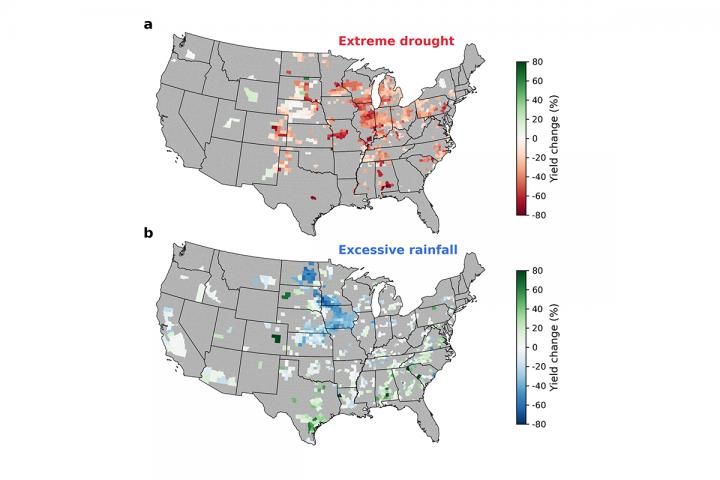
CHAMPAIGN, Ill. — Recent flooding in the Midwest has brought attention to the complex agricultural problems associated with too much rain. Data from the past three decades suggest that excessive rainfall can affect crop yield as much as excessive heat and drought. In a new study, an interdisciplinary team from the University of Illinois linked crop insurance, climate, soil and corn yield data from 1981 through 2016.

The study found that during some years, excessive rainfall reduced U.S. corn yield by as much as 34% relative to the expected yield. Data suggest that drought and excessive heat caused a yield loss of up to 37% during some years. The findings are published in the journal Global Change Biology.

“We linked county-level U.S. Department of Agriculture insurance data for corn loss with historical weather data, letting us quantify the impact of excessive rainfall on yield loss at a continental scale,” said Kaiyu Guan, a natural resources and environmental sciences professor and the study’s principal investigator. “This was done using crop insurance indemnity data paired with rigorous statistical analysis – not modeled simulations – which let the numbers speak for themselves.”

The study found that the impact of excessive rainfall varies regionally.

“Heavy rainfall can decrease corn yield more in cooler areas and the effect is exacerbated even further in areas that have poor drainage,” said Yan Li, a former U. of I. postdoctoral researcher and lead author of the study.

Excessive rainfall can affect crop productivity in various ways, including direct physical damage, delayed planting and harvesting, restricted root growth, oxygen deficiency and nutrient loss, the researchers said.

“It is challenging to simulate the effects of excessive rainfall because of the vast amount of seemingly minor details,” Yan said. “It is difficult to create a model based on the processes that occur after heavy rainfall – poor drainage due to small surface features, water table depth and various soil properties can lead to ponding of water in a crop field. Even though the ponding may take place over a small area, it could have a large effect on crop damage.”

“This study shows that we have a lot of work to do to improve our models,” said Evan DeLucia, the director of the Institute for Sustainability, Energy and Environment, a professor of integrative biology and study co-author. “While drought and heat stress have been well dealt with in the existing models, excessive rainfall impacts on crop system are much less mature.”

Many climate change models predict that the U.S. Corn Belt region will continue to experience more intense rainfall events in the spring. Because of this, the researchers feel that it is urgent for the government and farmers to design better risk management plans to deal with the predicted climate scenarios.

“As rainfall becomes more extreme, crop insurance needs to evolve to better meet planting challenges faced by farmers,” said Gary Schnitkey, a professor of agricultural and consumer economics and study co-author.

###

The USDA, National Institute of Food and Agriculture and the U.S. Department of Energy supported this study.

Editor’s notes:

To reach Kaiyu Guan, call 217-300-2690; [email protected]

The paper “Excessive rainfall leads to maize yield loss of a comparable
magnitude to extreme drought in the United States” is available online and from the U. of I. News Bureau. DOI: 10.1111/gcb.14628.

Media Contact
Lois Yoksoulian
[email protected]

Original Source

https://news.illinois.edu/view/6367/781555

Related Journal Article

http://dx.doi.org/10.1111/gcb.14628

Tags: Agricultural Production/EconomicsAgricultureClimate ChangeClimate SciencePlant SciencesWeather/Storms
Share13Tweet8Share2ShareShareShare2

Related Posts

Ancient Plant Populations Reveal Fresh Insights into Climate Resilience — Biology

Ancient Plant Populations Reveal Fresh Insights into Climate Resilience

May 8, 2026
Rare Brain Disorders in Children Linked to Mutations in Lesser-Known Protein Complex — Biology

Rare Brain Disorders in Children Linked to Mutations in Lesser-Known Protein Complex

May 8, 2026

From Odd Insect to Underwater Predator: The Remarkable Evolution of a Bloodthirsty Fruit Fly

May 8, 2026

SNU Professor Sangwoo Seo’s Team Develops Next-Generation CRISPR Biocontainment Technology to Control Microbial Survival Without DNA Cleavage

May 8, 2026
Please login to join discussion

POPULAR NEWS

  • Research Indicates Potential Connection Between Prenatal Medication Exposure and Elevated Autism Risk

    840 shares
    Share 336 Tweet 210
  • New Study Reveals Plants Can Detect the Sound of Rain

    727 shares
    Share 290 Tweet 181
  • Salmonella Haem Blocks Macrophages, Boosts Infection

    61 shares
    Share 24 Tweet 15
  • Breastmilk Balances E. coli and Beneficial Bacteria in Infant Gut Microbiomes

    57 shares
    Share 23 Tweet 14

About

We bring you the latest biotechnology news from best research centers and universities around the world. Check our website.

Follow us

Recent News

New Post-Hoc Analysis Explores Daily Oral Orforglipron Use in Adults Over 65 with Obesity, Regardless of Diabetes Status

Evaluating Digoxin Use in Patients with Symptomatic Rheumatic Heart Disease

Evaluating the Effectiveness and Safety of Digitalis Glycosides in Treating Heart Failure

Subscribe to Blog via Email

Enter your email address to subscribe to this blog and receive notifications of new posts by email.

Join 82 other subscribers
  • Contact Us

Bioengineer.org © Copyright 2023 All Rights Reserved.

Welcome Back!

Login to your account below

Forgotten Password?

Retrieve your password

Please enter your username or email address to reset your password.

Log In
No Result
View All Result
  • Homepages
    • Home Page 1
    • Home Page 2
  • News
  • National
  • Business
  • Health
  • Lifestyle
  • Science

Bioengineer.org © Copyright 2023 All Rights Reserved.