• HOME
  • NEWS
  • EXPLORE
    • CAREER
      • Companies
      • Jobs
    • EVENTS
    • iGEM
      • News
      • Team
    • PHOTOS
    • VIDEO
    • WIKI
  • BLOG
  • COMMUNITY
    • FACEBOOK
    • INSTAGRAM
    • TWITTER
Saturday, February 7, 2026
BIOENGINEER.ORG
No Result
View All Result
  • Login
  • HOME
  • NEWS
  • EXPLORE
    • CAREER
      • Companies
      • Jobs
        • Lecturer
        • PhD Studentship
        • Postdoc
        • Research Assistant
    • EVENTS
    • iGEM
      • News
      • Team
    • PHOTOS
    • VIDEO
    • WIKI
  • BLOG
  • COMMUNITY
    • FACEBOOK
    • INSTAGRAM
    • TWITTER
  • HOME
  • NEWS
  • EXPLORE
    • CAREER
      • Companies
      • Jobs
        • Lecturer
        • PhD Studentship
        • Postdoc
        • Research Assistant
    • EVENTS
    • iGEM
      • News
      • Team
    • PHOTOS
    • VIDEO
    • WIKI
  • BLOG
  • COMMUNITY
    • FACEBOOK
    • INSTAGRAM
    • TWITTER
No Result
View All Result
Bioengineer.org
No Result
View All Result
Home NEWS Science News

Evolutionary paths: Scientists have found new patterns in protein evolution

Bioengineer by Bioengineer
September 18, 2020
in Science News
Reading Time: 2 mins read
0
IMAGE
Share on FacebookShare on TwitterShare on LinkedinShare on RedditShare on Telegram

IMAGE

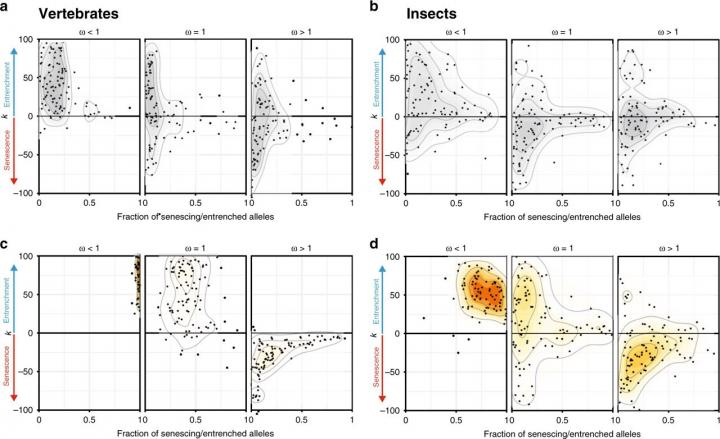
Credit: A. V. Stolyarova, et al/ Nature Communications

A group of scientists from Russia studied the trends in the evolution of amino acid sequences of proteins in vertebrates and insects and traced the factors influencing the process of evolution. The research results are published in the Nature Communications.

Proteins provide for the majority of the most crucial functions of the body. Hence, changes in the amino acid sequences of proteins are a real mirror of evolution, in which scientists can track evolutionary changes and their implications for the body.

The evolution of protein sequences can occur under the influence of two factors. The first one is external (for example, changes in the environment or the impact of pathogens), and it is the classic engine of evolution. The second factor is related to the changes within the genome, usually in this case, they mean epistasis, the interaction between different genes.

A group of scientists from Skoltech, the Institute for Information Transmission Problems of the Russian Academy of Sciences, Moscow State University, and the Institute of Epidemiology under the leadership of Georgii Bazykin, Professor of the Skoltech Life Sciences Center, showed that these two forces lead to opposite patterns of sequence evolution. Thus, looking at these patterns, it is possible to estimate the contribution of the external environment and epistasis to the evolution of proteins.

“Patterns are such that due to external changes, the variant of the gene currently entrenched in the course of evolution will become less profitable over time. On the contrary, under the influence of epistasis, coevolution occurs, the interacting regions of the genome “adjust” to each other. As a result, their successful combination becomes more and more evolutionarily advantageous,” says the first author of the study, Skoltech graduate student Anastasia Stolyarova.

Using bioinformatics analysis of protein sequences from the genomes of vertebrates and insects, scientists were able to describe new universal evolutionary patterns. External factors can be considered as a reason for positive selection affecting certain genomic positions and serve as an essential aspect for the rapid evolution of these positions. But the effect of epistasis is manifested in positions under negative selection, as a result of which substitutions from one option to another occur less often in them – they evolve more slowly.

###

Media Contact
Ilyana Zolotareva
[email protected]

Original Source

https://www.skoltech.ru/en/2020/09/evolutionary-paths-scientists-have-found-new-patterns-in-protein-evolution/

Related Journal Article

http://dx.doi.org/10.1038/s41467-020-18366-z

Tags: BiodiversityBioinformaticsBiologyBiotechnologyEvolutionGeneticsResearch/Development
Share12Tweet8Share2ShareShareShare2

Related Posts

Decoding Prostate Cancer Origins via snFLARE-seq, mxFRIZNGRND

February 7, 2026

Digital Health Perspectives from Baltic Sea Experts

February 7, 2026

Florida Cane Toad: Complex Spread and Selective Evolution

February 7, 2026

Exploring Decision-Making in Dementia Caregivers’ Mobility

February 7, 2026
Please login to join discussion

POPULAR NEWS

  • Robotic Ureteral Reconstruction: A Novel Approach

    Robotic Ureteral Reconstruction: A Novel Approach

    82 shares
    Share 33 Tweet 21
  • Digital Privacy: Health Data Control in Incarceration

    63 shares
    Share 25 Tweet 16
  • Study Reveals Lipid Accumulation in ME/CFS Cells

    57 shares
    Share 23 Tweet 14
  • Breakthrough in RNA Research Accelerates Medical Innovations Timeline

    53 shares
    Share 21 Tweet 13

About

We bring you the latest biotechnology news from best research centers and universities around the world. Check our website.

Follow us

Recent News

Decoding Prostate Cancer Origins via snFLARE-seq, mxFRIZNGRND

Digital Health Perspectives from Baltic Sea Experts

Florida Cane Toad: Complex Spread and Selective Evolution

Subscribe to Blog via Email

Enter your email address to subscribe to this blog and receive notifications of new posts by email.

Join 73 other subscribers
  • Contact Us

Bioengineer.org © Copyright 2023 All Rights Reserved.

Welcome Back!

Login to your account below

Forgotten Password?

Retrieve your password

Please enter your username or email address to reset your password.

Log In
No Result
View All Result
  • Homepages
    • Home Page 1
    • Home Page 2
  • News
  • National
  • Business
  • Health
  • Lifestyle
  • Science

Bioengineer.org © Copyright 2023 All Rights Reserved.