• HOME
  • NEWS
  • EXPLORE
    • CAREER
      • Companies
      • Jobs
    • EVENTS
    • iGEM
      • News
      • Team
    • PHOTOS
    • VIDEO
    • WIKI
  • BLOG
  • COMMUNITY
    • FACEBOOK
    • INSTAGRAM
    • TWITTER
Monday, October 5, 2026
BIOENGINEER.ORG
No Result
View All Result
  • Login
  • HOME
  • NEWS
  • EXPLORE
    • CAREER
      • Companies
      • Jobs
        • Lecturer
        • PhD Studentship
        • Postdoc
        • Research Assistant
    • EVENTS
    • iGEM
      • News
      • Team
    • PHOTOS
    • VIDEO
    • WIKI
  • BLOG
  • COMMUNITY
    • FACEBOOK
    • INSTAGRAM
    • TWITTER
  • HOME
  • NEWS
  • EXPLORE
    • CAREER
      • Companies
      • Jobs
        • Lecturer
        • PhD Studentship
        • Postdoc
        • Research Assistant
    • EVENTS
    • iGEM
      • News
      • Team
    • PHOTOS
    • VIDEO
    • WIKI
  • BLOG
  • COMMUNITY
    • FACEBOOK
    • INSTAGRAM
    • TWITTER
No Result
View All Result
Bioengineer.org
No Result
View All Result
Home NEWS Science News Health

Evolutionary coupling analysis identifies the impact of disease-associated variants

Bioengineer by Bioengineer
July 8, 2019
in Health
Reading Time: 2 mins read
0
IMAGE
Share on FacebookShare on TwitterShare on LinkedinShare on RedditShare on Telegram

IMAGE

Credit: POSTECH

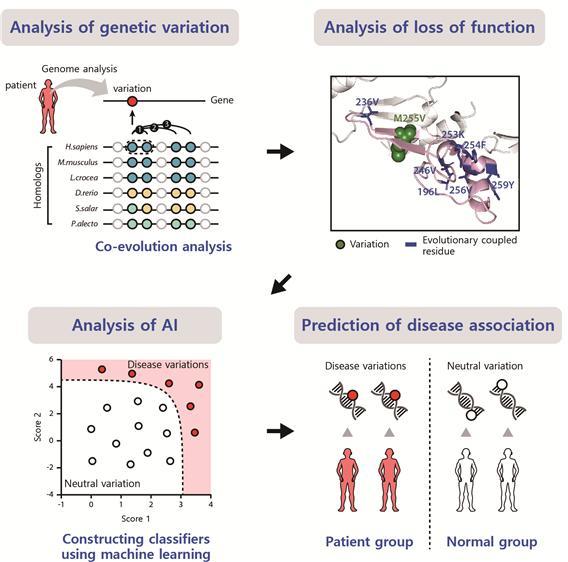
Predicting the impact of DNA sequence variants is important for sorting disease-associated variants (DVs) from neutral variants. Korean researchers at Pohang University of science and technology (POSTECH) report the development of a method to predict the impact of DVs. The study appears in the journal Nucleic Acids Research in June.

Current methods to predict the mutational impacts depend on evolutionary conservation at the mutation site, which is determined using homologous sequences and based on the assumption that variants at well-conserved sites have high impacts. However, many DVs at less-conserved but functionally important sites cannot be predicted by the current methods.

The researchers present a method to find DVs at less-conserved sites by predicting the mutational impacts using evolutionary coupling analysis. Functionally important and evolutionarily coupled sites often have compensatory variants on cooperative sites to avoid loss of function. They identified DVs at less-conserved sites that were not identified using current conservation-based methods.

Prof. Kim said that “This study can be applied to a variety of precision medicine approaches such as prognosis of patient’s diseases and finding personalized medicine.” “Based on a large scale sequence analysis, the developed method is useful to find more disease associated variants which help to find biomarkers and therapeutic targets of various human diseases.”

###

Media Contact
Hyeyong Choi
[email protected]

Original Source

http://www.postech.ac.kr/eng/evolutionary-coupling-analysis-identifies-the-impact-of-disease-associated-variants-at-less-conserved-sites/#post-19740

Related Journal Article

http://dx.doi.org/10.1093/nar/gkz536

Tags: BiologyDiagnosticsGenesGenetics
Share12Tweet8Share2ShareShareShare2

Related Posts

Mealtime Battles, Stigma and Job Loss Drive Parenting Stress in Chinese Autism Caregivers

Mealtime Battles, Stigma and Job Loss Drive Parenting Stress in Chinese Autism Caregivers

October 5, 2026
Night Owls at Greater Risk: Veteran Sleep Clock Tied to Depression and PTSD Symptoms

Night Owls at Greater Risk: Veteran Sleep Clock Tied to Depression and PTSD Symptoms

October 5, 2026

Poor Sleep May Signal Faster Decline in ALS, Large Chinese Cohort Study Finds

October 5, 2026

Normal Labs Last Week, Purulent Bile Today: How Severity Rules Decide Cholangitis Care

October 5, 2026
Please login to join discussion

POPULAR NEWS

  • Alloys That Shrink Their Own Grains: New PIX Mechanism Refines Metals With Heat Alone

    Alloys That Shrink Their Own Grains: New PIX Mechanism Refines Metals With Heat Alone

    29 shares
    Share 12 Tweet 7
  • Endurance Exercise Reshapes the Liver in Males and Females Through Distinct Molecular Routes

    29 shares
    Share 12 Tweet 7
  • Single Transcription Factor PU.1 Rapidly Converts Fibroblasts into Macrophage-Lineage Cells

    29 shares
    Share 12 Tweet 7
  • New Scale Measures How Ready Nurse Educators Really Are for the AI Era

    29 shares
    Share 12 Tweet 7

About

We bring you the latest biotechnology news from best research centers and universities around the world. Check our website.

Follow us

Recent News

Alloys That Shrink Their Own Grains: New PIX Mechanism Refines Metals With Heat Alone

Endurance Exercise Reshapes the Liver in Males and Females Through Distinct Molecular Routes

Single Transcription Factor PU.1 Rapidly Converts Fibroblasts into Macrophage-Lineage Cells

Subscribe to Blog via Email

Success! An email was just sent to confirm your subscription. Please find the email now and click 'Confirm' to start subscribing.

Join 85 other subscribers
  • Contact Us

Bioengineer.org © Copyright 2023 All Rights Reserved.

Welcome Back!

Login to your account below

Forgotten Password?

Retrieve your password

Please enter your username or email address to reset your password.

Log In
No Result
View All Result
  • Homepages
    • Home Page 1
    • Home Page 2
  • News
  • National
  • Business
  • Health
  • Lifestyle
  • Science

Bioengineer.org © Copyright 2023 All Rights Reserved.